Herod, Bar Kochba, Trump and Huckabee: A Battle for Eternity

Last week, on a beautiful June night, I found myself in the eastern Judean desert, not far from Bethlehem, at the foot of ancient Herodium, a lavish palace built by King Herod between 23 and 15 BCE. Herod was a widely despised, Roman-appointed client king of Israel, Jewish in name only, who displaced the Hasmonean dynasty. The Hasmoneans, descendants of the Maccabees, had won Jewish self-rule a century earlier, a victory still celebrated each year at Chanukah. Herod’s tyrannical, paranoid reign ended in the murder of his own wives and children. He was also an ambitious builder, and many of his grand projects still punctuate the landscape of modern Israel: Masada, the Tomb of the Patriarchs in Hebron, and most prominently his expanded Temple Mount, including the Western Wall.
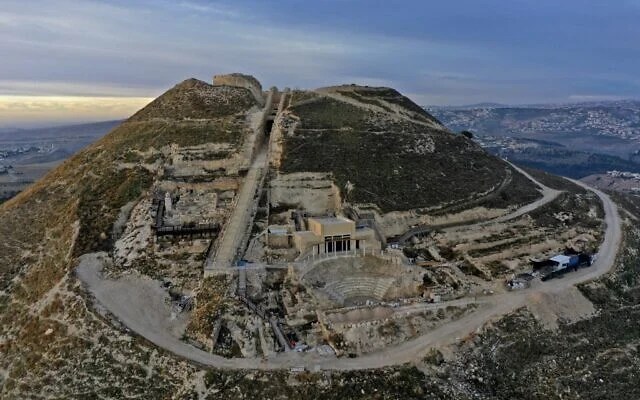
Aerial View of Herodium Fortress (Source: Menahem Kahana/ AFP )

The fortress looms above the surrounding desert for miles. It was my first time visiting, and while the winding, unfamiliar drive there was a bit stress-inducing, the moment I first glimpsed the site from afar, it took my breath away. Herod demanded a fortress so grand it could be seen from Jerusalem, and the terraformed desert mountain remains a masterful feat of engineering. Efforts are now underway to make the site, located in a politically sensitive area, accessible to the broader public. The evening was the kickoff to an academic conference on Israeli heritage in Judea and Samaria. Present were archaeologists, political figures, and US Ambassador to Israel Mike Huckabee, who was presented with a special award by the Ministry of Heritage. At the entrance, we were greeted by a recreated period marketplace, complete with actors dressed as Roman legionnaires scuffling with Israelite locals, a role which I suppose included the rest of us too. An illuminated theater had been erected inside the massive ancient pool Herod once, inexplicably, managed to fill with water in the middle of the desert. As the stars came out, we sat for an original production titled “Herod vs. Bar Kochba: The Battle for Eternity.”

A sense of the scene (note the looming mound of Herodium on the right)

Bar Kochba was a Jewish guerilla leader who led a three-year revolt against Roman occupation in Judea, seventy years after Rome destroyed the renovated Second Temple, another Herodian project and the catastrophe still mourned each year on the fast of Tisha B’Av. The play follows a young Jewish rebel, his wife, and son, camped out at a Herodium that has by then fallen into disrepair. Recent excavations at the site have in fact uncovered a trove of Bar Kochba-era coins; I was handed a replica of one at the event. As the rebels onstage dig tunnels, ration water, and prepare for battle, they are visited by the ghost of Herod, who still haunts his beloved palace. He mocks their devotion to Jewish sovereignty, a doomed cause, he insists, even a century after his own death, given the strength of Rome. Herod argues for compromise and accommodation – you are all headed towards death (forgive my paraphrase, I didn’t think to record at the time). Herod tells them: “Choose life, choose prosperity.” All that is needed, he suggests, is to submit to Roman rule, pay their taxes, and allow a few of their gods and statues into the Jewish holy places. The rebels are unconvinced. They are willing to die at Roman hands not because they love death, but because they are playing a longer game. “Perhaps it will be a few years, perhaps a thousand,” the mother tells her son, “but one day we will march back into Jerusalem and worship our God.”
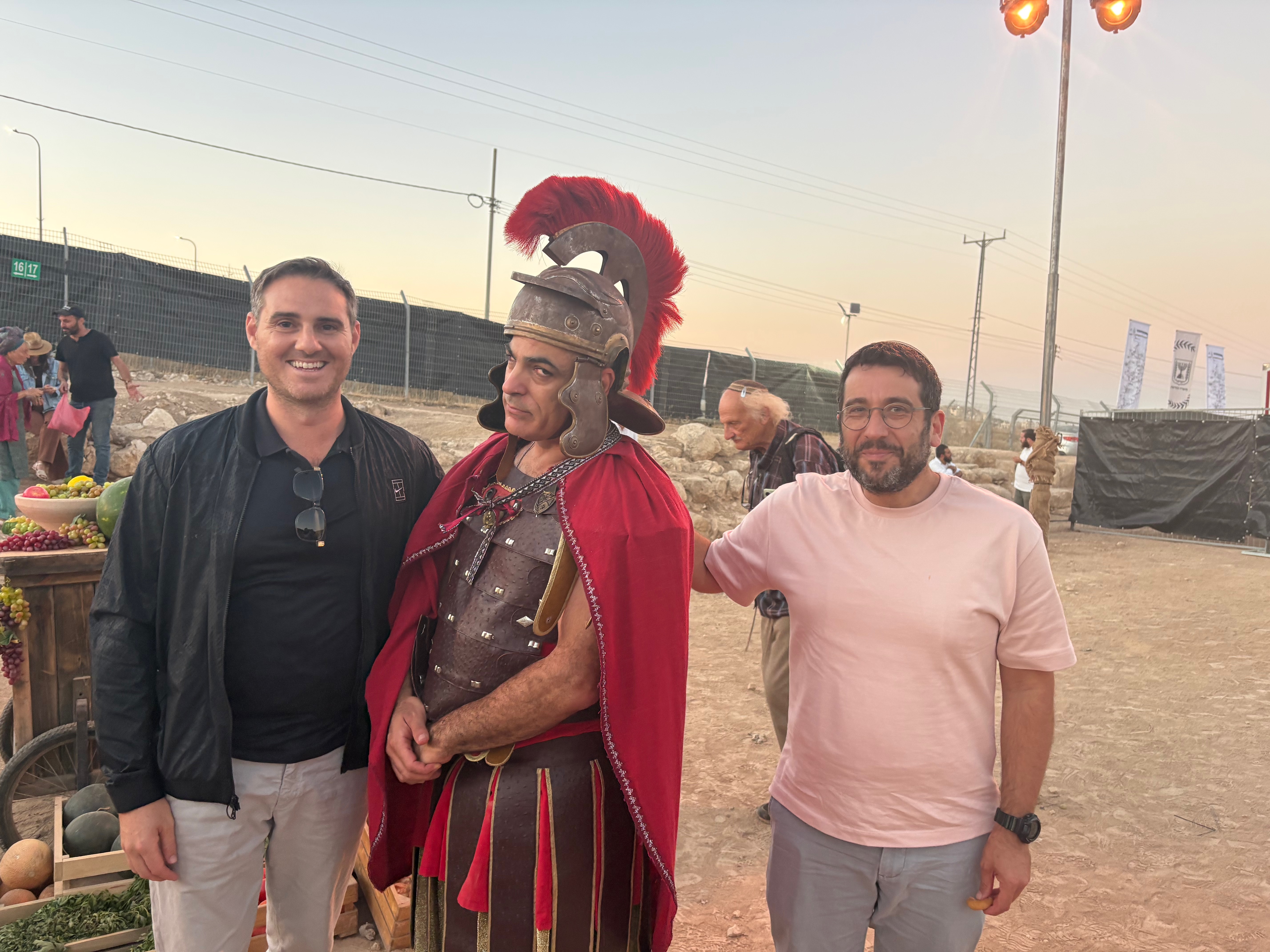
Roman Legionary Deigns to Take a Photo With the Israelite Riff-Raff

The play then shifts into an ahistorical debate between Herod and Bar Kochba themselves. Herod, played to perfection by the legendary Israeli actor Shuli Rand, makes the (correct) case that modern Israel is no direct heir to Bar Kochba’s fanatical legacy. “Look around you,” he says. “You’re sitting in a theater. Who brought theater to ancient Israel? Do you love culture? Wine? Good food?” These are not the tastes of single-minded desert warriors. Bar Kochba counters that modern Israelis may indeed enjoy a comfortable life, but when crisis strikes, as it did on October 7th, they will fight to their last breath for their people and their land. Bar Kochba himself left little behind. No children, no followers, nothing approaching the scale of what Herod built. His revolt’s brutal defeat left hundreds of thousands of Jewish civilians dead or enslaved. Rome expelled the Jews from Jerusalem, renamed the city Aelia Capitolina, and rebranded the province itself Syria Palaestina, scrubbing Judaea from the map entirely. But the play’s argument is that the fighting spirit that Bar Kochba drew on persists in the modern state regardless, a key part of its ethos from its founding to today.

Each member of the large audience was given a copy, in Hebrew translation, of Barry Strauss’s excellent new book, Jews vs. Rome. The book supplies more nuance than any play could, making a convincing case that the two-hundred-year Jewish struggle against Rome, a struggle with an outsized influence on both Rabbinic and Christian tradition, cannot be separated from the larger contest between empires playing out at the same time, namely between Rome and Parthia, heir to the Persian empire. No small nation in the Mediterranean basin could survive in that era without aligning with one power or the other, and the Jews knew this as well as anyone. Strauss argues that the revolt against Rome was also a desperate, ultimately futile bid to draw Parthian intervention to the Jewish cause.

The timing felt almost too fitting. That same morning, at the G7 summit in France, Trump had defended a newly signed Memorandum of Understanding with Iran, located more or less where Parthia once stood. The MOU calls for a sixty-day ceasefire, during which the US would release significant funds to Tehran, and involves the Iranians trying to bolt-on an Israeli ceasefire in its war against Hezbollah in Lebanon. The MOU was met with disappointment, to put it mildly, by many Israelis who had hoped for a more decisive outcome, not to mention concern that it will limit Israel’s existential struggle against Iran’s proxies. President Trump, in an attempt to push the MOU forward, voiced some criticism of recent Israeli military action in Lebanon, adding: “Without the United States there would be no Israel, without me there would be no Israel.” Trump’s claim here is characteristically over-the-top. Yet some 1,900 years after Judea’s doomed insurgencies against Rome, we are reminded once again of the painful necessity, for a small nation, of relying on a great power ally.

However, the United States is no Roman Empire, and as the evening at Herodium testified, Jewish life is flourishing across the Land of Israel and increasingly taking on a confident, nationalistic character. Three years into a war launched by the October 7th massacre, our strategic position is far stronger, our enemies considerably weakened, and the shekel is soaring (much to the frustration of American expats still earning in dollars). Modern Israeli culture has reclaimed figures like Bar Kochba and Shimon Bar Giora, who led the Zealots in the earlier Great Revolt, despite their crushing defeats at Roman hands. They represent a spirit of Jewish agency and independence that still underlies many of Israel’s great military and cultural achievements. Strauss, in his book, quotes Churchill’s line after a 1940 war cabinet meeting: “Nations that go down fighting rise again, but those who surrender tamely are finished.”

It was against this backdrop, both contemporary and ancient, that I especially appreciated Ambassador Huckabee’s remarks when he accepted his award. He spoke twice that night, once in a smaller, filmed setting that has since been clipped and mocked by Tucker Carlson and others with little sense of the context in which it was deliveed. But in his similar, full remarks before an audience of more than a thousand, Huckabee noted that the United States is approaching the 250th anniversary of its independence this July 4th, a milestone that might seem almost laughable set against 3,800 years of Jewish history in this land. “To you, we’re mere children,” he said. “You’ve been around a lot longer, and your history is not only your history, but I want to say this, and I hope you understand, your history is also our history.” He went on: “Without you and your history, and your preserving God’s purpose and God’s law, there would never be Western civilization. There would never be an America, because America was founded on the principles that were established right here in this land all those many thousands of years ago.” Many read Huckabee’s words as a direct answer to Trump’s comments earlier that day. His message was that Israel owes real gratitude to its current great power patron, the United States. But the United States, rooted as it is in biblical values, is itself a kind of outgrowth of the Jewish struggle against Rome that played out nineteen centuries ago. That struggle was the crucible from which both Rabbinic Judaism and Christianity were born.

In making this case, Huckabee charts a third way, distinct from the two offered onstage that night. It is not Herod’s path, accommodation purchased through submission and the gradual erosion of what makes a people distinct. Nor is it pure Bar Kochba – righteous rebellion that goes down fighting, in flames. Huckabee’s third way is partnership felt as kinship, a great power and a small nation bound not merely by shared interest but by shared inheritance. America’s strength flows from values Israel gave the world long before America existed to receive them. It is a relationship that asks Israel to feel gratitude without shame, and asks America to remember that the debt runs both ways. Driving home that night, I watched Herodium recede in the rearview mirror, its massive dome holding the dark a little longer than everything around it before finally sinking under the horizon. Herod built it to be seen from Jerusalem. Two thousand years later, it is still a fixed point in an old argument about what is needed for a nation, and the set of ideas it embodies, to fulfill its destiny.

Also published on Substack, if you’re new to my work please considering subscribing!

Three Ways in Which Operation Rising Lion is a Lot Like Narnia

Note: I recently started a Substack so this post appears both there and here on WordPress. I’m going to try to keep both platforms updated so please feel free to choose the one which you prefer and unsubscribe or turn off notifications from the second so you don’t see my updates twice.

From the deluge of fascinating news from Israel’s remarkably successful “Rising Lion” operation against the Iranian regime, one interesting tidbit relates to children’s literature, of all things. According to the Israeli newspaper Yediot Ahronot, IDF intelligence began to assemble a list of the leading scientists driving the Iranian nuclear weapon program in 2022, and their research efforts were given the secret code name “Narnia.” At 3:00 am on June 13, when the Israeli Air Force swiftly eliminated 10 of these scientists, along with striking the Natanz nuclear plant and other military targets, the operation was officially dubbed “Operation Narnia.”

a blue book with a picture of a man walking through the woods
Photo by Tim Alex on Unsplash

In describing the operation, the Jerusalem Post writes that name “reflects the operation’s improbable nature, like something out of a fantasy tale rather than a real-world event.” Indeed, it was hard to believe that the same country that suffered such devastating losses on October 7 due to intelligence failures could execute such a meticulously planned and perfectly executed military offensive. Yet there are many fantasy tales, and the name Narnia is much more than a metonym for all that is improbable or unlikely to occur. Could it be that somewhere in Israeli intelligence circles there is a fantasy geek who specifically chose this code name to evoke a specific connection with the literary world of Narnia? Perhaps. In the meantime, Israeli schools and all other activities are cancelled and we are stuck at home. So I find myself reading Narnia with some of my kids, perhaps for the third time. In our bleary-eyed and underslept state thanks to 2:00 am trips to the safe room, these are the connections that seem to emerge:

1- Narnia is Israel and Calormen is Iran

man sitting beside river painting
Photo by British Library on Unsplash

While some readers of Narnia stop at the famous first book, The Lion the Witch and the Wardrobe, the later books in Lewis’ series introduce us to other lands and cultures which surround Narnia and in doing so offer pointed parallels to the geopolitics of Lewis’ own time. One of these countries is a Middle-Eastern type of desert nation called Calormen, characterized by a hodgepodge of Persian and Arabian motifs: “The Calormenes have dark faces and long beards. They wear flowing robes and orange-coloured turbans, and they are a wise, wealthy, courteous, cruel and ancient people”. Calormenes have many admirable qualities, like a rich culture of storytelling to which Lewis’ narrator is obviously sympathetic, and splendid landscaping and food. Yet while it may outshine Narnia on the material front, it lacks basic freedoms which prevents the full flourishing of its people. Everyone in the society understands their place in a rigid hierarchical structure, and all are required to slavishly try to curry favor with their vainglorious leader the Tisroc. In the capital city Tashbaan, “there is only one traffic regulation, which is that everyone who is less important has to get out of the way for everyone who is more important; unless you want a cut from a whip or punch from the butt end of a spear.” When a poor boy raised in Calormen is mistakenly identified by the Narnians as a member of their party he is smitten with these joyful, bright-eyed people who seem to live without paranoia and insecurity. Yet he can’t help but lie about his identity, as the narrator explains: “he had, you see, no idea of how noble and free-born people behave.”

The individuals we meet in Calormen aren’t all that bad, but centuries reared in a culture where deception and obsequiousness, rather than hard work and talent, are needed to get ahead certainly takes its toll on the moral character of the society. Lewis contrasts this with Narnia, where freedom is cherished, and consequently people develop virtues like courage, honesty and kindness.

Now Narnia may be intended as a stand-in for Lewis’s own England, but in the spirit of William Blake’s “Till we have built Jerusalem / In England’s green & pleasant Land,” I believe there are some parallels with Israel too. While Israel is certainly influenced by its Middle-Eastern surroundings, it is an informal culture where people by and large have the freedom to speak their mind and determine their own destinies. Unlike nearly every other great military power in history, it never set its sight on building empire and controlling other nations. Like Narnia, it is content with merely perpetuating its own way of life within its own borders. Thus it remains a mystery why countries like Iran seek its destruction so vehemently and for so long. If it remains baffling to us, King Edmund of Narnia does offer a kind of answer. In trying to make sense of the curious urge in Calormen to wage war on Narnia, Edmund observes: “We are a little land. And little lands on the borders of a great empire were always hateful to the lords of the great empire. He longs to blot them out, gobble them up” (A Horse and His Boy, p. 68).

Israel right now is doing a lot to make Iran angry, but this anger predates airstrikes in Tehran by decades, and is rooted in the same lust for empire that C.S. Lewis observed during his own dark times. Our response must be the same as it is in the world of Narnia, to push back against Islamic expansionism through military defense, and also to cherish all of the qualities that make our culture unique and worth preserving.

2- Rising Lion

brown lion
Photo by Mika Brandt on Unsplash

When Narnians go into battle, the symbol that is displayed on their flags and shields is a lion. The lion of course is a reference to Aslan, the spiritual icon of Narnia and a Christological metaphor. The reason Jesus is associated with a lion is rooted in the Bible of course, “the lion of Judah,” and in Judaism lions are associated with kingship and sovereignty. Thus it’s also not surprising that “rising lion” is the name and symbol of the current Israeli campaign. The name “Rising Lion,” which is a translation of “Am KiLavi Yakum,” derives from the Prophet Balaam’s blessings of the People of Israel in the book of Numbers: “Behold, a people that rises like a lioness and raises itself like a lion. It does not lie down until it eats its prey and drinks the blood of the slain.” (Num. 23:24) Some unhinged Israel haters have pointed to this verse as proof of Israeli thirst for atrocities. The verse is obviously meant to be symbolic, but the truth is, lions are fearsome creatures who devour their prey. And we have learned over the past twenty months that, in order to defeat evil and restore peace and order to the world, we must be stronger and fiercer than our enemies. This does not always look nice. But that does not mean that it is not a moral posture. Here too, the Narnian parallel can be illuminating. When Susan first learns about the great lion of Narnia she is understandably scared: “Is he—quite safe?” I shall feel rather nervous about meeting a lion.” Mr. Beaver responds: “Safe? . . . Who said anything about safe? Course he isn’t safe. But he’s good. He’s the King I tell you” (The Lion, the Witch and the Wardrobe, p. 80.)

The current IDF campaign in Iran, and even more so, the extended war against Hamas in Gaza, contains visuals that are terrible and painful to behold. But as Lewis’s narrator reminds us, “People who have not been in Narnia sometimes think that a thing cannot be good and terrible at the same time.” What lions symbolize, in the Bible, in the world of fantasy and right now, is the way in which ferocity and justice must, in certain circumstances, work hand in hand. Critics of Israel’s campaign who are supposedly driven by religious pacifism may also take note another verse in Balaam’s litany of blessings directed at the Jewish people: He crouches and lies like a lion and like a lioness; who will dare rouse him? Those who bless you shall be blessed, and those who curse you shall be cursed” (Num, 24:9)

3-Pacifism is Not a Virtue

This brings me to a final point about some of the well-meaning critics, many of them Christian, of Israel’s courageous campaign against evil and America’s supporting role in that effort. While many fairy tales end with a vague “happily ever after,” Lewis takes care to remind us at the end of the Lion, the King and the Wardrobe how the four Pevensie children, now turned kings and queens, spend their days making good laws, keeping the peace, and waging honorable battles in defense of their beloved Narnia. The first progressive in the series is their annoying cousin Eustace Clarence Scrubb, who surfaces in the Voyage of the Dawn Treader when he accidentally gets sucked into a grand voyage with Edmund and Lucy through a painting. Eustace is just awful, a bully and a stick-in-the-mud who has no use for the grand adventures of the sort for which the Pevensie children live. Eustace’s coddled upbringing has given him few opportunities to appreciate the real dangers that exist in the world, although this thankfully changes when he is turned into a dragon. The privilege of distance from danger allows him the freedom to antagonize everyone around him and avoid retribution by declaring “I’m a pacifist. I don’t believe in fighting.”

Lewis was, indeed, critical of those who could never distinguish between a just war and pointless bloodbath. He viewed this problem as similar to an inability to distinguish good from evil. As early as 1940, Lewis delivered a lecture to the pacifist society at Oxford University entitled “Why I am Not a Pacifist,” in which he articulates, from various angles, a justification for wars that need to be fought in order to protect higher values. This does not make the realities of war any less terrible. Yet only by recognizing human necessity can one begin to improve things.

Lewis says:

To avert or postpone one particular war by wise policy, or to render one particular campaign shorter by strength and skill or less terrible by mercy to the conquered and the civilians is more useful than all the proposals for universal peace that have ever been made; just as the dentist who can stop one toothache has deserved better of humanity than all the men who think they have some scheme for producing a perfectly healthy race.

To try to fight a better war, or a shorter or more precise war in which less civilians are killed, is a noble virtue. To avoid war altogether, in all circumstances, is simply a pipe dream that, as Lewis says in the same lecture, will result in “[handing] over the state which does tolerate Pacifists to its totalitarian neighbour who does not.”

Lewis’ analysis applies perfectly to Israel’s situation in its seven front war from Gaza to Iran. The war we fight now is intended to prevent future wars, to invite peace and prosperity to this beleaguered region as well as to other parts of the world. We are not waiting for a lion to save us from “beyond the sea.” We are an “am shel ariyot,” a nation of lions, fighting our hardest on behalf of our highest values. May the current conflict and this larger war come to a speedy, victorious and decisive conclusion.