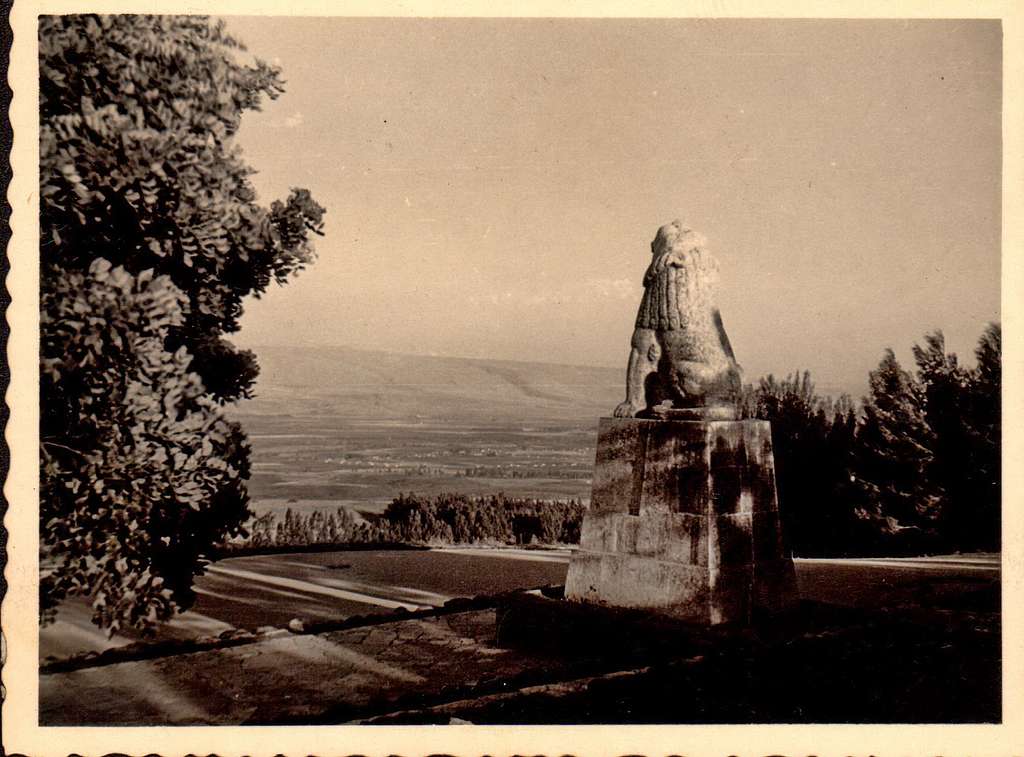
One of our family’s favorite songs to play in the car here in Israel is a feel-good anthem called “Al Tira Yisrael,” (“Have No Fear, Israel”). The version we listen to, by Israeli singer Itay Levi, is meant to inspire confidence during the difficult period following October 7. Its refrain includes a quote from the Biblical Book of Amos: “Do not fear Israel, do not be afraid, / For are you not a young lion?/ And if a lion roars—who won’t be afraid?/ Who won’t be afraid?”
The sentiment of Israel roaring like a lion reached its pinnacle during the “Sha’agat HaAri” (“Lion’s Roar”) joint US–Israeli campaign against Iran, which took place between Purim and Pesach this year. This, too, draws on Amos and suggests continuity with the “Rising Lion” campaign that took place against Iran one year ago in June. Yet a closer reading of Amos reveals a more complex context for the line, “If a lion roars, who will not be afraid?” One might even ask whether its fear is meant for our enemies or for our own society.
Amos was a Judean shepherd and farmer living in the eighth century bce in a place called Tekoa, located on the edge of the desert southeast of Jerusalem. Despite living in a time of relative tranquility, he is called upon by G-d to warn the inhabitants of the Northern Kingdom of Israel, largely residing in Samaria, to stop their corrupt behavior or face destruction. Amos prophesies using rich and vivid literary language. The lion is one recurring motif among many that the prophet employs to stunning and devastating effect.
Rabbi Yitzchak Etshalom, a well-known Tanach teacher based in Los Angeles, authored a wonderful volume entitled Amos: The Genius of Prophetic Rhetoric published by Maggid Books, an imprint of Koren Publishers in Jerusalem. The book is part of a series of scholarly volumes that address specific Biblical books. Each book is designed to be read on its own but also serves as a learning supplement. It offers deep, line-by-line analysis of a book’s language that is sensitive to the history of traditional interpretation, as well as to its historical and archaeological context, and to a peshat-based “close reading” of the text itself. In this spirit, Rabbi Etshalom’s Amos marries rabbinic interpretation with scholarly analysis, while demonstrating an unyielding dedication to making sense of Amos’s brilliant but dense and sometimes elusive prophetic rhetoric.
“To be a Zionist in 1944, or indeed at any point before the state of Israel is created, requires tremendous imagination, which is why the movement draws mainly the literary and the desperate.”
Hannah Senesh occupies a unique place in Israeli history and memory. Only 19 years old on the eve of World War II, she left her hometown of Budapest to build the land of Israel with her young Zionist peers. At 23, she made the inconceivable choice to parachute back into Nazi-occupied Europe. The mission ultimately failed in its stated purpose and resulted in Senesh’s execution. But it left the fledgling Jewish State with a national hero, whose poetry and diary entries still reverberate today. Senesh wasn’t alone, she was one among a small group of Jewish members of the yishuv who donned British army uniforms in an implausible bid to try to save Jewish lives from the German killing machine, often their own families included. A few of these figures, such as Enzo Sereni and Haviva Reik, also entered the national consciousness, with streets and settlements named in their honor. Others are less well-known. For a story that is this iconic, one would imagine that its details would be more or less widely understood. Yet as Matti Friedman demonstrates in his riveting new book “Out of the Sky,” one of Israel’s greatest legends is also riddled with mysteries and open questions.
The heroic operation was the result of a collaboration between the fledgling Jewish army, the Haganah and British intelligence. The idea, at least as the British understood it, was for a group of Jewish men and women, almost all of them recent refugees from Europe, to join the British army and leverage their skill in their native languages in order to assist British POWs and local resistance fighters behind enemy lines. On the Jewish end, motivations were more multifaceted. The Jewish conscripts sought British military training, which would help them when the time came for their own inevitable war of independence. Even more so, they desperately wanted to try to help the Jewish communities of Europe in some way. A total of 250 men and women were recruited to take part in this unusual mission, but only 37 of them completed the training. Of this number, 12 were captured and seven did not make it home.
Friedman lays out the extent to which this improbable mission, rooted in the loftiest ideals, never really had a chance of succeeding. Firstly, by the time it took place in 1944, most Jews in Europe had already been murdered. No allied powers, including the British commanders overseeing this secret mission, seemed to prioritize saving their lives. Even the safety of the Jewish volunteers was not viewed as urgent. Enzo Sereni, the brilliant Italian Labor Zionist and polymath, who Ben-Gurion tried to prevent from jumping because “there wasn’t another man like him,” was carelessly dropped atop a German army installation in Northern Italy. As Friedman notes in an interesting aside, the Mossad unit operating out of Istanbul at the time had been infiltrated by German double agents, who likely knew about the parachutists’ missions before they even landed.
A visitor could walk through the entire Hannah Senesh House in Sdot Yam — a beautifully renovated museum in the kibbutz where she lived for two years before setting out on her perilous mission — without seeing any mention of a seemingly important fact: that her mission was doomed from the start. Yet Friedman’s aim is not to diminish Senesh’s extraordinary bravery, or that of her fellow operatives. Rather, he seeks to understand their courage in a new light.
In recent years, Friedman has become one of the most compelling English-language chroniclers of Israeli history and society. What distinguishes his work — whether he is examining the brilliant letters of a young Israeli soldier on a Lebanese outpost or recounting Leonard Cohen’s sojourn in Israel after the Yom Kippur War — is his tendency to frame Israel’s turbulent history through a literary lens. While the canon of modern Hebrew wartime literature remains relatively sparse — perhaps because most writers keep their distance from the battlefield — Israel has never lacked for fighters with poetic souls in the state’s early years or today.
Throughout the book, Friedman explores the intellectual worlds of his unusually thoughtful protagonists, suggesting that “if they showed up at a military recruiting office now, they’d probably be turned away.” Senesh, the daughter of a well-known Hungarian-Jewish playwright, dreamed of following in her father’s footsteps and wrote poems of startling quality as early as age 15. Sereni held a Ph.D. in philosophy from the University of Rome. Friedman recounts how, in addition to having already written a novel and novella, he dreamed of writing a great Italian novel which would depict the conflicts and controversies of his time through the lens of his own Jewish family.
In this sense both Senesh and Sereni follow in the path of other great Zionist leaders, like Herzl and Jabotinsky, who began their careers as journalists and writers of fiction, eventually putting aside their universalistic literary ambitions for the more particularistic cause of Jewish sovereignty. Friedman makes the terrific observation that this is no coincidence: “To be a Zionist in 1944, or indeed at any point before the state of Israel is created, requires tremendous imagination, which is why the movement draws mainly the literary and the desperate.”
Part of the book’s premise is that the exquisite literary sensibilities of these proto-Israeli heroes helps explain why they made the jump. Friedman writes: “The parachutists aren’t commandos. They’re storytellers. They’ve been sent to write, with their lives, a Zionist story about the war – a story that will lead others not to despair but to action.” Senesh’s military achievements may have been miniscule – hardly any time passed from the beginning of her mission until her execution in a Hungarian prison, only three months before liberation.
Yet we remember Senesh because of her literary achievements: among them the diary she wrote vividly portraying her transition from a precocious, assimilated 13-year-old girl into a fervent Zionist activist. At every major juncture in her short life Senesh seemed to find the time to quickly craft a phenomenal poem. She handed her fellow fighter “blessed is the match consumed in kindling flame” right before entering occupied Hungary. Shortly before her execution she managed to pen a short lyric poem: “I gambled on what mattered most/The dice were cast. I lost.” While Senesh failed in saving other Jews, and even herself, she succeeded in her larger objective. As Friedman summarizes it: “The mission isn’t military, it’s literary, and she’s the best writer.”
In writing “Out of the Sky” — a book equally about a remarkable episode in history as it is the act of crafting and telling stories — Friedman certainly crafts his own. While many fascinating and heretofore little-known stories about Senesh and her fellow parachuters make it into the book, others do not. Friedman leans toward a portrait of Senesh as a clever, cosmopolitan European. He reminds us of her youth and her theatrical family. In her precocious diary entries, Zionism feels like a role she has chosen to play. He clearly admires her heroism but does not exaggerate it. Yet alternative accounts remain.
In his introduction to the first edition of Senesh’s collected writings, Abba Eban wrote, “all the definitions of giant courage come together in Senesh’s life.” Joel Palgi, another parachutist who followed a similar path to Senesh but inexplicably managed to survive, wrote about her in his memoirs as a force of nature, the undisputed leader of their group, fiercely admired by fellow resistance comrades as she transformed from a poet into a fighter. Even the Gestapo, in Palgi’s telling, were in awe of Senesh. He describes the sadistic prison warden who used to visit Senesh’s cell every day to argue about politics. Senesh’s mother Katherine, in her own memoir, describes the mesmerizing power Senesh held over guards and fellow prisoners alike. Children gravitated toward her, fellow prisoners drew strength from Senesh’s whispered encouragement, her Zionist education campaign, and her ingenious secret broadcasts from the window of her cell. One SS guard told Senesh, “I’ve never known a woman as brave as you.”
“Out of the Sky” does not contradict these remarkable testimonies, which contain a whiff of hagiography, though surely have some grounding in truth. It’s not really a book about superheroes, unusual people with uniquely phenomenal qualities who changed the course of history. Rather, it’s a book about regular people, highly intelligent and talented to be sure, who met the challenges of their age with bravery and foresight. What distinguished them as heroes was that they understood, both in their lives and their deaths, they could contribute to the writing of a story much larger than themselves.
In Chaim Potok’s classic novel My Name Is Asher Lev, a young Chasidic boy tries to integrate his religious faith with his prodigious artistic talent. In school he scribbles on the margins of his sacred books. On weekends he takes clandestine trips to view Renaissance art at the Brooklyn Museum. Throughout the novel he grapples with the question: Is art something that brings us closer to G-d and to the Jewish people, or does it operate on another plane entirely?
Asher Lev is a member of the Ladover sect, a thinly disguised stand-in for Chabad-Lubavitch, and the beloved Ladover Rebbe gently explains that it makes no difference whether a man is a shoemaker or a lawyer or a painter; rather, “a life is measured by how it is lived for the sake of Heaven.” Yet, despite the Rebbe’s encouragement, ultimately Potok’s book insists that the chasm between the life of a Chasid and that of an artist is impossible to fully bridge.
The role of visual art in the religious Jewish worldview has always been somewhat tenuous. This may be rooted in the Torah itself: the second of the Ten Commandments prohibits the creation of graven images and the “likeness of any thing that is in the heavens above, that is in the earth beneath, or that is in the water under the earth.” But it may also be an accidental byproduct of history: the destruction of the Holy Temple in Jerusalem in all its aesthetic glory, the exclusion of Jews from artistic guilds, and the overwhelming dominance of Christian iconography in the history of Western art. While Jewish decorative arts abound—micrography, illuminated manuscripts, silver Judaica items—Jewish representation in the fine arts, at least prior to the modern era, is decidedly less pronounced. And while Jewish individuals have achieved prominence as modern artists, they tend toward secularism and individualism in both worldview and artistic language. We have yet to see a uniquely Jewish artistic idiom arise—that is, a path forward for an artist who wishes to tie him- or herself to a Jewish tradition in visual art.
It was an honor to review Koren Press’s outstanding new book One Day in October for the Jerusalem Post Magazine this past week. While the book is not necessarily “literary” in nature, it is brilliantly written and edited, and moved me in a way that few books have. This piece is actually an abbreviated version of a longer review essay that will hopefully appear in the Jerusalem Report in the coming weeks. Grateful to be part of this “עם של אריות,” “nation of lions,” whose incredible bravery continues to exhibit itself each and every day.
Walk the streets of Israel post-October 7 and one experiences a country transformed. This transformation manifests in many aspects of our lives: our political allegiances, our sense of certainty and security, and our attitudes toward one another. But our streets have also literally, physically, been transformed. Cars are bedecked in Israeli flags and bumper stickers that commemorate fallen loved ones and friends. The now iconic red-and-black hostage posters line storefronts and traffic poles (in Israel they don’t get ripped down). Army green is everywhere—at times every fifth person walking down the street seems to be in uniform and carrying a large weapon. And street art and graffiti that focuses on the hostages or the ongoing military campaign is ubiquitous. Grassroots memorials take various forms—from yizkor candles to red poppies (the classic symbol of military loss is also a common wildflower in the south of Israel) to countless other manifestations. This spontaneous public art is intense and concentrated in certain places, such as Hostage Square in Tel Aviv and the Nova massacre memorial in Re’im. But it also can be found on random street corners and benches, in malls or in doctor’s offices. Art is everywhere, a direct outcome of a nation that is actively grieving horrific events and continuing crises.
Ziva Jelin, Panorama: Pavement and Mud, 2018, acrylic and tar on canvas. Photo credit: Ron Plitnitzki.
A new exhibit, recently opened at the ANU Museum of the Jewish People in Tel Aviv, seeks to explore this creative phenomenon in real time. The exhibit is simply titled “October 7.” It begins by considering the notion that art is irrelevant at the height of wartime, as expressed by the proverb “When the cannons are heard, the muses are silent.” Orit Shaham Gover, the chief curator of ANU, proposes this alternative: “As the cannons are heard, the voices of the muses are emerging all the more clearly from deep down in the throat.”
“On a bright spring day in a swanky Tel Aviv neighborhood, a handsome man sporting a trim beard and a perfectly perched black yarmulke alights from an expensive SUV. He kisses his beautiful and modestly clad wife, as three smartly dressed yeshiva boys across the street watch, swoon, and dream of similar lives for themselves. “A yeshiva boy who married well?” one suggests. “No, no—he earned it for himself!” his friend explains: After being expelled from a prestigious yeshiva for owning a smartphone, he flew to Rome, camped out for a week on the doorstep of Borsalino headquarters, and earned the right to open the first official Israeli chain of stores for the high-end Italian hatmaker. Although he is too busy earning money to study in yeshiva full time, he still dedicates time every day to study Talmud. “The modern haredi,” the boys say, sighing. “He enjoys both worlds. He has this and yet he also has that!” As they wave to him crossing the street, a large truck comes out of nowhere and plows into him. And so the show’s question remains: Is it really possible to have both this and that?”
Please check out the absolutely wonderful latest issue of Jewish Review of Books for a review of the second season of Shababnikim, a fabulous Israel television series with much more depth than initially meets the eye.
In March, the Tel Aviv Jewish museum formerly known as the Nahum Goldmann Museum of the Jewish Diaspora(or Beit Hatfutsot) reopened after a ten-year, $100 million renovation. Now called ANU—Museum of the Jewish People, it offers a cheery, inclusive vision of Jewish peoplehood.
Several years ago, a blog called Judaism Without Apologies began to circulate on social media. The blog began by juxtaposing two Jewish characters’ lives and ideals: Shimen, a Gerer Hasid of sorts and Holocaust survivor living on the Upper West Side of Manhattan, and Heidi, a cosmopolitan Princeton graduate who thinks of herself as a citizen of the world.
A photograph by George Kalinsky of my own Polish Holocaust survivor grandfather at the Siyum HaShas in 1990. I imagine Shimen having a similar intense, independent-minded look.
The series was narrated by the American Israeli computer scientist Moshe Koppel, who had attended Shimen’s Gerer shtiebel in his youth. After obtaining a PhD in mathematics, Koppel spent a year at Prince- ton’s Institute for Advanced Study, where he met the original Heidi, the first of many he would encounter in the years to come. Koppel’s blog may have been rooted in comic sociology, but it quickly morphed into a serious discussion of moral philosophy, game theory, cultural anthropology, the nature of language, and ultimately an argument about the future of Judaism itself. Despite its rather niche appeal, the blog’s unique fusion of a no-holds-barred attitude with serious erudition attracted some diehard fans. Koppel has just published an expanded book-length version, which presents a cleaned-up and even more compelling defense of the old-fashioned Judaism Koppel imbibed in the shtiebel.
Shimen, a real-life acquaintance of Koppel (Heidi is a composite), is at the heart of the book. He survived the Lodz Ghetto and Auschwitz, but his wife and two precious children did not. After the war, Shimen picked up a handgun and collected Jewish children who had been hidden by Polish families and returned them to their communities. Elie Wiesel, who prayed in Shimen’s Gerer shtiebel from time to time, once told a story about celebrating Rosh Hashanah in Auschwitz without wine. An inmate announced, “we’ll take out tin cups and fill them with tears. And that is how we’ll make our kiddush . . . heard before God.” That, apparently, was Shimen. Koppel writes of Polish Hasidic Holocaust survivors like him:
[They] were intense, they were angry, they could be funny in a biting sort of way. . . . But one thing they had no patience for was high-minded pieties. They despised pomposity and self-righteousness. Their devotion to Yiddishkeit, old-fashioned Judaism, as a way of life, and to the Jews as a people, were as natural and instinctive as drawing breath.
“Shortly before the 1991 Gulf War, Rabbi Yaakov Smith, a father of six and an emissary of the Chabad Hasidic movement in the Old City of Jerusalem, hosted a Shabbat dinner. As the guests were leaving, one took Smith aside and said something that would reverberate with his host: “That was an amazing act you performed. Whatever is wrong, take care of yourself.” Fast forward thirty years and Yaakov has become Yiscah Smith, a transgender person who still lives and teaches in Jerusalem. Smith’s transformation is the subject of the documentary I Was Not Born a Mistake, created by the Israeli filmmakers Rachel Rusinek and Eyal Ben-Moshe. The film premiered at the Jerusalem Film Festival this past Hanukkah and made its U.S. debut in January.:
In 2016, a hefty new Artscroll biography was published whose cover stands out in the sefarim store among images of bearded rabbis. Emunah with Love and Chicken Soup is the story of the late Rebbetzin Henny Machlis, whose Jerusalem home was legendary for welcoming hundreds of guests each Shabbos, providing them with home-cooked meals as well as a deeper nourishment they may not have known they needed. The book is written by Sara Yoheved Rigler, author of Holy Woman and a frequent contributor to Aish.com. Rigler writes with a unique appreciation for holy Jewish women. While her books would probably not pass the academic smell test, she is able to convey the passion and fire of a great individual in her writing in a way that tends to escape her more polished peers. Henny Machlis as well as her husband Rabbi Mordechai Machlis were truly great individuals who stretched themselves beyond their individual egos to leave a remarkable legacy. Rigler writes in the book that when Henny was younger she used to say that she wanted to have 20 children and introduce Judaism to the entire world. She ended up having 14 children (with nine c-sections!) and inspired tens of thousands of Jews and non-Jews alike. She was, as the book jacket describes, “a virtuoso in chesed,” someone for whom the normal boundaries separating oneself from others is effaced.
For the full review, in the Jewish Link of NJ’s Literary Link, click here.