
Moving from the United States to Israel will inevitably impact your identity in profound ways. You may even find yourself assuming strange roles, like de facto aliyah ambassador or pseudo real estate agent, advising friends and family back in the US who are contemplating their own potential moves in the future. Honestly, it’s all good, I think every place in Israel offers something distinct and wonderful. Sometimes I even wonder what I, a religious mother of 7, who likes to read and talk about ideas, is doing in the overpriced lifestyle mecca of Ra’anana, the “pearl” of the Sharon, Israel’s version of Silicon Valley. But I adore it here, what can I say, and was glad to make my case in the Jewish Link’s recent Israel Real Estate supplement. Posting the full text here as well as a link to the original article (which may or may not also include a picture of Netanya).
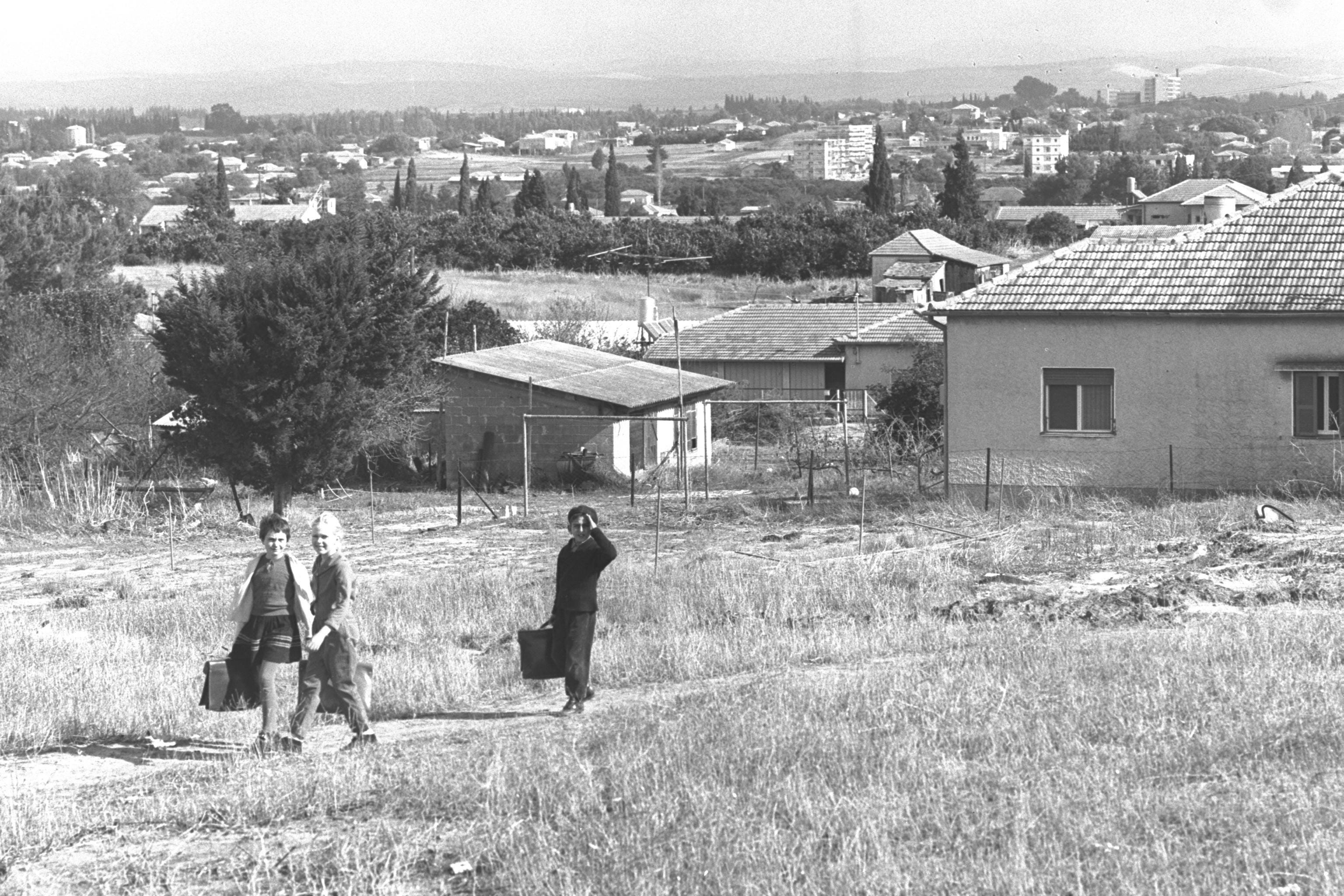
General View of Ra’anana (1964)
When we announced that we were making aliyah to Ra’anana with our family seven years ago from Teaneck, we fielded the full gamut of comments and stereotypes. Some people called Ra’anana the “6th Town” (a reference to the Five Towns). Others joked, “it’s a wonderful place, only 5 minutes from Israel.” One acquaintance mused, rather memorably, “It’s just like Tenafly, without all the Israelis.” Upon arrival we were not too surprised to learn that the hype was rather off — we were very much in Israel, with all of the challenges and opportunities this entails.
Ra’anana is a small, diverse city of about 85,000 located in the Sharon region of Israel. It features crisp refreshing winters that never get too cold, when citrus fruits ripen all over the city, and a warm radiant spring season. Summers are hot. It’s about 25 minutes north of Tel Aviv, and a short 15-20 minute drive to the beach in Herziliya. Founded in 1924 by members of the Ahuza A–New York Society, many of them Polish Jews living in New York, it has always had a bit of an international flavor. The original residents were mostly of European origin, soon joined by an influx of Yemenite residents, then later waves from England, France and South Africa, and more recently Brazil and Latin America.
The majority of residents are still native Israelis, including many young families who work in hi-tech. Since olim in Ra’anana come from all over the world and not just English-speaking countries, the lingua franca in school and on the playground is Hebrew. Schools are largely experienced in dealing with the challenges of absorbing new immigrants. The rich variety of food and shopping reflects the diversity of the population. When Shabbat nears, my children ask for special treats like South African biltong, French pastries and Yemenite lachuch bread (with hilbe, a kind of addictive frothy fenugreek dip) in anticipation.
Ra’anana has a wide range of housing options, from large free-standing homes to compact starter apartments, and each year more attractive apartment buildings are built. The strong and ever-growing demand for housing in Ra’anana, both from native Israelis and olim, makes housing notoriously expensive: a 3- or 4-bedroom apartment averages ₪2–4 million (roughly $650,000–$1,300,000), and private homes can range from $2 million toward $4 million or more on the most sought-after streets.
Our home in Israel costs a lot more than our home in Teaneck did (though carrying costs, like property taxes and maintenance, are lower). But we feel we receive many benefits in return, not just from the home itself but from the community and environment. We live in a dynamic, walkable city, with beautiful parks, enriching after-school activities for our kids and stimulating cultural events for our whole family. We have access to an exceptionally well-stocked English language library, world-class tennis, baseball and squash facilities, a superb skate park and “Ninja” style obstacle course, and Israel’s largest municipal music conservatory — all in a small, accessible city, so nothing is ever too packed and attendance always means seeing familiar, friendly faces.
Ra’anana is known as one of the more religiously strong cities in the Sharon area, though the religious population hovers around 30-40% and is not a majority like in cities such as Beit Shemesh or Efrat. Nevertheless, it often feels like one can’t walk half a block without seeing another synagogue. Within two blocks of my house are two Yemenite synagogues, a Moroccan shul, a Chabad shul for the French community, a Hareidi yeshiva hosting the “Leibadik” minyan, a raucous Carlebach shul founded by Australian immigrants, and a joint Sephardi-Ashkenazi “unity” minyan. This is just a random sampling within a five minute walk of my house.
There are several large shuls catering directly to English-speaking olim which include programming for youth and teens. There are vibrant batei midrash, including a community Kollel offering daytime Talmud Torah classes in English, and Matan HaSharon, a wonderful institution for high-level women’s learning. While living in Ra’anana has met our needs as a young, growing family, it’s nice to live in a city that also has extensive opportunities for residents of every age level, especially retirees. A friend in his forties recently built a house in Ra’anana with old age in mind, as he said, “I never plan to move again.” I wish him good health and a long life- a blessing that is sensibly grounded, as many studies cite Ra’anana residents as enjoying the longest average life expectancy in Israel or even the Middle East.
As for education, in addition to secular and pluralistic schools, Ra’anana offers a range of religious options: three “Mamad” style state religious public schools, a “Torani” religious public school called Noam with separation between boys and girls, several Haredi schools, and a new Chabad elementary school popular among olim. There are two religious boys’ high schools, including the massive AMIT boys’ school in its new campus, and a Bnei Akiva yeshiva high school with a rich history; one large dati-leumi girls’ high school, also under AMIT; and a Haredi girls’ high school called Horev. Students seeking more options, especially for girls’ high schools, sometimes travel to neighboring Kfar Saba and Herziliya and even as far as Petach Tikvah and Bnei Brak.
Ra’anana has a reputation as a safe city; crime rates and break-ins are quite low, and, like many places in Israel, it’s not uncommon to see an eight-year-old walking himself home from school or stopping into the makolet on his own for an ice-pop. Terrorism incidents have been few and far-between (with one tragic exception two years ago). The municipal security system is highly responsive and will come almost comically quickly in response to any sort of minor concern or complaint.
Yet, Ra’anana has not been immune to the larger challenges Israeli society has faced since October 7. As would be expected in a community filled with committed Zionists and general high-achievers, many heroic soldiers from Ra’anana have fallen in Israel’s wars. One famous son is Roi Klein HY”D, a talented religious IDF officer who grew up in Ra’anana and was killed during the Second Lebanon War when he famously jumped on a grenade to save his fellow soldiers, the words Shema Yisrael on his lips. Ra’anana suffered its share of losses on October 7th, including Aryeh Ziering HY”D, the son of American olim and an officer in the IDF’s canine unit “Oketz,” who was with his family in Ra’anana for Simchat Torah when he was called up with his unit to the south. The ensuing war brought more tragic news, but also a sense of awe and pride. Shauli Greenglick HY”D, a talented singer who had advanced to the final rounds of Israel’s version of “The Voice,” withdrew from the competition to rejoin his battalion fighting in northern Gaza, and was killed only a few weeks after his audition. Over these past few difficult years, the names of Ra’anana’s fallen heroes — Yaron Chitiz HY”D, Yisrael Natan Rosenfeld HY”D, and others — have become household names. Come Sukkot, sukkot citywide bear posters with their pictures; a charming new neighborhood coffee cart was dedicated in their memory.
In 2024, the newspaper Makor Rishon ran a remarkable piece about eight young fallen soldiers and their families, among them Greenglick, our daughter’s good friend’s brother Dan Wajdenbaum HY”D, and another friend’s brother Daniel Ben Harosh HY”D — all of whom grew up on, or adjacent to, one street (Ravutsky) in the Northeast section of Ra’anana. The boys had crossed into each other’s yards and played ball together, had gone to school together, and their parents were friends and acquaintances — native Israelis and olim alike, stretching from all quarters of the world. The thesis of the article, beyond paying tribute to these young men and their families, was that this one small street in Ra’anana — which has endured so much pain but also exhibited incredible bravery and resilience — is a microcosm of Israel as a whole.
The decision to move to Israel, especially in this current climate, is an admirable one. The choice of community is filled with complicating factors: career opportunities, the type of community one envisions, budget, and more. Some are moved by the sweeping views and sense of pioneerism in a small yishuv in the North or the Shomron; others by a bustling city and its opportunities. Sometimes when I visit Jerusalem I feel a bit of a tug — to live in a place with so much spiritual power, so much intellectual and artistic vitality, has a special appeal to me. Yet in moving our family across the world, from American suburbia, grandparents and cousins, to a great unknown, the strong communities, wide avenues and well-manicured parks of Ra’anana made for an easy and pleasant adjustment. Ra’anana is a great choice for a life that combines cosmopolitanism and community, exposure to different Jewish cultures, and the comfort of being among others who made the same choice you did. As for those people who teased us by saying “Ra’anana is only 5 minutes from Israel” — they are still in New Jersey. We find ourselves in a warm community and growing city, enjoying the benefits of each, at the heart of Israeli life.

