Out of the Sky

“To be a Zionist in 1944, or indeed at any point before the state of Israel is created, requires tremendous imagination, which is why the movement draws mainly the literary and the desperate.”

This review was published in this week’s Jewish Journal

Hannah Senesh occupies a unique place in Israeli history and memory. Only 19 years old on the eve of World War II, she left her hometown of Budapest to build the land of Israel with her young Zionist peers. At 23, she made the inconceivable choice to parachute back into Nazi-occupied Europe. The mission ultimately failed in its stated purpose and resulted in Senesh’s execution. But it left the fledgling Jewish State with a national hero, whose poetry and diary entries still reverberate today. Senesh wasn’t alone, she was one among a small group of Jewish members of the yishuv who donned British army uniforms in an implausible bid to try to save Jewish lives from the German killing machine, often their own families included. A few of these figures, such as Enzo Sereni and Haviva Reik, also entered the national consciousness, with streets and settlements named in their honor. Others are less well-known. For a story that is this iconic, one would imagine that its details would be more or less widely understood. Yet as Matti Friedman demonstrates in his riveting new book “Out of the Sky,” one of Israel’s greatest legends is also riddled with mysteries and open questions.

The heroic operation was the result of a collaboration between the fledgling Jewish army, the Haganah and British intelligence. The idea, at least as the British understood it, was for a group of Jewish men and women, almost all of them recent refugees from Europe, to join the British army and leverage their skill in their native languages in order to assist British POWs and local resistance fighters behind enemy lines. On the Jewish end, motivations were more multifaceted. The Jewish conscripts sought British military training, which would help them when the time came for their own inevitable war of independence. Even more so, they desperately wanted to try to help the Jewish communities of Europe in some way. A total of 250 men and women were recruited to take part in this unusual mission, but only 37 of them completed the training. Of this number, 12 were captured and seven did not make it home.

Friedman lays out the extent to which this improbable mission, rooted in the loftiest ideals, never really had a chance of succeeding. Firstly, by the time it took place in 1944, most Jews in Europe had already been murdered. No allied powers, including the British commanders overseeing this secret mission, seemed to prioritize saving their lives. Even the safety of the Jewish volunteers was not viewed as urgent. Enzo Sereni, the brilliant Italian Labor Zionist and polymath, who Ben-Gurion tried to prevent from jumping because “there wasn’t another man like him,” was carelessly dropped atop a German army installation in Northern Italy.  As Friedman notes in an interesting aside, the Mossad unit operating out of Istanbul at the time had been infiltrated by German double agents, who likely knew about the parachutists’ missions before they even landed.

A visitor could walk through the entire Hannah Senesh House in Sdot Yam — a beautifully renovated museum in the kibbutz where she lived for two years before setting out on her perilous mission — without seeing any mention of a seemingly important fact: that her mission was doomed from the start. Yet Friedman’s aim is not to diminish Senesh’s extraordinary bravery, or that of her fellow operatives. Rather, he seeks to understand their courage in a new light.

In recent years, Friedman has become one of the most compelling English-language chroniclers of Israeli history and society. What distinguishes his work — whether he is examining the brilliant letters of a young Israeli soldier on a Lebanese outpost or recounting Leonard Cohen’s sojourn in Israel after the Yom Kippur War — is his tendency to frame Israel’s turbulent history through a literary lens. While the canon of modern Hebrew wartime literature remains relatively sparse — perhaps because most writers keep their distance from the battlefield — Israel has never lacked for fighters with poetic souls in the state’s early years or today.

Throughout the book, Friedman explores the intellectual worlds of his unusually thoughtful protagonists, suggesting that “if they showed up at a military recruiting office now, they’d probably be turned away.” Senesh, the daughter of a well-known Hungarian-Jewish playwright, dreamed of following in her father’s footsteps and wrote poems of startling quality as early as age 15. Sereni held a Ph.D. in philosophy from the University of Rome. Friedman recounts how, in addition to having already written a novel and novella, he dreamed of writing a great Italian novel which would depict the conflicts and controversies of his time through the lens of his own Jewish family.

In this sense both Senesh and Sereni follow in the path of other great Zionist leaders, like Herzl and Jabotinsky, who began their careers as journalists and writers of fiction, eventually putting aside their universalistic literary ambitions for the more particularistic cause of Jewish sovereignty. Friedman makes the terrific observation that this is no coincidence: “To be a Zionist in 1944, or indeed at any point before the state of Israel is created, requires tremendous imagination, which is why the movement draws mainly the literary and the desperate.”

Part of the book’s premise is that the exquisite literary sensibilities of these proto-Israeli heroes helps explain why they made the jump. Friedman writes: “The parachutists aren’t commandos. They’re storytellers. They’ve been sent to write, with their lives, a Zionist story about the war – a story that will lead others not to despair but to action.” Senesh’s military achievements may have been miniscule – hardly any time passed from the beginning of her mission until her execution in a Hungarian prison, only three months before liberation.

Yet we remember Senesh because of her literary achievements: among them the diary she wrote vividly portraying her transition from a precocious, assimilated 13-year-old girl into a fervent Zionist activist. At every major juncture in her short life Senesh seemed to find the time to quickly craft a phenomenal poem. She handed her fellow fighter “blessed is the match consumed in kindling flame” right before entering occupied Hungary. Shortly before her execution she managed to pen a short lyric poem: “I gambled on what mattered most/The dice were cast. I lost.” While Senesh failed in saving other Jews, and even herself, she succeeded in her larger objective. As Friedman summarizes it: “The mission isn’t military, it’s literary, and she’s the best writer.”

In writing “Out of the Sky” — a book equally about a remarkable episode in history as it is the act of crafting and telling stories — Friedman certainly crafts his own. While many fascinating and heretofore little-known stories about Senesh and her fellow parachuters make it into the book, others do not. Friedman leans toward a portrait of Senesh as a clever, cosmopolitan European. He reminds us of her youth and her theatrical family. In her precocious diary entries, Zionism feels like a role she has chosen to play. He clearly admires her heroism but does not exaggerate it. Yet alternative accounts remain.

In his introduction to the first edition of Senesh’s collected writings, Abba Eban wrote, “all the definitions of giant courage come together in Senesh’s life.” Joel Palgi, another parachutist who followed a similar path to Senesh but inexplicably managed to survive, wrote about her in his memoirs as a force of nature, the undisputed leader of their group, fiercely admired by fellow resistance comrades as she transformed from a poet into a fighter. Even the Gestapo, in Palgi’s telling, were in awe of Senesh. He describes the sadistic prison warden who used to visit Senesh’s cell every day to argue about politics. Senesh’s mother Katherine, in her own memoir, describes the mesmerizing power Senesh held over guards and fellow prisoners alike. Children gravitated toward her, fellow prisoners drew strength from Senesh’s whispered encouragement, her Zionist education campaign, and her ingenious secret broadcasts from the window of her cell. One SS guard told Senesh, “I’ve never known a woman as brave as you.”

“Out of the Sky” does not contradict these remarkable testimonies, which contain a whiff of hagiography, though surely have some grounding in truth. It’s not really a book about superheroes, unusual people with uniquely phenomenal qualities who changed the course of history. Rather, it’s a book about regular people, highly intelligent and talented to be sure, who met the challenges of their age with bravery and foresight.  What distinguished them as heroes was that they understood, both in their lives and their deaths, they could contribute to the writing of a story much larger than themselves.

For the original article see this week’s Jewish Journal
The Riddler

“My teacher used to say that we must learn to stay with a difficult question for forty years. Not to let up, and not to despair. Then there is a chance that we will reach the truth.”

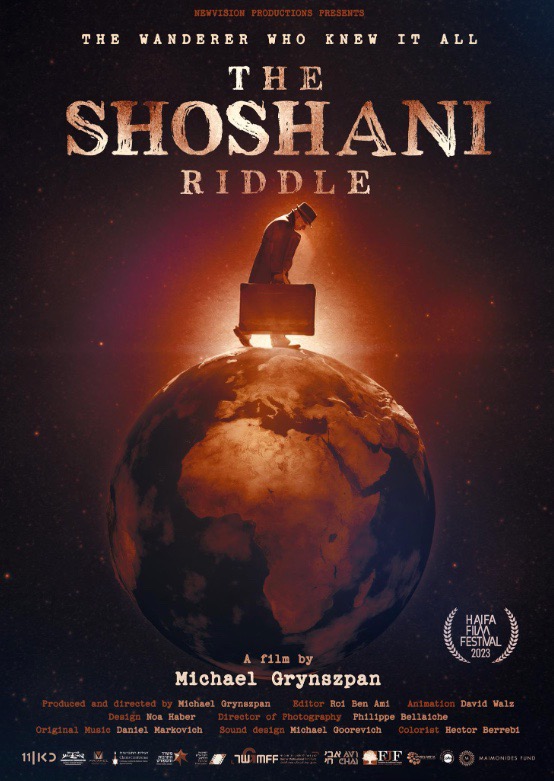
Amid the chaos and trauma of October 7, 2023, one of the innumerable cultural events deferred was the release of a unique documentary about the elusive Monsieur Shoshani. Shoshani’s mysterious persona, brilliance, and iconoclastic disposition have been the stuff of legend since he emerged from Europe after the Holocaust (he is depicted on the movie poster as a hunched-over figure carrying a suitcase). Shoshani was purportedly a master of Jewish tradition, Western philosophy, mathematics, science, and as many as thirty languages. He taught Torah everywhere he went—France, Morocco, Israel, and Uruguay—though what, exactly, he taught and where he came from remain a mystery. His students ranged from scholars and physicists to farmers and Holocaust orphans.

After he met Shoshani, the great French Jewish philosopher Emmanuel Levinas famously said, “I cannot tell what he knows; all I can say is that all that I know, he knows.” His gravestone in Montevideo, Uruguay, reportedly paid for by Elie Wiesel, reads, “His birth and life were sealed in a riddle.”

Although Shoshani’s life remains shrouded in mystery, the curtain seems to be drawing back, at least a bit.In 2021, the National Library of Israel announced Shoshani, whom Levinas once called “the Oral Torah in his entirety,” had left dozens of notebooks behind. Some of these cryptic notes…had been preserved in a secretive trust by four of his students since 1969. Another trove was donated to the National Library by Professor Shalom Rosenberg, an Argentinian-born scholar of Jewish thought at Hebrew University who became close with Shoshani toward the end of his life. For the last fifteen years, French Israeli director Michael Grynszpan has toiled and puzzled over the notebooks and the life of their author. His result is The Shoshani Riddle, which chronicles Grynszpan’s hunt for Shoshani and his attempts to piece together the master’s life story.

For the full review of this wonderful film, please the new Winter issue of Jewish Review of Books.

Kuma: The Story of the Jewish People

The Bible Lands Museum in Jerusalem is known for its collection of Near Eastern antiquities from the Biblical period. Yet amidst its galleries stands a startling cultural artifact of far more recent origin.

Kuma—meaning “Rise”—is a nearly ten-foot-long scroll depicting a dense, vivid, intellectually rich, and aesthetically stunning account of Jewish history. Its full title, Kuma, Mei Afatzim ve-Kankantum,” refers to the materials used to prepare ink for Torah scrolls and other sacred texts. Evoking an unfurled Torah scroll, Kuma is the high-school senior project of a brilliant young yeshiva student, artist and poet named Eitan Rosenzweig הי”ד. Staff Sgt. Rosenzweig, an Alon Shvut native and student in the Yerucham Yeshivat Hesder, served in the Givati brigade and was killed in Gaza in November 2023, at the age of 21.

Kuma weaves together Jungian theories of the unconscious, the mythologist Joseph Campbell’s concept of the heroic journey, and imagery drawn from Western art and Jewish history—some of which appear elsewhere in the Bible Lands Museum. Kuma also incorporates literary allusions to the Bible, Talmud, modern Hebrew literature, Eastern and Western general philosophy, and more. It is a work of art that one must study rather than merely observe.

The full essay can be read at Tradition Online.

Review: My Quarrel With Hersh Rasseyner by Chaim Grade

Translated by Ruth Wisse

Published by The Tikvah Fund and Toby Press

The year is 1948. Two Holocaust survivors run into each other on a Paris subway. Though each had assumed the other was killed in the Holocaust, they waste little time exchanging questions about wartime experiences or polite inquiries about the well-being of family and friends. Instead, the two fall back into an argument they had begun many years before, in the period preceding World War II. Both are graduates of the Novardok yeshiva in Lithuania, and their argument is intellectual, philosophical, and also deeply personal. They debate the question of how a Jew should relate to the world around them. One believes the world outside of Judaism is rich with insight and enlightenment. The other maintains that the Torah is the only source of meaning in this life, and all other endeavors amount to nothing but vanity and self-destruction. 

For the full review of this wonderful new translation of a classic Yiddish story see the excellent new issue of Lubavitch International Magazine.

When Heidi Met Shimen, or, Why Real Religion Endures

A review of Judaism Straight up by Moshe Koppel

Several years ago, a blog called Judaism Without Apologies began to circulate on social media. The blog began by juxtaposing two Jewish characters’ lives and ideals: Shimen, a Gerer Hasid of sorts and Holocaust survivor living on the Upper West Side of Manhattan, and Heidi, a cosmopolitan Princeton graduate who thinks of herself as a citizen of the world.

A photograph by George Kalinsky of my own Polish Holocaust survivor grandfather at the Siyum HaShas in 1990. I imagine Shimen having a similar intense, independent-minded look.


The series was narrated by the American Israeli computer scientist Moshe Koppel, who had attended Shimen’s Gerer shtiebel in his youth. After obtaining a PhD in mathematics, Koppel spent a year at Prince- ton’s Institute for Advanced Study, where he met the original Heidi, the first of many he would encounter in the years to come. Koppel’s blog may have been rooted in comic sociology, but it quickly morphed into a serious discussion of moral philosophy, game theory, cultural anthropology, the nature of language, and ultimately an argument about the future of Judaism itself. Despite its rather niche appeal, the blog’s unique fusion of a no-holds-barred attitude with serious erudition attracted some diehard fans. Koppel has just published an expanded book-length version, which presents a cleaned-up and even more compelling defense of the old-fashioned Judaism Koppel imbibed in the shtiebel.

Shimen, a real-life acquaintance of Koppel (Heidi is a composite), is at the heart of the book. He survived the Lodz Ghetto and Auschwitz, but his wife and two precious children did not. After the war, Shimen picked up a handgun and collected Jewish children who had been hidden by Polish families and returned them to their communities. Elie Wiesel, who prayed in Shimen’s Gerer shtiebel from time to time, once told a story about celebrating Rosh Hashanah in Auschwitz without wine. An inmate announced, “we’ll take out tin cups and fill them with tears. And that is how we’ll make our kiddush . . . heard before God.” That, apparently, was Shimen. Koppel writes of Polish Hasidic Holocaust survivors like him: 

[They] were intense, they were angry, they could be funny in a biting sort of way. . . . But one thing they had no patience for was high-minded pieties. They despised pomposity and self-righteousness. Their devotion to Yiddishkeit, old-fashioned Judaism, as a way of life, and to the Jews as a people, were as natural and instinctive as drawing breath.

To read the full review see the wonderful new issue of Jewish Review of Books.

A Family Treasure: The Siddur That Survived Auschwitz

lasting-impressions-rindner-siddur-holocaust-auschwitz

My young daughter was playing in my mother’s living room and approached me holding a battered prayer book she found on the shelf. When I realized what it was, I gasped. I hadn’t thought of it in years, but the siddur is a family treasure. My grandmother, Raizel Berger, a native of the Maramures region of Romania, was sent to Auschwitz along with her family in 1944. She managed to smuggle a small siddur into the camp by hiding it in her stocking garter. The young women in her bunker, mostly Chasidic Jews from Romania and Hungary, took turns praying from it each night. One of the girls worked in the kitchen and snuck out a potato sack to use as a cover for the siddur, onto which she used a rough yarn to beautifully embroider a Star of David in the center. The pages of the siddur are delicate with age, but the section of Tehillim (Psalms) is particularly worn from repeated use.

After the war, my grandmother married my grandfather, a Holocaust survivor from Poland. They moved to the United States and had four daughters in quick succession. The siddur continued to be used on a daily basis in their brownstone home in Brooklyn. Each holiday, my grandparents lit dozens of Yizkor candles for their many murdered family members. But their resilience to transition into loving parents and industrious new immigrants almost immediately after surviving such horrors still baffles the mind. So too the siddur, once hidden in the bowels of a dark dungeon and used by inmates of the most horrific and debased place on earth, transitioned to use for mundane, though still holy, daily prayers. In unsentimental fashion typical of Jews of my grandparents’ type, the siddur was not treated as a talisman. At some point, someone even scrawled a phone number on the inside cover…

For the full essay please see the Winter 2019/2020 edition of Jewish Action Magazine.

S.Y. Agnon and the Orthodox Reader

This review appeared in the Fall issue of Jewish Action Magazine

agnon_smiles

 The Israeli writer Shmuel Yosef Agnon, winner of the Nobel Prize for Literature in 1966, authored works of modern Hebrew literature that are steeped in the language of the Torah and hundreds of years of Eastern European Jewish history and tradition. His stories, set in his Galician hometown of Buczacz, transport the reader into the vibrant world of Polish Jewry before World War II. There are probably few readers outside of the Orthodox Jewish community who have the cultural literacy necessary to recognize many of the Jewish allusions in Agnon’s stories. Yet Agnon’s works have not made the deep inroads into the Orthodox world that one might imagine they would.

Click here for the full article