From Meitzarim to the Strait of Hormuz: Living the Bible in Real Time

On the seventh morning of this past holiday of Passover in Israel I walked gingerly to synagogue, still groggy from a 3:00 am siren, wondering what had come of President Trump’s ultimatum to Iran issued before I turned off my phone for the final day of the holiday. When I arrived, I saw a friend sitting outside with a weary look – common among parents of five young kids who have been jumping off the walls for nearly six weeks at home during a war. Her youngest lay at her feet on his belly whacking a stick into a muddy puddle leftover from the previous day’s rainstorm. “How are you?” I asked, “actually now I’m great!” she smiled, “did you hear the news? There’s been a ceasefire. They opened the Straits of Hormuz.”

I hadn’t heard, but as I entered the synagogue, the congregation had just risen to hear the Song of the Sea, the chapter of Exodus depicting the splitting of the Red Sea, which is read on the final day of Passover each year when our tradition believes the event took place. Of course, I thought, Trump’s warning had to be issued on the eve of this miraculous commemoration, of course it involved another body of water being opened up to free passage. Of course, if the ceasefire holds, this would mean that the war had run for a course of 40 days more or less, a time period associated with transformation in the Bible. The Hebrew word for Egypt is “Mitzrayim,” which in Jewish thought is often read as “meitzarim,” or “narrow straits.” Could it just be a coincidence that a Strait is at the center of the current conflict? Even my friend’s toddler with his grubby stick started to take on cosmic significance – a mini Moses raising his staff before the splitting of the sea.
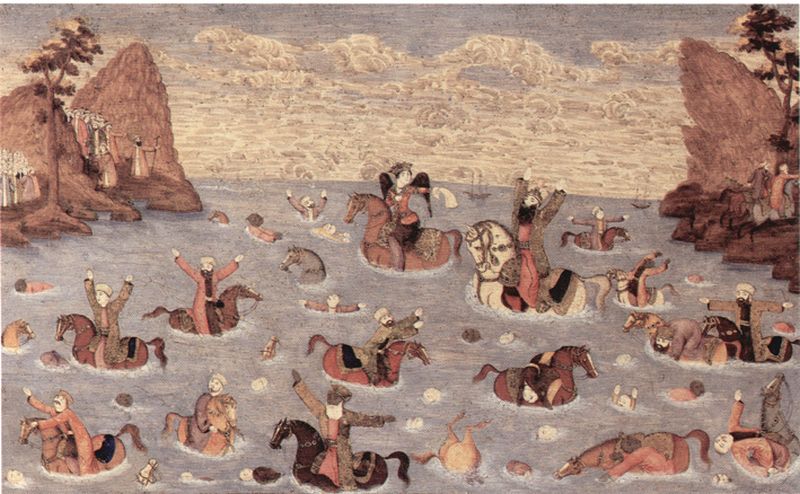
Pharaoh and His Army Drown in the Sea. Isfahan, Iran. 19th Century. Property of the Israel Museum

Personally, I have never been one for modern miracle stories, for Bible codes or hidden predictions embedded in numerical patterns in the Torah. I teach literature, so naturally I love stories and myths. But I understand them as just that, human attempts to find patterns in the world in which we live and imbue it with meaning and significance. Yet, at some point since I moved to Israel, my mindset has begun to shift. There is something about being in a land with so much Biblical significance that makes a person start to feel like she is living in the Bible herself.

Take the start of this recent conflagration with Iran, on the morning of the Shabbat before Purim commonly known as “Shabbat Zachor,” “the Sabbath of Remembering.” On this Shabbat we are required to “remember what Amalek did to you on your journey after you left Egypt” (Deut. 25:17). Amalek has been having a bit of a moment lately in the American anti-semite camp. Despite the fact that the injunction to remember Amalek is mentioned in the same Bible that both Jews and Christians cherish, Tucker Carlson and others have been latching onto it as yet another example of Israeli and Jewish treachery. This despite the straightforward nature of the commandment – to destroy an evil nation that, if given the chance, would gladly murder us first, with a particularly malicious focus on abusing the weak, elderly, infirm, etc. In truth, the commandment to “blot out the memory of Amalek” has never really made it to the rotation of practical commandments for religious Jews. We recall it every year as a kind of symbolic reminder of the limits of moral relativism – that we are commanded to wipe out evil as best as we can.

This past Shabbat Zachor was the most memorable one of my life. Synagogues all around the country closed early as sirens rang out, and it was clear that most Israeli Jews would not be able to hear the biblically mandated passage read aloud from a Torah scroll in its proper context. In my case, word got out that it was going to be read on a nearby street corner, and at noon sharp dozens of neighbors emerged from their homes and safe rooms as if out of nowhere. Just as the Torah reader unfurled his scroll and began to chant, an early missile warning rang out. I assumed everyone would run home but one older man shouted “just keep going,” and the biblical verses were read out in a clear and precise fashion. Upon completion, the actual oncoming missile siren blared and everyone listening disappeared almost as suddenly as they had emerged. Later that evening we would discover the improbable news that the Iranian supreme leader Ali Khamenei and his senior leadership had been killed that same morning by an Israeli strike. Of course, this occurred right around the same time Zachor is normally read in synagogue.

The Purim which followed was a constrained one as the war with Iran increased in intensity and rockets rained down all across Israel. Celebrations were cancelled, public readings of the Scroll of Esther were curtailed, children across the country were devastated that they would not be able to show off their costumes to their teachers and friends. Purim in the Bible takes place not in the Land of Israel but in Persia, the ancient forerunner of Iran. Purim celebrates the improbable overturning of the plot of Haman, the evil advisor to the Persian King Ahashverosh, to destroy the Jewish people. The catchphrase of the holiday is “v’nahafoch hu,” “and it was reversed.” And indeed, what we experienced was the great reversal of a terrible lot that had been cast against the Jews by the neo-Persian Islamist empire. Decades of Iranian sponsored terrorism, money and training funneled to Hamas and Hezbollah and other terror groups, all for the purpose of strangling Israel and murdering its Jews. Finally, our fortunes were reversed, thanks in significant part to the assistance of a great world power and friend (Esther and Mordechai didn’t do it alone either). Now, the sovereign Jewish state directed and influenced the sort of situation in which we previously found ourselves the victim.
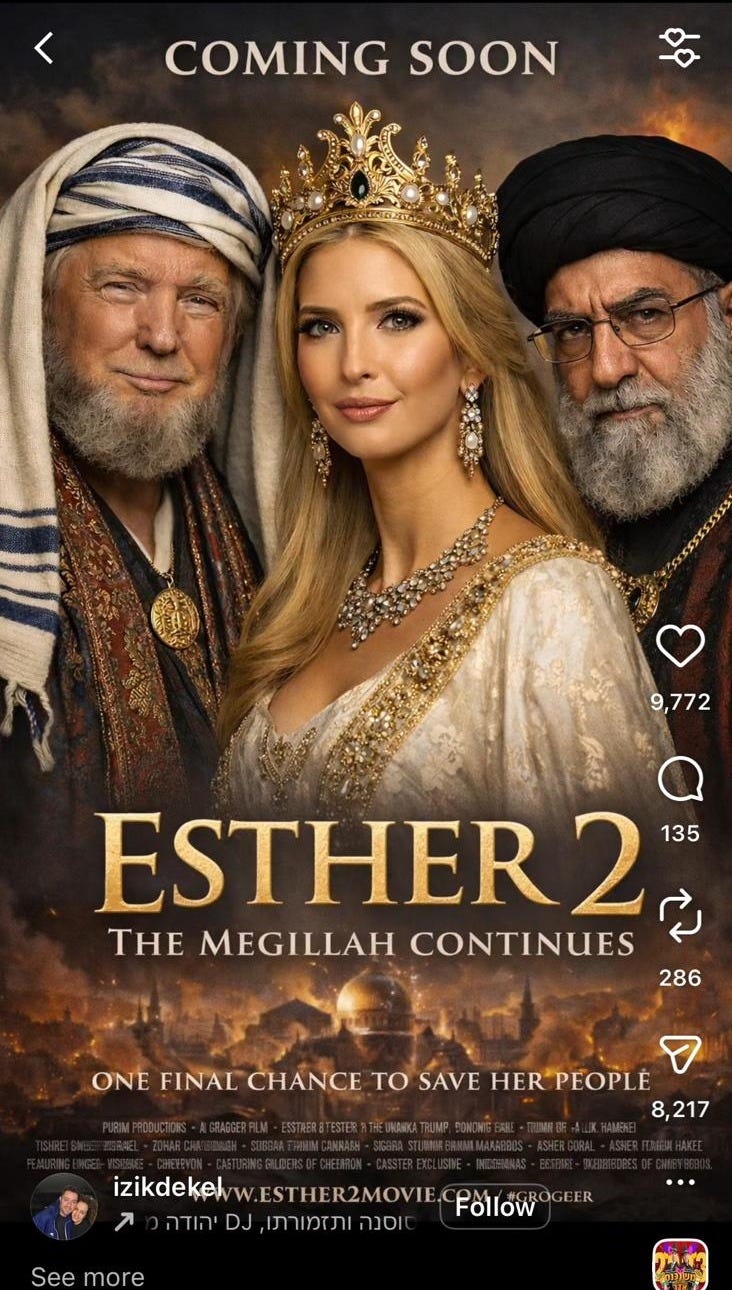
One Funny Meme Among Many

Since we were stuck inside for a great deal of that Purim, humorous memes circulated like wildfire. Khamenei contains the same letters as Haman, Trump likened to Ahashverosh (in addition to his relative Cyrus the Great), Benjamin Netanyahu to the righteous Mordechai (who the Bible says is from the tribe of Benjamin). Who then is Esther? Ivanka Trump? Miriam Adelson? At a certain point the analogies turned into Purim parody but no one could doubt that something remarkable was happening. Legends of the past were turning into reality, past and present mingling. One friend said “Purim may have been cancelled but this was the truest Purim we’ve ever had.”

For many of us, these feelings have been gestating since the breakout of October 7th, for some of us even longer. While Hamas chose the timing of their assault to coincide with the Jewish holiday of Simchat Torah, it was left to us to parse the significance of it occurring at the climax of the Jewish holiday and yearly Torah reading cycle. Precisely two years later, the anticipation toward the freeing of the final batch of hostages during Sukkot, also known by its Rabbinic name “the time of our joy,” made for one of the most joyous Sukkot celebrations many of us have ever experienced. This idea isn’t a new one in Judaism. The requirement to remember the Exodus from Egypt is a case in point. We don’t only remember the details of the story, or relay the miracles wrought by God. At the Passover seder we say, “in every generation, a person is obligated to see himself as if he has personally left Egypt.” Jewish tradition supposes a kind of reliving, not only a remembering, of the events of the Bible in every subsequent generation.

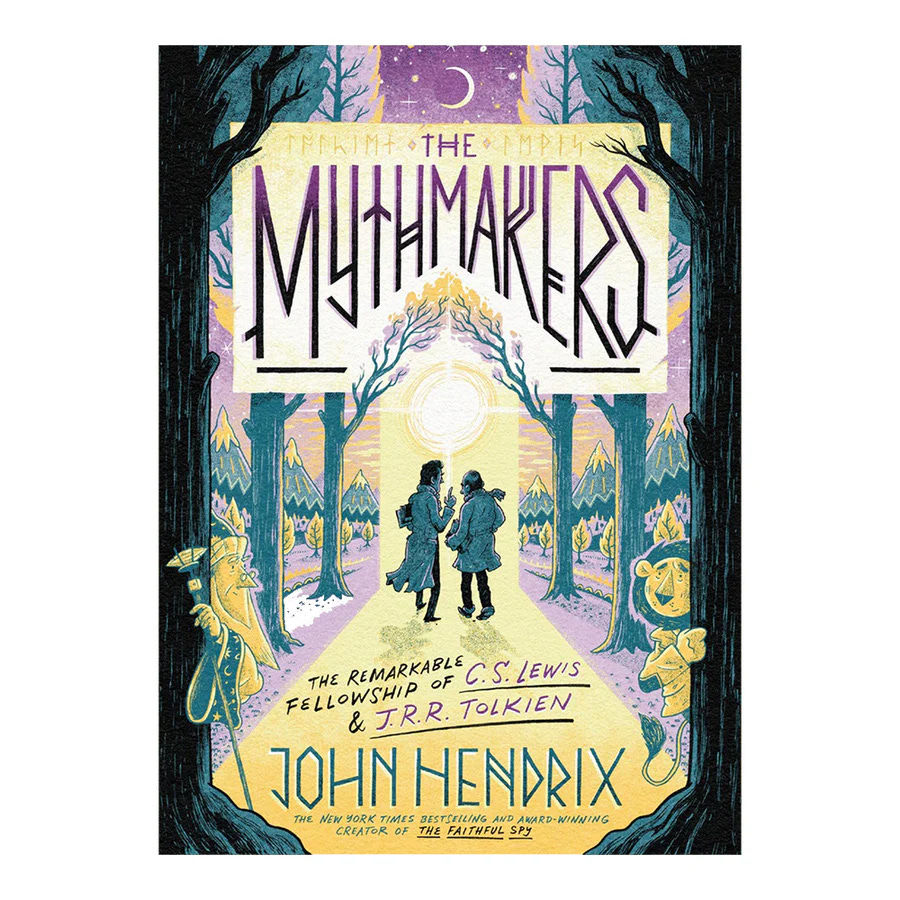
This past year I bought my myth and fantasy loving son a beautiful book called The Mythmakers, a graphic novel by John Hendrix which depicts the famed literary friendship of C.S. Lewis and J.R.R. Tolkien. The book aims, among other things, to get to the heart of what myth is – stories for which the category of “fact” or “fiction” is irrelevant because they explore the way a culture understands itself and its history. A true myth, the book’s wise Gandalf-line narrator explains, “takes place in a ‘time out of time’ and a ‘place out of place’ – separated from our reachable world.” This is part of the magic of myth, that something so completely distant and foreign can also feel so incredibly familiar. The book contains an entertaining visual romp through examples of ancient myths that include among them the book of Genesis and Jonath and the Whale.
What I’ve realized, I suppose, after the events of the last few years, is that moving to Israel means that the events of the Bible stop being myths and start to be something else, maybe something closer to prophecy – or a blueprint, a pattern, for the world we live in. This is different from the relationship that Jews outside of Israel have to the weekly Torah portion, which they read, find personal connections in, or use to generate a wise insight that connects to life in some meaningful way. That sort of reading treats the text essentially as myth, even if you happen to believe the myth is true even on a literal level. What’s going on now in Israel is actually a bit more prosaic than myth, maybe even less intellectually exciting. We don’t need to perform convoluted hermeneutic somersaults to see the connections between the Jewish story here in Israel and our foundational texts – rather the connection is simple and palpable. As sophisticated readers, we shouldn’t need the current war against Iran to be completely geographically aligned with our ancient Persian struggle in order to draw parallels (though it happens to be). The terrorists of Hamas don’t have to be actually located in ancient Philistine territory in order to be associated with those enemies (though they are). They don’t have to voluntarily call themselves Palestinians in order to recall those bloodthirsty adversaries of the biblical Israelites (though they do). We know how to read texts and draw subtle inferences, create complicated analogies, and find meaning where it isn’t obvious. But what is there to say when the parallels are so simple and present?

Another Biblical text we read over the Passover holiday is Ezekiel 37, the vision of the dry bones. The vision takes place after the first destruction of the Jewish temple, when the Jewish people are in the Babylonian exile. God places the prophet Ezekiel in a valley full of bones and asks him “O human being, can these bones live again.” We all know the answer, on a symbolic level. Old ideas can be refreshed; a once vanquished people can be reborn. Ezekiel probably has a sense of where God is going with this and starts prophesying. In the midst of his prophecy he is startled by a strange sound, “suddenly there was a sound of rattling, and the bones came together, bone to matching bone.” To Ezekiel’s surprise this rich and literary parable has taken a literal turn: the breath of God enters the bones and they actually come to life. God does not say “as if.” He tells the people of Israel: “I will put my breath into you and you shall live again, and I will set you upon your own soil.”
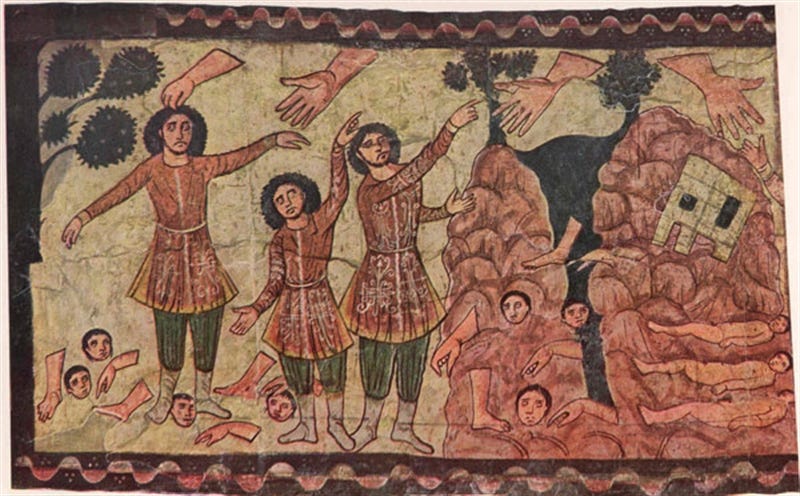
Ezekiel Sees the Dry Bones (Dura Europos Synagogue, 244 CE)

The nice thing about myth is that, with enough exposure, you learn to read between the lines- to recognize where a narrative is heading and what it asks of us. Living the story in medias res (in the middle of things) is never as clear. Does this current ceasefire spell some kind of meaningful turning point for the Jewish people or is it just one pause in a long grind of missiles and war? Which of today’s leaders, like an aging and delusional Saul, is nearing his end—and who, if anyone, might emerge as a Davidic alternative? Living the Bible in real time doesn’t give us unique prophetic access to what the future holds. It doesn’t immunize us from mistakes, nor does it make our pain or grief over loss any less acute. But it assures us that what’s taking place now is far from random: that God’s magnificent plan for the Jewish people is still unfolding, and that the center of the Jewish story remains where it’s always been, here in the Land of Israel.
Children of the Book

“Books, even works of genius, are not incandescent orbs that exist independently in some kind of ether. For books to have enduring value, they must be read by people. For those readers to exist, they must be born and raised.”

Was a pleasure to review Ilana Kurshan’s fantastic new book for the Summer issue of Tradition, now available online.

Three Ways in Which Operation Rising Lion is a Lot Like Narnia

Note: I recently started a Substack so this post appears both there and here on WordPress. I’m going to try to keep both platforms updated so please feel free to choose the one which you prefer and unsubscribe or turn off notifications from the second so you don’t see my updates twice.

From the deluge of fascinating news from Israel’s remarkably successful “Rising Lion” operation against the Iranian regime, one interesting tidbit relates to children’s literature, of all things. According to the Israeli newspaper Yediot Ahronot, IDF intelligence began to assemble a list of the leading scientists driving the Iranian nuclear weapon program in 2022, and their research efforts were given the secret code name “Narnia.” At 3:00 am on June 13, when the Israeli Air Force swiftly eliminated 10 of these scientists, along with striking the Natanz nuclear plant and other military targets, the operation was officially dubbed “Operation Narnia.”

a blue book with a picture of a man walking through the woods
Photo by Tim Alex on Unsplash

In describing the operation, the Jerusalem Post writes that name “reflects the operation’s improbable nature, like something out of a fantasy tale rather than a real-world event.” Indeed, it was hard to believe that the same country that suffered such devastating losses on October 7 due to intelligence failures could execute such a meticulously planned and perfectly executed military offensive. Yet there are many fantasy tales, and the name Narnia is much more than a metonym for all that is improbable or unlikely to occur. Could it be that somewhere in Israeli intelligence circles there is a fantasy geek who specifically chose this code name to evoke a specific connection with the literary world of Narnia? Perhaps. In the meantime, Israeli schools and all other activities are cancelled and we are stuck at home. So I find myself reading Narnia with some of my kids, perhaps for the third time. In our bleary-eyed and underslept state thanks to 2:00 am trips to the safe room, these are the connections that seem to emerge:

1- Narnia is Israel and Calormen is Iran

man sitting beside river painting
Photo by British Library on Unsplash

While some readers of Narnia stop at the famous first book, The Lion the Witch and the Wardrobe, the later books in Lewis’ series introduce us to other lands and cultures which surround Narnia and in doing so offer pointed parallels to the geopolitics of Lewis’ own time. One of these countries is a Middle-Eastern type of desert nation called Calormen, characterized by a hodgepodge of Persian and Arabian motifs: “The Calormenes have dark faces and long beards. They wear flowing robes and orange-coloured turbans, and they are a wise, wealthy, courteous, cruel and ancient people”. Calormenes have many admirable qualities, like a rich culture of storytelling to which Lewis’ narrator is obviously sympathetic, and splendid landscaping and food. Yet while it may outshine Narnia on the material front, it lacks basic freedoms which prevents the full flourishing of its people. Everyone in the society understands their place in a rigid hierarchical structure, and all are required to slavishly try to curry favor with their vainglorious leader the Tisroc. In the capital city Tashbaan, “there is only one traffic regulation, which is that everyone who is less important has to get out of the way for everyone who is more important; unless you want a cut from a whip or punch from the butt end of a spear.” When a poor boy raised in Calormen is mistakenly identified by the Narnians as a member of their party he is smitten with these joyful, bright-eyed people who seem to live without paranoia and insecurity. Yet he can’t help but lie about his identity, as the narrator explains: “he had, you see, no idea of how noble and free-born people behave.”

The individuals we meet in Calormen aren’t all that bad, but centuries reared in a culture where deception and obsequiousness, rather than hard work and talent, are needed to get ahead certainly takes its toll on the moral character of the society. Lewis contrasts this with Narnia, where freedom is cherished, and consequently people develop virtues like courage, honesty and kindness.

Now Narnia may be intended as a stand-in for Lewis’s own England, but in the spirit of William Blake’s “Till we have built Jerusalem / In England’s green & pleasant Land,” I believe there are some parallels with Israel too. While Israel is certainly influenced by its Middle-Eastern surroundings, it is an informal culture where people by and large have the freedom to speak their mind and determine their own destinies. Unlike nearly every other great military power in history, it never set its sight on building empire and controlling other nations. Like Narnia, it is content with merely perpetuating its own way of life within its own borders. Thus it remains a mystery why countries like Iran seek its destruction so vehemently and for so long. If it remains baffling to us, King Edmund of Narnia does offer a kind of answer. In trying to make sense of the curious urge in Calormen to wage war on Narnia, Edmund observes: “We are a little land. And little lands on the borders of a great empire were always hateful to the lords of the great empire. He longs to blot them out, gobble them up” (A Horse and His Boy, p. 68).

Israel right now is doing a lot to make Iran angry, but this anger predates airstrikes in Tehran by decades, and is rooted in the same lust for empire that C.S. Lewis observed during his own dark times. Our response must be the same as it is in the world of Narnia, to push back against Islamic expansionism through military defense, and also to cherish all of the qualities that make our culture unique and worth preserving.

2- Rising Lion

brown lion
Photo by Mika Brandt on Unsplash

When Narnians go into battle, the symbol that is displayed on their flags and shields is a lion. The lion of course is a reference to Aslan, the spiritual icon of Narnia and a Christological metaphor. The reason Jesus is associated with a lion is rooted in the Bible of course, “the lion of Judah,” and in Judaism lions are associated with kingship and sovereignty. Thus it’s also not surprising that “rising lion” is the name and symbol of the current Israeli campaign. The name “Rising Lion,” which is a translation of “Am KiLavi Yakum,” derives from the Prophet Balaam’s blessings of the People of Israel in the book of Numbers: “Behold, a people that rises like a lioness and raises itself like a lion. It does not lie down until it eats its prey and drinks the blood of the slain.” (Num. 23:24) Some unhinged Israel haters have pointed to this verse as proof of Israeli thirst for atrocities. The verse is obviously meant to be symbolic, but the truth is, lions are fearsome creatures who devour their prey. And we have learned over the past twenty months that, in order to defeat evil and restore peace and order to the world, we must be stronger and fiercer than our enemies. This does not always look nice. But that does not mean that it is not a moral posture. Here too, the Narnian parallel can be illuminating. When Susan first learns about the great lion of Narnia she is understandably scared: “Is he—quite safe?” I shall feel rather nervous about meeting a lion.” Mr. Beaver responds: “Safe? . . . Who said anything about safe? Course he isn’t safe. But he’s good. He’s the King I tell you” (The Lion, the Witch and the Wardrobe, p. 80.)

The current IDF campaign in Iran, and even more so, the extended war against Hamas in Gaza, contains visuals that are terrible and painful to behold. But as Lewis’s narrator reminds us, “People who have not been in Narnia sometimes think that a thing cannot be good and terrible at the same time.” What lions symbolize, in the Bible, in the world of fantasy and right now, is the way in which ferocity and justice must, in certain circumstances, work hand in hand. Critics of Israel’s campaign who are supposedly driven by religious pacifism may also take note another verse in Balaam’s litany of blessings directed at the Jewish people: He crouches and lies like a lion and like a lioness; who will dare rouse him? Those who bless you shall be blessed, and those who curse you shall be cursed” (Num, 24:9)

3-Pacifism is Not a Virtue

This brings me to a final point about some of the well-meaning critics, many of them Christian, of Israel’s courageous campaign against evil and America’s supporting role in that effort. While many fairy tales end with a vague “happily ever after,” Lewis takes care to remind us at the end of the Lion, the King and the Wardrobe how the four Pevensie children, now turned kings and queens, spend their days making good laws, keeping the peace, and waging honorable battles in defense of their beloved Narnia. The first progressive in the series is their annoying cousin Eustace Clarence Scrubb, who surfaces in the Voyage of the Dawn Treader when he accidentally gets sucked into a grand voyage with Edmund and Lucy through a painting. Eustace is just awful, a bully and a stick-in-the-mud who has no use for the grand adventures of the sort for which the Pevensie children live. Eustace’s coddled upbringing has given him few opportunities to appreciate the real dangers that exist in the world, although this thankfully changes when he is turned into a dragon. The privilege of distance from danger allows him the freedom to antagonize everyone around him and avoid retribution by declaring “I’m a pacifist. I don’t believe in fighting.”

Lewis was, indeed, critical of those who could never distinguish between a just war and pointless bloodbath. He viewed this problem as similar to an inability to distinguish good from evil. As early as 1940, Lewis delivered a lecture to the pacifist society at Oxford University entitled “Why I am Not a Pacifist,” in which he articulates, from various angles, a justification for wars that need to be fought in order to protect higher values. This does not make the realities of war any less terrible. Yet only by recognizing human necessity can one begin to improve things.

Lewis says:

To avert or postpone one particular war by wise policy, or to render one particular campaign shorter by strength and skill or less terrible by mercy to the conquered and the civilians is more useful than all the proposals for universal peace that have ever been made; just as the dentist who can stop one toothache has deserved better of humanity than all the men who think they have some scheme for producing a perfectly healthy race.

To try to fight a better war, or a shorter or more precise war in which less civilians are killed, is a noble virtue. To avoid war altogether, in all circumstances, is simply a pipe dream that, as Lewis says in the same lecture, will result in “[handing] over the state which does tolerate Pacifists to its totalitarian neighbour who does not.”

Lewis’ analysis applies perfectly to Israel’s situation in its seven front war from Gaza to Iran. The war we fight now is intended to prevent future wars, to invite peace and prosperity to this beleaguered region as well as to other parts of the world. We are not waiting for a lion to save us from “beyond the sea.” We are an “am shel ariyot,” a nation of lions, fighting our hardest on behalf of our highest values. May the current conflict and this larger war come to a speedy, victorious and decisive conclusion.

One Life to Live: Torah U-Madda Today

In a new symposium at The Lehrhaus entitled “Reclaiming Torah u-Madda,” I was given the chance to reflect on the state of “Torah U-Madda” (the relationship between Torah and Western culture) in the Modern Orthodox community today. I sought to address this topic on a philosophical level, through an analysis of a wonderful story by Isaac Bashevis Singer, as well as through some “real-world” examples of how these ideas might play out in practice. My latter comments generated more controversy than I would have liked. I would like to emphasize that my account of what has challenged me personally about my native community is not meant to constitute a comprehensive indictment of all that is wrong with Modern Orthodoxy. My goal in the essay is to introduce a philosophical framework and then briefly suggest how this framework might cohere in real-life scenarios. I don’t mind disagreement about the relevance of these scenarios but I am even more interested in discussing the worldview that underlies them.

Please see here for the full article. And I recommend perusing all of the terrific contributions to this forum.

Living Antiquities: Ozick, Great Books & Judaism

A recent conversation over at Tradition Magazine discusses the potential relationship (or lack thereof) between “Great Books” and Judaism. I weighed in with the help of one particularly great book, Antiquities by Cynthia Ozick. Please read the full essay here.

An excerpt: “There are many wonderful cases to be made for the contributions of great books to our culture, our civilization, and to ourselves. But on a common-sense level, Menand is right. While people who love literature (myself included) can make a compelling case for why these texts enrich our lives, we cannot generalize that those who read great literature are on the whole better people than those who are interested in other matters. Countless well-known authors and literature scholars have been involved in every kind of sordid affair imaginable. Indeed, whenever a new anti-Semitic tinged crusade against the Jewish State pops up, literature departments are inevitably leading the charge. Menand writes that “knowledge is a tool, not a state of being.” To me there is no doubt that the experience of reading Cervantes or Jane Austen can generate profound insights into the complexity of human experience, and morally sensitive writers like George Eliot or Leo Tolstoy create a powerful case for virtue. Yet clearly something else is necessary in order to lay the foundations of a moral life in practice.”

For more on that “something else,” see my latest in Tradition.