Sergeant Itay Amar was nineteen when he fell in combat in the southern Gaza Strip in June 2024, along with seven of his peers. After receiving his locked iPhone among his belongings, his mother, Lorin, tried to open it, insisting he must have left some kind of message behind. “He left one . . . I know my son. That’s what he was like his whole life, keeping me posted. It couldn’t be that he’d go in and not leave anything behind. It wouldn’t be grandiose, maybe just one sentence, but it would be there.”
Eventually Lorin got into the phone, and found a short last note: “Stay happy for me.” The words comforted her and the rest of Itay’s family and were engraved on his tombstone.
Like most armies, the IDF does not require soldiers to write letters of farewell to their families before entering combat. Still, these letters are written, on scraps of paper, unsent emails, or Google documents.
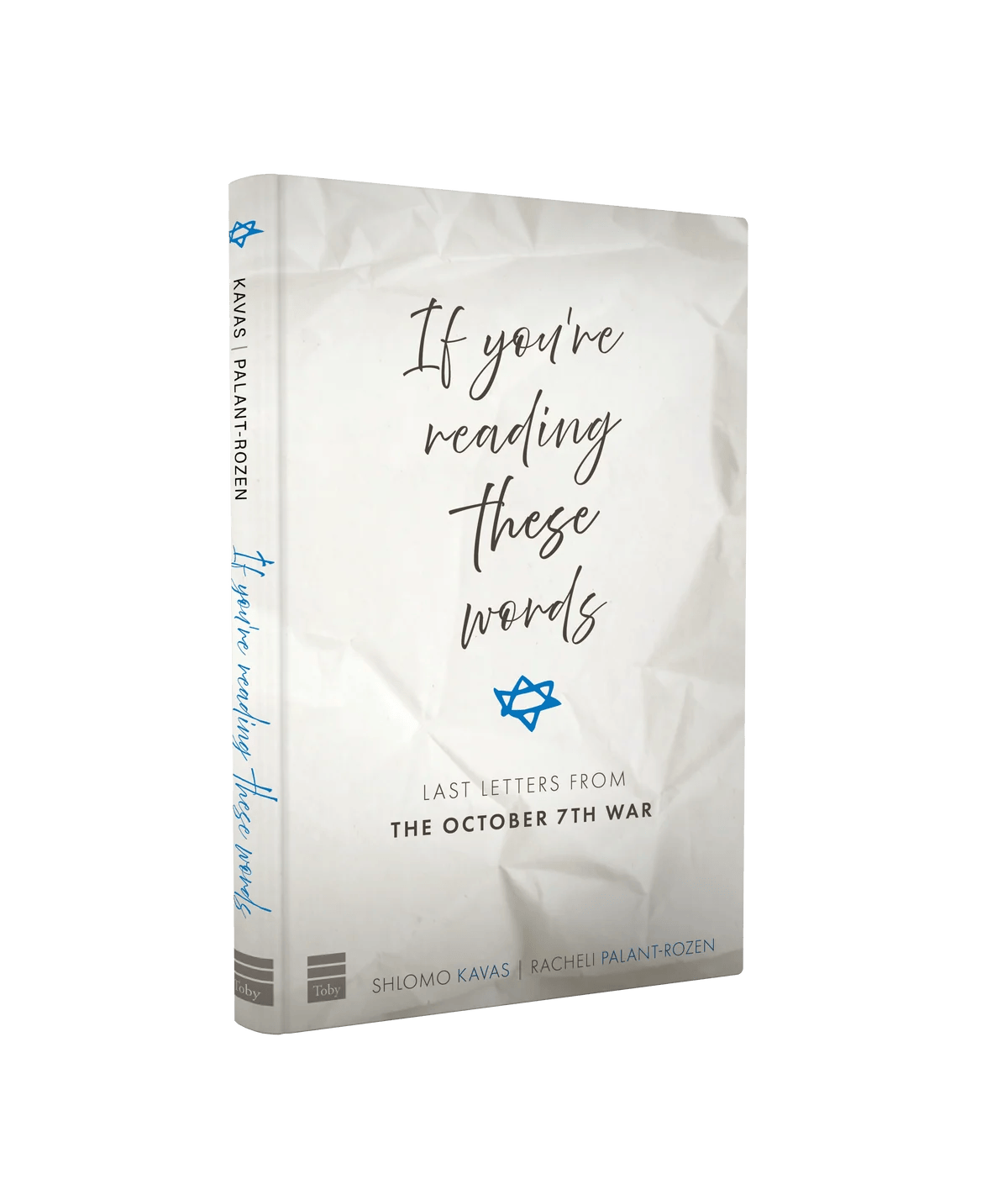
In 2024, copywriter Shlomo Kavas and journalist Racheli Palant-Rozen decided to collect and preserve these notes, working with researchers to contact each fallen soldier’s family. The result was If You’re Reading These Words, a book of forty-nine letters presented largely unedited, with notes explaining the context of each letter: inside jokes, family legends, quotations from songs, poems, and the Bible. Each letter is introduced with a brief biography of the soldier, a record of how they fell in combat, and an artist’s sketch of their face in blue and white. President Isaac Herzog wrote the Foreword, and interspersed throughout are essays by a wide range of Israeli public figures, from freed hostage Emily Damari and Fauda creator Avi Issacharoff to spiritual influencer Rabbanit Yemima Mizrachi and singer-songwriter Eviatar Banai, offering their own kind of running narrative of tragedy and hope.
The book was first published in Hebrew in 2025 and was an immediate bestseller. Comedian and journalist Hanoch Daum called it “one of the most important war books ever published in Israel.”
Moving from the United States to Israel will inevitably impact your identity in profound ways. You may even find yourself assuming strange roles, like de facto aliyah ambassador or pseudo real estate agent, advising friends and family back in the US who are contemplating their own potential moves in the future. Honestly, it’s all good, I think every place in Israel offers something distinct and wonderful. Sometimes I even wonder what I, a religious mother of 7, who likes to read and talk about ideas, is doing in the overpriced lifestyle mecca of Ra’anana, the “pearl” of the Sharon, Israel’s version of Silicon Valley. But I adore it here, what can I say, and was glad to make my case in the Jewish Link’s recent Israel Real Estate supplement. Posting the full text here as well as a link to the original article (which may or may not also include a picture of Netanya).
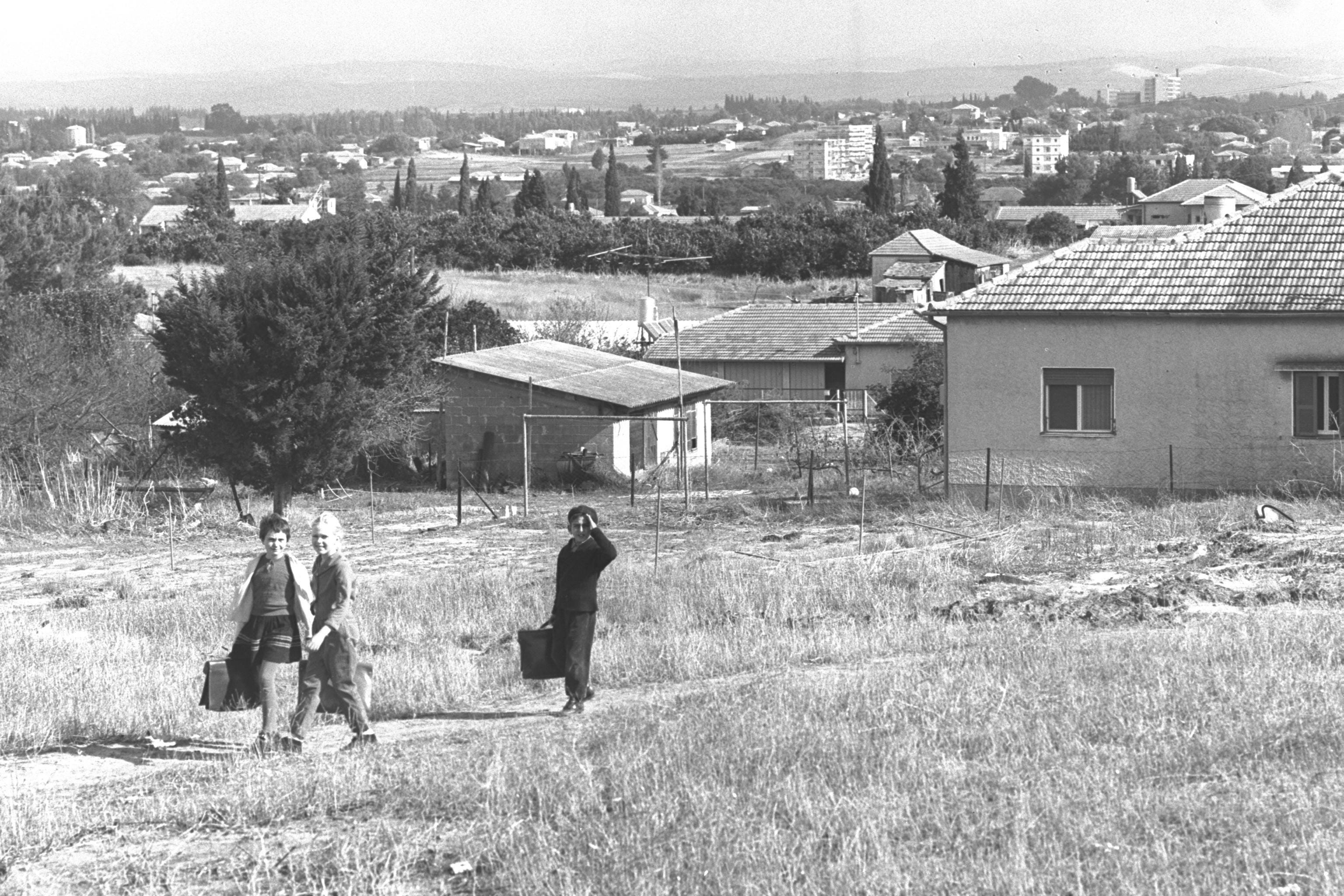
General View of Ra’anana (1964)
When we announced that we were making aliyah to Ra’anana with our family seven years ago from Teaneck, we fielded the full gamut of comments and stereotypes. Some people called Ra’anana the “6th Town” (a reference to the Five Towns). Others joked, “it’s a wonderful place, only 5 minutes from Israel.” One acquaintance mused, rather memorably, “It’s just like Tenafly, without all the Israelis.” Upon arrival we were not too surprised to learn that the hype was rather off — we were very much in Israel, with all of the challenges and opportunities this entails.
Ra’anana is a small, diverse city of about 85,000 located in the Sharon region of Israel. It features crisp refreshing winters that never get too cold, when citrus fruits ripen all over the city, and a warm radiant spring season. Summers are hot. It’s about 25 minutes north of Tel Aviv, and a short 15-20 minute drive to the beach in Herziliya. Founded in 1924 by members of the Ahuza A–New York Society, many of them Polish Jews living in New York, it has always had a bit of an international flavor. The original residents were mostly of European origin, soon joined by an influx of Yemenite residents, then later waves from England, France and South Africa, and more recently Brazil and Latin America.
The majority of residents are still native Israelis, including many young families who work in hi-tech. Since olim in Ra’anana come from all over the world and not just English-speaking countries, the lingua franca in school and on the playground is Hebrew. Schools are largely experienced in dealing with the challenges of absorbing new immigrants. The rich variety of food and shopping reflects the diversity of the population. When Shabbat nears, my children ask for special treats like South African biltong, French pastries and Yemenite lachuch bread (with hilbe, a kind of addictive frothy fenugreek dip) in anticipation.
Ra’anana has a wide range of housing options, from large free-standing homes to compact starter apartments, and each year more attractive apartment buildings are built. The strong and ever-growing demand for housing in Ra’anana, both from native Israelis and olim, makes housing notoriously expensive: a 3- or 4-bedroom apartment averages ₪2–4 million (roughly $650,000–$1,300,000), and private homes can range from $2 million toward $4 million or more on the most sought-after streets.
Our home in Israel costs a lot more than our home in Teaneck did (though carrying costs, like property taxes and maintenance, are lower). But we feel we receive many benefits in return, not just from the home itself but from the community and environment. We live in a dynamic, walkable city, with beautiful parks, enriching after-school activities for our kids and stimulating cultural events for our whole family. We have access to an exceptionally well-stocked English language library, world-class tennis, baseball and squash facilities, a superb skate park and “Ninja” style obstacle course, and Israel’s largest municipal music conservatory — all in a small, accessible city, so nothing is ever too packed and attendance always means seeing familiar, friendly faces.
Ra’anana is known as one of the more religiously strong cities in the Sharon area, though the religious population hovers around 30-40% and is not a majority like in cities such as Beit Shemesh or Efrat. Nevertheless, it often feels like one can’t walk half a block without seeing another synagogue. Within two blocks of my house are two Yemenite synagogues, a Moroccan shul, a Chabad shul for the French community, a Hareidi yeshiva hosting the “Leibadik” minyan, a raucous Carlebach shul founded by Australian immigrants, and a joint Sephardi-Ashkenazi “unity” minyan. This is just a random sampling within a five minute walk of my house.
There are several large shuls catering directly to English-speaking olim which include programming for youth and teens. There are vibrant batei midrash, including a community Kollel offering daytime Talmud Torah classes in English, and Matan HaSharon, a wonderful institution for high-level women’s learning. While living in Ra’anana has met our needs as a young, growing family, it’s nice to live in a city that also has extensive opportunities for residents of every age level, especially retirees. A friend in his forties recently built a house in Ra’anana with old age in mind, as he said, “I never plan to move again.” I wish him good health and a long life- a blessing that is sensibly grounded, as many studies cite Ra’anana residents as enjoying the longest average life expectancy in Israel or even the Middle East.
As for education, in addition to secular and pluralistic schools, Ra’anana offers a range of religious options: three “Mamad” style state religious public schools, a “Torani” religious public school called Noam with separation between boys and girls, several Haredi schools, and a new Chabad elementary school popular among olim. There are two religious boys’ high schools, including the massive AMIT boys’ school in its new campus, and a Bnei Akiva yeshiva high school with a rich history; one large dati-leumi girls’ high school, also under AMIT; and a Haredi girls’ high school called Horev. Students seeking more options, especially for girls’ high schools, sometimes travel to neighboring Kfar Saba and Herziliya and even as far as Petach Tikvah and Bnei Brak.
Ra’anana has a reputation as a safe city; crime rates and break-ins are quite low, and, like many places in Israel, it’s not uncommon to see an eight-year-old walking himself home from school or stopping into the makolet on his own for an ice-pop. Terrorism incidents have been few and far-between (with one tragic exception two years ago). The municipal security system is highly responsive and will come almost comically quickly in response to any sort of minor concern or complaint.
Yet, Ra’anana has not been immune to the larger challenges Israeli society has faced since October 7. As would be expected in a community filled with committed Zionists and general high-achievers, many heroic soldiers from Ra’anana have fallen in Israel’s wars. One famous son is Roi Klein HY”D, a talented religious IDF officer who grew up in Ra’anana and was killed during the Second Lebanon War when he famously jumped on a grenade to save his fellow soldiers, the words Shema Yisrael on his lips. Ra’anana suffered its share of losses on October 7th, including Aryeh Ziering HY”D, the son of American olim and an officer in the IDF’s canine unit “Oketz,” who was with his family in Ra’anana for Simchat Torah when he was called up with his unit to the south. The ensuing war brought more tragic news, but also a sense of awe and pride. Shauli Greenglick HY”D, a talented singer who had advanced to the final rounds of Israel’s version of “The Voice,” withdrew from the competition to rejoin his battalion fighting in northern Gaza, and was killed only a few weeks after his audition. Over these past few difficult years, the names of Ra’anana’s fallen heroes — Yaron Chitiz HY”D, Yisrael Natan Rosenfeld HY”D, and others — have become household names. Come Sukkot, sukkot citywide bear posters with their pictures; a charming new neighborhood coffee cart was dedicated in their memory.
In 2024, the newspaper Makor Rishon ran a remarkable piece about eight young fallen soldiers and their families, among them Greenglick, our daughter’s good friend’s brother Dan Wajdenbaum HY”D, and another friend’s brother Daniel Ben Harosh HY”D — all of whom grew up on, or adjacent to, one street (Ravutsky) in the Northeast section of Ra’anana. The boys had crossed into each other’s yards and played ball together, had gone to school together, and their parents were friends and acquaintances — native Israelis and olim alike, stretching from all quarters of the world. The thesis of the article, beyond paying tribute to these young men and their families, was that this one small street in Ra’anana — which has endured so much pain but also exhibited incredible bravery and resilience — is a microcosm of Israel as a whole.
The decision to move to Israel, especially in this current climate, is an admirable one. The choice of community is filled with complicating factors: career opportunities, the type of community one envisions, budget, and more. Some are moved by the sweeping views and sense of pioneerism in a small yishuv in the North or the Shomron; others by a bustling city and its opportunities. Sometimes when I visit Jerusalem I feel a bit of a tug — to live in a place with so much spiritual power, so much intellectual and artistic vitality, has a special appeal to me. Yet in moving our family across the world, from American suburbia, grandparents and cousins, to a great unknown, the strong communities, wide avenues and well-manicured parks of Ra’anana made for an easy and pleasant adjustment. Ra’anana is a great choice for a life that combines cosmopolitanism and community, exposure to different Jewish cultures, and the comfort of being among others who made the same choice you did. As for those people who teased us by saying “Ra’anana is only 5 minutes from Israel” — they are still in New Jersey. We find ourselves in a warm community and growing city, enjoying the benefits of each, at the heart of Israeli life.
Last week, on a beautiful June night, I found myself in the eastern Judean desert, not far from Bethlehem, at the foot of ancient Herodium, a lavish palace built by King Herod between 23 and 15 BCE. Herod was a widely despised, Roman-appointed client king of Israel, Jewish in name only, who displaced the Hasmonean dynasty. The Hasmoneans, descendants of the Maccabees, had won Jewish self-rule a century earlier, a victory still celebrated each year at Chanukah. Herod’s tyrannical, paranoid reign ended in the murder of his own wives and children. He was also an ambitious builder, and many of his grand projects still punctuate the landscape of modern Israel: Masada, the Tomb of the Patriarchs in Hebron, and most prominently his expanded Temple Mount, including the Western Wall.
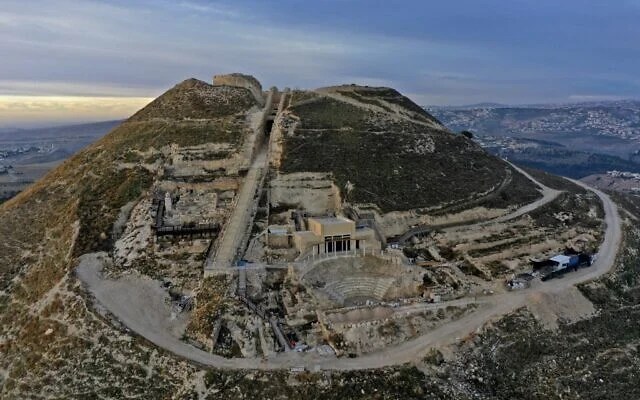
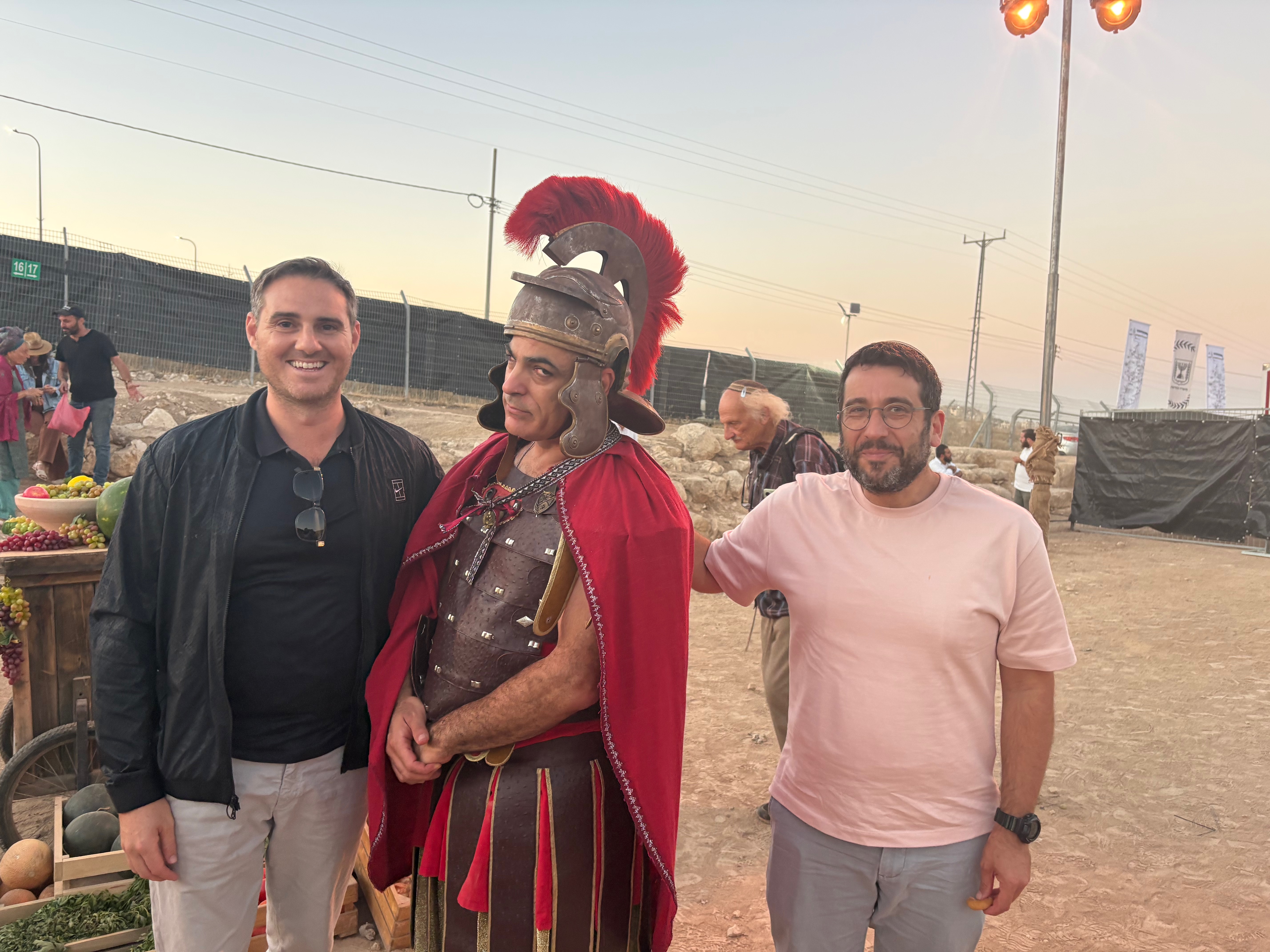
The fortress looms above the surrounding desert for miles. It was my first time visiting, and while the winding, unfamiliar drive there was a bit stress-inducing, the moment I first glimpsed the site from afar, it took my breath away. Herod demanded a fortress so grand it could be seen from Jerusalem, and the terraformed desert mountain remains a masterful feat of engineering. Efforts are now underway to make the site, located in a politically sensitive area, accessible to the broader public. The evening was the kickoff to an academic conference on Israeli heritage in Judea and Samaria. Present were archaeologists, political figures, and US Ambassador to Israel Mike Huckabee, who was presented with a special award by the Ministry of Heritage. At the entrance, we were greeted by a recreated period marketplace, complete with actors dressed as Roman legionnaires scuffling with Israelite locals, a role which I suppose included the rest of us too. An illuminated theater had been erected inside the massive ancient pool Herod once, inexplicably, managed to fill with water in the middle of the desert. As the stars came out, we sat for an original production titled “Herod vs. Bar Kochba: The Battle for Eternity.”
A sense of the scene (note the looming mound of Herodium on the right)
Bar Kochba was a Jewish guerilla leader who led a three-year revolt against Roman occupation in Judea, seventy years after Rome destroyed the renovated Second Temple, another Herodian project and the catastrophe still mourned each year on the fast of Tisha B’Av. The play follows a young Jewish rebel, his wife, and son, camped out at a Herodium that has by then fallen into disrepair. Recent excavations at the site have in fact uncovered a trove of Bar Kochba-era coins; I was handed a replica of one at the event. As the rebels onstage dig tunnels, ration water, and prepare for battle, they are visited by the ghost of Herod, who still haunts his beloved palace. He mocks their devotion to Jewish sovereignty, a doomed cause, he insists, even a century after his own death, given the strength of Rome. Herod argues for compromise and accommodation – you are all headed towards death (forgive my paraphrase, I didn’t think to record at the time). Herod tells them: “Choose life, choose prosperity.” All that is needed, he suggests, is to submit to Roman rule, pay their taxes, and allow a few of their gods and statues into the Jewish holy places. The rebels are unconvinced. They are willing to die at Roman hands not because they love death, but because they are playing a longer game. “Perhaps it will be a few years, perhaps a thousand,” the mother tells her son, “but one day we will march back into Jerusalem and worship our God.”
Roman Legionary Deigns to Take a Photo With the Israelite Riff-Raff
The play then shifts into an ahistorical debate between Herod and Bar Kochba themselves. Herod, played to perfection by the legendary Israeli actor Shuli Rand, makes the (correct) case that modern Israel is no direct heir to Bar Kochba’s fanatical legacy. “Look around you,” he says. “You’re sitting in a theater. Who brought theater to ancient Israel? Do you love culture? Wine? Good food?” These are not the tastes of single-minded desert warriors. Bar Kochba counters that modern Israelis may indeed enjoy a comfortable life, but when crisis strikes, as it did on October 7th, they will fight to their last breath for their people and their land. Bar Kochba himself left little behind. No children, no followers, nothing approaching the scale of what Herod built. His revolt’s brutal defeat left hundreds of thousands of Jewish civilians dead or enslaved. Rome expelled the Jews from Jerusalem, renamed the city Aelia Capitolina, and rebranded the province itself Syria Palaestina, scrubbing Judaea from the map entirely. But the play’s argument is that the fighting spirit that Bar Kochba drew on persists in the modern state regardless, a key part of its ethos from its founding to today.
Each member of the large audience was given a copy, in Hebrew translation, of Barry Strauss’s excellent new book, Jews vs. Rome. The book supplies more nuance than any play could, making a convincing case that the two-hundred-year Jewish struggle against Rome, a struggle with an outsized influence on both Rabbinic and Christian tradition, cannot be separated from the larger contest between empires playing out at the same time, namely between Rome and Parthia, heir to the Persian empire. No small nation in the Mediterranean basin could survive in that era without aligning with one power or the other, and the Jews knew this as well as anyone. Strauss argues that the revolt against Rome was also a desperate, ultimately futile bid to draw Parthian intervention to the Jewish cause.
The timing felt almost too fitting. That same morning, at the G7 summit in France, Trump had defended a newly signed Memorandum of Understanding with Iran, located more or less where Parthia once stood. The MOU calls for a sixty-day ceasefire, during which the US would release significant funds to Tehran, and involves the Iranians trying to bolt-on an Israeli ceasefire in its war against Hezbollah in Lebanon. The MOU was met with disappointment, to put it mildly, by many Israelis who had hoped for a more decisive outcome, not to mention concern that it will limit Israel’s existential struggle against Iran’s proxies. President Trump, in an attempt to push the MOU forward, voiced some criticism of recent Israeli military action in Lebanon, adding: “Without the United States there would be no Israel, without me there would be no Israel.” Trump’s claim here is characteristically over-the-top. Yet some 1,900 years after Judea’s doomed insurgencies against Rome, we are reminded once again of the painful necessity, for a small nation, of relying on a great power ally.
However, the United States is no Roman Empire, and as the evening at Herodium testified, Jewish life is flourishing across the Land of Israel and increasingly taking on a confident, nationalistic character. Three years into a war launched by the October 7th massacre, our strategic position is far stronger, our enemies considerably weakened, and the shekel is soaring (much to the frustration of American expats still earning in dollars). Modern Israeli culture has reclaimed figures like Bar Kochba and Shimon Bar Giora, who led the Zealots in the earlier Great Revolt, despite their crushing defeats at Roman hands. They represent a spirit of Jewish agency and independence that still underlies many of Israel’s great military and cultural achievements. Strauss, in his book, quotes Churchill’s line after a 1940 war cabinet meeting: “Nations that go down fighting rise again, but those who surrender tamely are finished.”
It was against this backdrop, both contemporary and ancient, that I especially appreciated Ambassador Huckabee’s remarks when he accepted his award. He spoke twice that night, once in a smaller, filmed setting that has since been clipped and mocked by Tucker Carlson and others with little sense of the context in which it was deliveed. But in his similar, full remarks before an audience of more than a thousand, Huckabee noted that the United States is approaching the 250th anniversary of its independence this July 4th, a milestone that might seem almost laughable set against 3,800 years of Jewish history in this land. “To you, we’re mere children,” he said. “You’ve been around a lot longer, and your history is not only your history, but I want to say this, and I hope you understand, your history is also our history.” He went on: “Without you and your history, and your preserving God’s purpose and God’s law, there would never be Western civilization. There would never be an America, because America was founded on the principles that were established right here in this land all those many thousands of years ago.” Many read Huckabee’s words as a direct answer to Trump’s comments earlier that day. His message was that Israel owes real gratitude to its current great power patron, the United States. But the United States, rooted as it is in biblical values, is itself a kind of outgrowth of the Jewish struggle against Rome that played out nineteen centuries ago. That struggle was the crucible from which both Rabbinic Judaism and Christianity were born.
In making this case, Huckabee charts a third way, distinct from the two offered onstage that night. It is not Herod’s path, accommodation purchased through submission and the gradual erosion of what makes a people distinct. Nor is it pure Bar Kochba – righteous rebellion that goes down fighting, in flames. Huckabee’s third way is partnership felt as kinship, a great power and a small nation bound not merely by shared interest but by shared inheritance. America’s strength flows from values Israel gave the world long before America existed to receive them. It is a relationship that asks Israel to feel gratitude without shame, and asks America to remember that the debt runs both ways. Driving home that night, I watched Herodium recede in the rearview mirror, its massive dome holding the dark a little longer than everything around it before finally sinking under the horizon. Herod built it to be seen from Jerusalem. Two thousand years later, it is still a fixed point in an old argument about what is needed for a nation, and the set of ideas it embodies, to fulfill its destiny.
Also published on Substack, if you’re new to my work please considering subscribing!
“To be a Zionist in 1944, or indeed at any point before the state of Israel is created, requires tremendous imagination, which is why the movement draws mainly the literary and the desperate.”
Hannah Senesh occupies a unique place in Israeli history and memory. Only 19 years old on the eve of World War II, she left her hometown of Budapest to build the land of Israel with her young Zionist peers. At 23, she made the inconceivable choice to parachute back into Nazi-occupied Europe. The mission ultimately failed in its stated purpose and resulted in Senesh’s execution. But it left the fledgling Jewish State with a national hero, whose poetry and diary entries still reverberate today. Senesh wasn’t alone, she was one among a small group of Jewish members of the yishuv who donned British army uniforms in an implausible bid to try to save Jewish lives from the German killing machine, often their own families included. A few of these figures, such as Enzo Sereni and Haviva Reik, also entered the national consciousness, with streets and settlements named in their honor. Others are less well-known. For a story that is this iconic, one would imagine that its details would be more or less widely understood. Yet as Matti Friedman demonstrates in his riveting new book “Out of the Sky,” one of Israel’s greatest legends is also riddled with mysteries and open questions.
The heroic operation was the result of a collaboration between the fledgling Jewish army, the Haganah and British intelligence. The idea, at least as the British understood it, was for a group of Jewish men and women, almost all of them recent refugees from Europe, to join the British army and leverage their skill in their native languages in order to assist British POWs and local resistance fighters behind enemy lines. On the Jewish end, motivations were more multifaceted. The Jewish conscripts sought British military training, which would help them when the time came for their own inevitable war of independence. Even more so, they desperately wanted to try to help the Jewish communities of Europe in some way. A total of 250 men and women were recruited to take part in this unusual mission, but only 37 of them completed the training. Of this number, 12 were captured and seven did not make it home.
Friedman lays out the extent to which this improbable mission, rooted in the loftiest ideals, never really had a chance of succeeding. Firstly, by the time it took place in 1944, most Jews in Europe had already been murdered. No allied powers, including the British commanders overseeing this secret mission, seemed to prioritize saving their lives. Even the safety of the Jewish volunteers was not viewed as urgent. Enzo Sereni, the brilliant Italian Labor Zionist and polymath, who Ben-Gurion tried to prevent from jumping because “there wasn’t another man like him,” was carelessly dropped atop a German army installation in Northern Italy. As Friedman notes in an interesting aside, the Mossad unit operating out of Istanbul at the time had been infiltrated by German double agents, who likely knew about the parachutists’ missions before they even landed.
A visitor could walk through the entire Hannah Senesh House in Sdot Yam — a beautifully renovated museum in the kibbutz where she lived for two years before setting out on her perilous mission — without seeing any mention of a seemingly important fact: that her mission was doomed from the start. Yet Friedman’s aim is not to diminish Senesh’s extraordinary bravery, or that of her fellow operatives. Rather, he seeks to understand their courage in a new light.
In recent years, Friedman has become one of the most compelling English-language chroniclers of Israeli history and society. What distinguishes his work — whether he is examining the brilliant letters of a young Israeli soldier on a Lebanese outpost or recounting Leonard Cohen’s sojourn in Israel after the Yom Kippur War — is his tendency to frame Israel’s turbulent history through a literary lens. While the canon of modern Hebrew wartime literature remains relatively sparse — perhaps because most writers keep their distance from the battlefield — Israel has never lacked for fighters with poetic souls in the state’s early years or today.
Throughout the book, Friedman explores the intellectual worlds of his unusually thoughtful protagonists, suggesting that “if they showed up at a military recruiting office now, they’d probably be turned away.” Senesh, the daughter of a well-known Hungarian-Jewish playwright, dreamed of following in her father’s footsteps and wrote poems of startling quality as early as age 15. Sereni held a Ph.D. in philosophy from the University of Rome. Friedman recounts how, in addition to having already written a novel and novella, he dreamed of writing a great Italian novel which would depict the conflicts and controversies of his time through the lens of his own Jewish family.
In this sense both Senesh and Sereni follow in the path of other great Zionist leaders, like Herzl and Jabotinsky, who began their careers as journalists and writers of fiction, eventually putting aside their universalistic literary ambitions for the more particularistic cause of Jewish sovereignty. Friedman makes the terrific observation that this is no coincidence: “To be a Zionist in 1944, or indeed at any point before the state of Israel is created, requires tremendous imagination, which is why the movement draws mainly the literary and the desperate.”
Part of the book’s premise is that the exquisite literary sensibilities of these proto-Israeli heroes helps explain why they made the jump. Friedman writes: “The parachutists aren’t commandos. They’re storytellers. They’ve been sent to write, with their lives, a Zionist story about the war – a story that will lead others not to despair but to action.” Senesh’s military achievements may have been miniscule – hardly any time passed from the beginning of her mission until her execution in a Hungarian prison, only three months before liberation.
Yet we remember Senesh because of her literary achievements: among them the diary she wrote vividly portraying her transition from a precocious, assimilated 13-year-old girl into a fervent Zionist activist. At every major juncture in her short life Senesh seemed to find the time to quickly craft a phenomenal poem. She handed her fellow fighter “blessed is the match consumed in kindling flame” right before entering occupied Hungary. Shortly before her execution she managed to pen a short lyric poem: “I gambled on what mattered most/The dice were cast. I lost.” While Senesh failed in saving other Jews, and even herself, she succeeded in her larger objective. As Friedman summarizes it: “The mission isn’t military, it’s literary, and she’s the best writer.”
In writing “Out of the Sky” — a book equally about a remarkable episode in history as it is the act of crafting and telling stories — Friedman certainly crafts his own. While many fascinating and heretofore little-known stories about Senesh and her fellow parachuters make it into the book, others do not. Friedman leans toward a portrait of Senesh as a clever, cosmopolitan European. He reminds us of her youth and her theatrical family. In her precocious diary entries, Zionism feels like a role she has chosen to play. He clearly admires her heroism but does not exaggerate it. Yet alternative accounts remain.
In his introduction to the first edition of Senesh’s collected writings, Abba Eban wrote, “all the definitions of giant courage come together in Senesh’s life.” Joel Palgi, another parachutist who followed a similar path to Senesh but inexplicably managed to survive, wrote about her in his memoirs as a force of nature, the undisputed leader of their group, fiercely admired by fellow resistance comrades as she transformed from a poet into a fighter. Even the Gestapo, in Palgi’s telling, were in awe of Senesh. He describes the sadistic prison warden who used to visit Senesh’s cell every day to argue about politics. Senesh’s mother Katherine, in her own memoir, describes the mesmerizing power Senesh held over guards and fellow prisoners alike. Children gravitated toward her, fellow prisoners drew strength from Senesh’s whispered encouragement, her Zionist education campaign, and her ingenious secret broadcasts from the window of her cell. One SS guard told Senesh, “I’ve never known a woman as brave as you.”
“Out of the Sky” does not contradict these remarkable testimonies, which contain a whiff of hagiography, though surely have some grounding in truth. It’s not really a book about superheroes, unusual people with uniquely phenomenal qualities who changed the course of history. Rather, it’s a book about regular people, highly intelligent and talented to be sure, who met the challenges of their age with bravery and foresight. What distinguished them as heroes was that they understood, both in their lives and their deaths, they could contribute to the writing of a story much larger than themselves.
The Bible Lands Museum in Jerusalem is known for its collection of Near Eastern antiquities from the Biblical period. Yet amidst its galleries stands a startling cultural artifact of far more recent origin.
Kuma—meaning “Rise”—is a nearly ten-foot-long scroll depicting a dense, vivid, intellectually rich, and aesthetically stunning account of Jewish history. Its full title, “Kuma, Mei Afatzim ve-Kankantum,” refers to the materials used to prepare ink for Torah scrolls and other sacred texts. Evoking an unfurled Torah scroll, Kuma is the high-school senior project of a brilliant young yeshiva student, artist and poet named Eitan Rosenzweig הי”ד. Staff Sgt. Rosenzweig, an Alon Shvut native and student in the Yerucham Yeshivat Hesder, served in the Givati brigade and was killed in Gaza in November 2023, at the age of 21.
Kuma weaves together Jungian theories of the unconscious, the mythologist Joseph Campbell’s concept of the heroic journey, and imagery drawn from Western art and Jewish history—some of which appear elsewhere in the Bible Lands Museum. Kuma also incorporates literary allusions to the Bible, Talmud, modern Hebrew literature, Eastern and Western general philosophy, and more. It is a work of art that one must study rather than merely observe.
Note: I recently started a Substack so this post appears both there and here on WordPress. I’m going to try to keep both platforms updated so please feel free to choose the one which you prefer and unsubscribe or turn off notifications from the second so you don’t see my updates twice.
From the deluge of fascinating news from Israel’s remarkably successful “Rising Lion” operation against the Iranian regime, one interesting tidbit relates to children’s literature, of all things. According to the Israeli newspaper Yediot Ahronot, IDF intelligence began to assemble a list of the leading scientists driving the Iranian nuclear weapon program in 2022, and their research efforts were given the secret code name “Narnia.” At 3:00 am on June 13, when the Israeli Air Force swiftly eliminated 10 of these scientists, along with striking the Natanz nuclear plant and other military targets, the operation was officially dubbed “Operation Narnia.”
In describing the operation, the Jerusalem Post writes that name “reflects the operation’s improbable nature, like something out of a fantasy tale rather than a real-world event.” Indeed, it was hard to believe that the same country that suffered such devastating losses on October 7 due to intelligence failures could execute such a meticulously planned and perfectly executed military offensive. Yet there are many fantasy tales, and the name Narnia is much more than a metonym for all that is improbable or unlikely to occur. Could it be that somewhere in Israeli intelligence circles there is a fantasy geek who specifically chose this code name to evoke a specific connection with the literary world of Narnia? Perhaps. In the meantime, Israeli schools and all other activities are cancelled and we are stuck at home. So I find myself reading Narnia with some of my kids, perhaps for the third time. In our bleary-eyed and underslept state thanks to 2:00 am trips to the safe room, these are the connections that seem to emerge:
While some readers of Narnia stop at the famous first book, The Lion the Witch and the Wardrobe, the later books in Lewis’ series introduce us to other lands and cultures which surround Narnia and in doing so offer pointed parallels to the geopolitics of Lewis’ own time. One of these countries is a Middle-Eastern type of desert nation called Calormen, characterized by a hodgepodge of Persian and Arabian motifs: “The Calormenes have dark faces and long beards. They wear flowing robes and orange-coloured turbans, and they are a wise, wealthy, courteous, cruel and ancient people”. Calormenes have many admirable qualities, like a rich culture of storytelling to which Lewis’ narrator is obviously sympathetic, and splendid landscaping and food. Yet while it may outshine Narnia on the material front, it lacks basic freedoms which prevents the full flourishing of its people. Everyone in the society understands their place in a rigid hierarchical structure, and all are required to slavishly try to curry favor with their vainglorious leader the Tisroc. In the capital city Tashbaan, “there is only one traffic regulation, which is that everyone who is less important has to get out of the way for everyone who is more important; unless you want a cut from a whip or punch from the butt end of a spear.” When a poor boy raised in Calormen is mistakenly identified by the Narnians as a member of their party he is smitten with these joyful, bright-eyed people who seem to live without paranoia and insecurity. Yet he can’t help but lie about his identity, as the narrator explains: “he had, you see, no idea of how noble and free-born people behave.”
The individuals we meet in Calormen aren’t all that bad, but centuries reared in a culture where deception and obsequiousness, rather than hard work and talent, are needed to get ahead certainly takes its toll on the moral character of the society. Lewis contrasts this with Narnia, where freedom is cherished, and consequently people develop virtues like courage, honesty and kindness.
Now Narnia may be intended as a stand-in for Lewis’s own England, but in the spirit of William Blake’s “Till we have built Jerusalem / In England’s green & pleasant Land,” I believe there are some parallels with Israel too. While Israel is certainly influenced by its Middle-Eastern surroundings, it is an informal culture where people by and large have the freedom to speak their mind and determine their own destinies. Unlike nearly every other great military power in history, it never set its sight on building empire and controlling other nations. Like Narnia, it is content with merely perpetuating its own way of life within its own borders. Thus it remains a mystery why countries like Iran seek its destruction so vehemently and for so long. If it remains baffling to us, King Edmund of Narnia does offer a kind of answer. In trying to make sense of the curious urge in Calormen to wage war on Narnia, Edmund observes: “We are a little land. And little lands on the borders of a great empire were always hateful to the lords of the great empire. He longs to blot them out, gobble them up” (A Horse and His Boy, p. 68).
Israel right now is doing a lot to make Iran angry, but this anger predates airstrikes in Tehran by decades, and is rooted in the same lust for empire that C.S. Lewis observed during his own dark times. Our response must be the same as it is in the world of Narnia, to push back against Islamic expansionism through military defense, and also to cherish all of the qualities that make our culture unique and worth preserving.
When Narnians go into battle, the symbol that is displayed on their flags and shields is a lion. The lion of course is a reference to Aslan, the spiritual icon of Narnia and a Christological metaphor. The reason Jesus is associated with a lion is rooted in the Bible of course, “the lion of Judah,” and in Judaism lions are associated with kingship and sovereignty. Thus it’s also not surprising that “rising lion” is the name and symbol of the current Israeli campaign. The name “Rising Lion,” which is a translation of “Am KiLavi Yakum,” derives from the Prophet Balaam’s blessings of the People of Israel in the book of Numbers: “Behold, a people that rises like a lioness and raises itself like a lion. It does not lie down until it eats its prey and drinks the blood of the slain.” (Num. 23:24) Some unhinged Israel haters have pointed to this verse as proof of Israeli thirst for atrocities. The verse is obviously meant to be symbolic, but the truth is, lions are fearsome creatures who devour their prey. And we have learned over the past twenty months that, in order to defeat evil and restore peace and order to the world, we must be stronger and fiercer than our enemies. This does not always look nice. But that does not mean that it is not a moral posture. Here too, the Narnian parallel can be illuminating. When Susan first learns about the great lion of Narnia she is understandably scared: “Is he—quite safe?” I shall feel rather nervous about meeting a lion.” Mr. Beaver responds: “Safe? . . . Who said anything about safe? Course he isn’t safe. But he’s good. He’s the King I tell you” (The Lion, the Witch and the Wardrobe, p. 80.)
The current IDF campaign in Iran, and even more so, the extended war against Hamas in Gaza, contains visuals that are terrible and painful to behold. But as Lewis’s narrator reminds us, “People who have not been in Narnia sometimes think that a thing cannot be good and terrible at the same time.” What lions symbolize, in the Bible, in the world of fantasy and right now, is the way in which ferocity and justice must, in certain circumstances, work hand in hand. Critics of Israel’s campaign who are supposedly driven by religious pacifism may also take note another verse in Balaam’s litany of blessings directed at the Jewish people: ”He crouches and lies like a lion and like a lioness; who will dare rouse him? Those who bless you shall be blessed, and those who curse you shall be cursed” (Num, 24:9)
3-Pacifism is Not a Virtue
This brings me to a final point about some of the well-meaning critics, many of them Christian, of Israel’s courageous campaign against evil and America’s supporting role in that effort. While many fairy tales end with a vague “happily ever after,” Lewis takes care to remind us at the end of the Lion, the King and the Wardrobe how the four Pevensie children, now turned kings and queens, spend their days making good laws, keeping the peace, and waging honorable battles in defense of their beloved Narnia. The first progressive in the series is their annoying cousin Eustace Clarence Scrubb, who surfaces in the Voyage of the Dawn Treader when he accidentally gets sucked into a grand voyage with Edmund and Lucy through a painting. Eustace is just awful, a bully and a stick-in-the-mud who has no use for the grand adventures of the sort for which the Pevensie children live. Eustace’s coddled upbringing has given him few opportunities to appreciate the real dangers that exist in the world, although this thankfully changes when he is turned into a dragon. The privilege of distance from danger allows him the freedom to antagonize everyone around him and avoid retribution by declaring “I’m a pacifist. I don’t believe in fighting.”
Lewis was, indeed, critical of those who could never distinguish between a just war and pointless bloodbath. He viewed this problem as similar to an inability to distinguish good from evil. As early as 1940, Lewis delivered a lecture to the pacifist society at Oxford University entitled “Why I am Not a Pacifist,” in which he articulates, from various angles, a justification for wars that need to be fought in order to protect higher values. This does not make the realities of war any less terrible. Yet only by recognizing human necessity can one begin to improve things.
Lewis says:
To avert or postpone one particular war by wise policy, or to render one particular campaign shorter by strength and skill or less terrible by mercy to the conquered and the civilians is more useful than all the proposals for universal peace that have ever been made; just as the dentist who can stop one toothache has deserved better of humanity than all the men who think they have some scheme for producing a perfectly healthy race.
To try to fight a better war, or a shorter or more precise war in which less civilians are killed, is a noble virtue. To avoid war altogether, in all circumstances, is simply a pipe dream that, as Lewis says in the same lecture, will result in “[handing] over the state which does tolerate Pacifists to its totalitarian neighbour who does not.”
Lewis’ analysis applies perfectly to Israel’s situation in its seven front war from Gaza to Iran. The war we fight now is intended to prevent future wars, to invite peace and prosperity to this beleaguered region as well as to other parts of the world. We are not waiting for a lion to save us from “beyond the sea.” We are an “am shel ariyot,” a nation of lions, fighting our hardest on behalf of our highest values. May the current conflict and this larger war come to a speedy, victorious and decisive conclusion.
Last week when President Trump announced his intention to clean out and rebuild the Gaza Strip, I don’t think I was alone in feeling something I had not felt in a long time. It was not the elation of giving it to ones enemies, or the smug satisfaction of political validation. It was a rather fragile feeling, somewhat tentative, one might even say naive. Throughout the war we have experienced crushing blows but also astounding, miraculous, successes. Yet in these victories there is often a cyclical dynamic: we conquer territory only to withdraw weeks later, we kill terrorists only for their ranks to be replenished by a seemingly infinite supply of hateful young jihadists. Even our genuine exhilaration at the return of a few of our hostages is marred by our fear of what’s to come from from the murderous and unrepentant terrorists who are being released in turn. As always, we trust in God and our military and wish for the best, but common sense tells us that, in good measure, the problems we face today aren’t going anyway time soon.
For real hope to blossom, we need to understand that change is on the horizon. Trump’s proposal, whether or not its likely to materialize, offers a rare vision that could potentially break the cycle in which we find ourselves. I was therefore surprised to notice a few American Rabbis and “Jewish professionals” pontificating on the matter with critical accusations of ethnic cleansing and the like. On second thought I suppose it’s not that surprising. Only someone who is not particularly starved for hope could look such a gift horse in the mouth. If Trump’s Gaza proposal leaves you ethically outraged, or even indifferent, this simply demonstrates your own removal from the pit of despair in which Israelis find ourselves since October 7th. In the days following his announcement, I have not spoken to any Israeli, on the right or the left, who does not feel just a little bit hopeful, or at least tickled, that a world leader finally has the courage to propose a way out of our current morass.
I don’t know if it is providence or simply an all-knowing algorithm, but last week a new song popped into my Spotify playlist called “Ribbon of Hope,” “Chut shel Tikvah,” written by the popular Israeli singer-songwriter Aaron Razel and his wife Efrat. The song was actually composed about a year ago, around the time of the first hostage release, when Razel and his wife were enjoying a beautiful day together on the Tel Aviv boardwalk. I understand those kinds of days as I’ve experienced many of them myself since October 7th. A lovely day when you have the chance to appreciate the beauty and wonder of daily life in Israel, with the sickening knowledge that all around us families are grieving, soldiers are fighting for their lives (and ours) on the battlefield and that dozens of our brethren are wasting away in the depths of Hamas torture dens. Yet this day was different, as Razel sings, there was a sense that something monumental is about to change.
Soon the gates will open
and soon
the sun will rise again
the wild flowers will fill the fields
with colors anew
until they do
we won’t forget the pain.
The song has a kind of 1960s, folksy feel, amplified by harmonica interludes by the famous Israeli musician Ehud Banai. Although it owes a debt to peace anthems from the past, there’s a difference here, a respect for the necessity of war and also, I think, a kind of underlying ambiguity that is not necessarily apparent on first listen.
Above in the skies
are the voices of war
while in our hearts
we long for comfort
And I, like a captured child
tie to my window
a ribbon of hope
Two allusions here may be familiar to listeners. One is the “ribbon of hope,” which likely references the Book of Joshua’s story of the harlot Rachav, who saves the Israelite spies in Jericho and hangs a red string from her window. Interestingly, in Joshua the Hebrew word tikvah means cord – but hints at the hope that Rachav and her family can ultimately be saved from the wicked society on whose edge they dwell. The ribbon in the song also is reminiscent of the yellow ribbon that has morphed into the ubiquitous symbol of the Israeli hostages imprisoned by Hamas.
The phrase “captured child,” is a translation of “tinok shenishba,” a Rabbinic term that refers to a Jew who was kidnapped by gentiles as a child and as a result cannot be Halakhically held responsible for his lack of Jewish observance. It could be that the Razels chose “tinok shenishba,” just for its associations with innocence and captivity, though I wonder if something else is being suggested here. The term “captured child” is used in Rabbinic literature in reference to sin, it allows us to relieve responsibility from adults who simply don’t know better.
Perhaps some of the implication here is that a certain kind of hope is indeed naive, and perhaps even wrong. We hope and pray for the safe release of our hostages, even if we know that under the current parameters it comes at a cost that is unforgivable. We dream of an end to the war, even if we know that ending it prematurely means passing on the baton to the next generation, that is to our own children and grandchildren. Yellow ribbons have become mixed symbols in our divisive national context. We all long for the return of our hostages alive and in good health. But the cars that sport yellow ribbons often have washed out anti-Bibi bumper stickers as well. Hostage Square is just around the corner from Kaplan Street, and despite many many fine efforts to steer things differently, the Hostages and Missing Families Forum is hopelessly politicized and pointed often in the precise direction of its potential allies.
Finding shared sources of hope and consolation in this environment can be challenging. Which perhaps is why the Razels chose to newly rededicate the song to Agam Berger, a 19 year old observation soldier and gifted violinist who was released in a recent prisoner exchange. Reports about Agam have captivated the Israeli public since they filtered out after the first hostage deal, how she refused to eat unkosher meat or clean or cook for her captors on Shabbat, how she lovingly braided the hair of female hostages before they were released, even though she was forced to remain. Her first message to the world upon her release (in exchange for 50 craven terrorists) was “I chose the path of faith and in the path of faith I returned.”
Amidst all the protests, uproar at the Knesset, burning trashcans on the Ayalon, we are presented with the image of one brave young woman clinging to her faith, using it to hold up herself and others, and in doing so uplifting her nation as well. This also is a version of hope because it presents us with another path. If the hostage crisis has been used as yet another wedge to pointlessly drive us apart, perhaps the purity and heroism of these individuals can also help us find a way to move forward together.
The new addition of the song includes an added stanza that honors Agam. The line “who is this coming up from the desert” is a quote from the Song of Songs, and can just as easily be applied to the Jewish people leaving their Egyptian captivity. In the song it also refers to Agam:
And I ask
who is she
who is she
who rises up out of the desert
And I hear
I am she
I am she
clear as a lake (agam) of rivers.
Both Agam the person and also the sparkling water imagery with which she is associated, adds the presence of something refreshing and new. A new shot at national unity, at spiritual consciousness, and for her and her family, a new chance at life – it is not a coincidence that the Hebrew words mikvah and tikvah are related. And now, “on the horizon/ are days of hope/the waves whisper their faith.”
Personally I don’t know anything about what the coming years, months, or even days will bring. None of us do. But we can be grateful for the mere chance to be a teeny bit closer to breaking away from a rotten paradigm that has brought so much bloodshed and destruction – toward something new, “rising up from the desert.” Maybe things won’t exactly pan out in the way that the American president, and all of us, dream (there may also be some differences there). As for me, I’m still going to cling to ribbons of hope.
It was an honor to review Koren Press’s outstanding new book One Day in October for the Jerusalem Post Magazine this past week. While the book is not necessarily “literary” in nature, it is brilliantly written and edited, and moved me in a way that few books have. This piece is actually an abbreviated version of a longer review essay that will hopefully appear in the Jerusalem Report in the coming weeks. Grateful to be part of this “עם של אריות,” “nation of lions,” whose incredible bravery continues to exhibit itself each and every day.