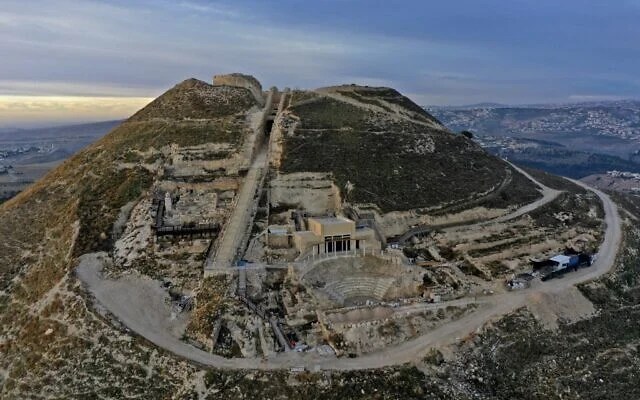
Last week, on a beautiful June night, I found myself in the eastern Judean desert, not far from Bethlehem, at the foot of ancient Herodium, a lavish palace built by King Herod between 23 and 15 BCE. Herod was a widely despised, Roman-appointed client king of Israel, Jewish in name only, who displaced the Hasmonean dynasty. The Hasmoneans, descendants of the Maccabees, had won Jewish self-rule a century earlier, a victory still celebrated each year at Chanukah. Herod’s tyrannical, paranoid reign ended in the murder of his own wives and children. He was also an ambitious builder, and many of his grand projects still punctuate the landscape of modern Israel: Masada, the Tomb of the Patriarchs in Hebron, and most prominently his expanded Temple Mount, including the Western Wall.
Aerial View of Herodium Fortress (Source: Menahem Kahana/ AFP )
The fortress looms above the surrounding desert for miles. It was my first time visiting, and while the winding, unfamiliar drive there was a bit stress-inducing, the moment I first glimpsed the site from afar, it took my breath away. Herod demanded a fortress so grand it could be seen from Jerusalem, and the terraformed desert mountain remains a masterful feat of engineering. Efforts are now underway to make the site, located in a politically sensitive area, accessible to the broader public. The evening was the kickoff to an academic conference on Israeli heritage in Judea and Samaria. Present were archaeologists, political figures, and US Ambassador to Israel Mike Huckabee, who was presented with a special award by the Ministry of Heritage. At the entrance, we were greeted by a recreated period marketplace, complete with actors dressed as Roman legionnaires scuffling with Israelite locals, a role which I suppose included the rest of us too. An illuminated theater had been erected inside the massive ancient pool Herod once, inexplicably, managed to fill with water in the middle of the desert. As the stars came out, we sat for an original production titled “Herod vs. Bar Kochba: The Battle for Eternity.”

A sense of the scene (note the looming mound of Herodium on the right)
Bar Kochba was a Jewish guerilla leader who led a three-year revolt against Roman occupation in Judea, seventy years after Rome destroyed the renovated Second Temple, another Herodian project and the catastrophe still mourned each year on the fast of Tisha B’Av. The play follows a young Jewish rebel, his wife, and son, camped out at a Herodium that has by then fallen into disrepair. Recent excavations at the site have in fact uncovered a trove of Bar Kochba-era coins; I was handed a replica of one at the event. As the rebels onstage dig tunnels, ration water, and prepare for battle, they are visited by the ghost of Herod, who still haunts his beloved palace. He mocks their devotion to Jewish sovereignty, a doomed cause, he insists, even a century after his own death, given the strength of Rome. Herod argues for compromise and accommodation – you are all headed towards death (forgive my paraphrase, I didn’t think to record at the time). Herod tells them: “Choose life, choose prosperity.” All that is needed, he suggests, is to submit to Roman rule, pay their taxes, and allow a few of their gods and statues into the Jewish holy places. The rebels are unconvinced. They are willing to die at Roman hands not because they love death, but because they are playing a longer game. “Perhaps it will be a few years, perhaps a thousand,” the mother tells her son, “but one day we will march back into Jerusalem and worship our God.”
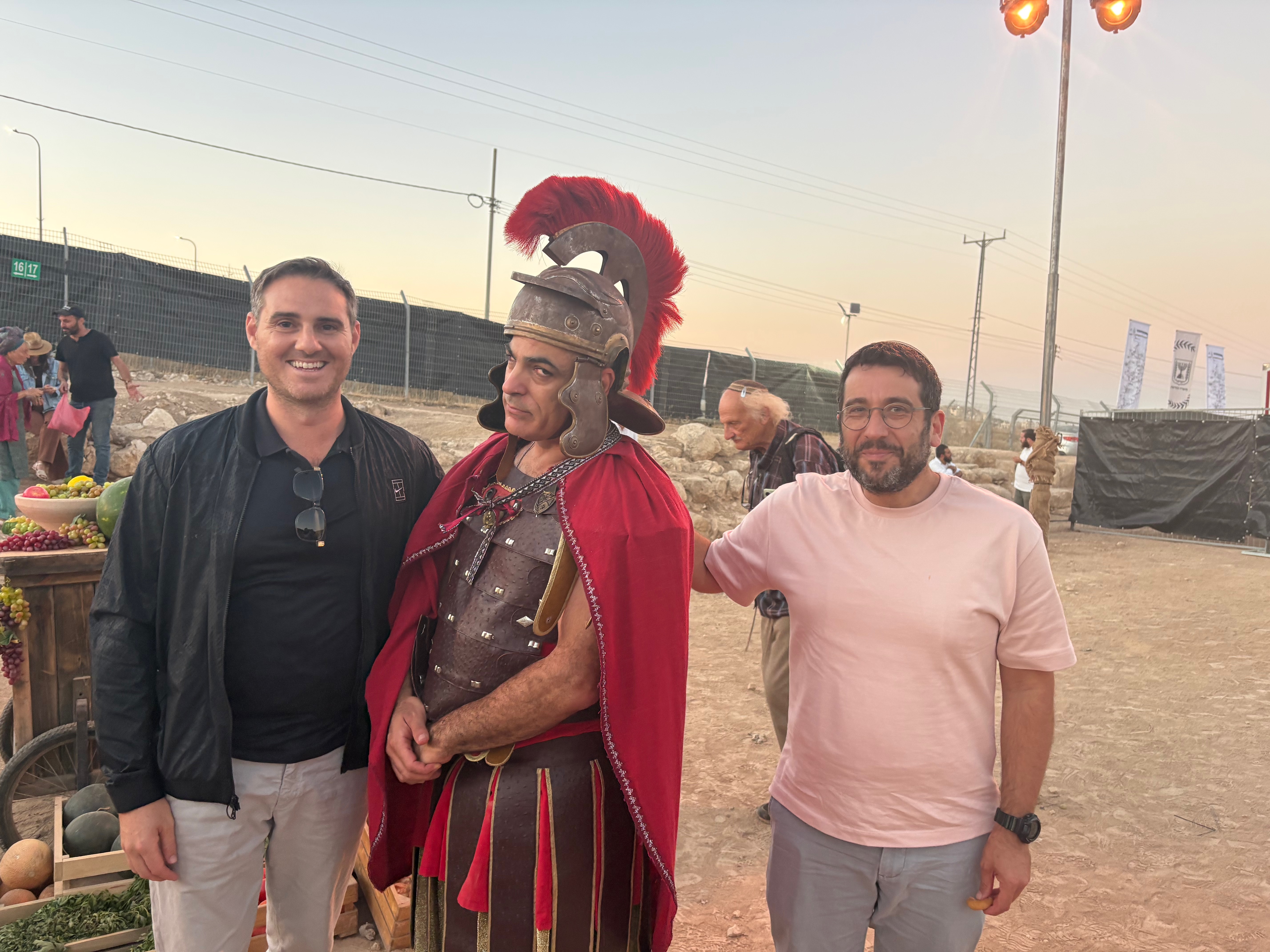
Roman Legionary Deigns to Take a Photo With the Israelite Riff-Raff
The play then shifts into an ahistorical debate between Herod and Bar Kochba themselves. Herod, played to perfection by the legendary Israeli actor Shuli Rand, makes the (correct) case that modern Israel is no direct heir to Bar Kochba’s fanatical legacy. “Look around you,” he says. “You’re sitting in a theater. Who brought theater to ancient Israel? Do you love culture? Wine? Good food?” These are not the tastes of single-minded desert warriors. Bar Kochba counters that modern Israelis may indeed enjoy a comfortable life, but when crisis strikes, as it did on October 7th, they will fight to their last breath for their people and their land. Bar Kochba himself left little behind. No children, no followers, nothing approaching the scale of what Herod built. His revolt’s brutal defeat left hundreds of thousands of Jewish civilians dead or enslaved. Rome expelled the Jews from Jerusalem, renamed the city Aelia Capitolina, and rebranded the province itself Syria Palaestina, scrubbing Judaea from the map entirely. But the play’s argument is that the fighting spirit that Bar Kochba drew on persists in the modern state regardless, a key part of its ethos from its founding to today.
Each member of the large audience was given a copy, in Hebrew translation, of Barry Strauss’s excellent new book, Jews vs. Rome. The book supplies more nuance than any play could, making a convincing case that the two-hundred-year Jewish struggle against Rome, a struggle with an outsized influence on both Rabbinic and Christian tradition, cannot be separated from the larger contest between empires playing out at the same time, namely between Rome and Parthia, heir to the Persian empire. No small nation in the Mediterranean basin could survive in that era without aligning with one power or the other, and the Jews knew this as well as anyone. Strauss argues that the revolt against Rome was also a desperate, ultimately futile bid to draw Parthian intervention to the Jewish cause.
The timing felt almost too fitting. That same morning, at the G7 summit in France, Trump had defended a newly signed Memorandum of Understanding with Iran, located more or less where Parthia once stood. The MOU calls for a sixty-day ceasefire, during which the US would release significant funds to Tehran, and involves the Iranians trying to bolt-on an Israeli ceasefire in its war against Hezbollah in Lebanon. The MOU was met with disappointment, to put it mildly, by many Israelis who had hoped for a more decisive outcome, not to mention concern that it will limit Israel’s existential struggle against Iran’s proxies. President Trump, in an attempt to push the MOU forward, voiced some criticism of recent Israeli military action in Lebanon, adding: “Without the United States there would be no Israel, without me there would be no Israel.” Trump’s claim here is characteristically over-the-top. Yet some 1,900 years after Judea’s doomed insurgencies against Rome, we are reminded once again of the painful necessity, for a small nation, of relying on a great power ally.
However, the United States is no Roman Empire, and as the evening at Herodium testified, Jewish life is flourishing across the Land of Israel and increasingly taking on a confident, nationalistic character. Three years into a war launched by the October 7th massacre, our strategic position is far stronger, our enemies considerably weakened, and the shekel is soaring (much to the frustration of American expats still earning in dollars). Modern Israeli culture has reclaimed figures like Bar Kochba and Shimon Bar Giora, who led the Zealots in the earlier Great Revolt, despite their crushing defeats at Roman hands. They represent a spirit of Jewish agency and independence that still underlies many of Israel’s great military and cultural achievements. Strauss, in his book, quotes Churchill’s line after a 1940 war cabinet meeting: “Nations that go down fighting rise again, but those who surrender tamely are finished.”
It was against this backdrop, both contemporary and ancient, that I especially appreciated Ambassador Huckabee’s remarks when he accepted his award. He spoke twice that night, once in a smaller, filmed setting that has since been clipped and mocked by Tucker Carlson and others with little sense of the context in which it was deliveed. But in his similar, full remarks before an audience of more than a thousand, Huckabee noted that the United States is approaching the 250th anniversary of its independence this July 4th, a milestone that might seem almost laughable set against 3,800 years of Jewish history in this land. “To you, we’re mere children,” he said. “You’ve been around a lot longer, and your history is not only your history, but I want to say this, and I hope you understand, your history is also our history.” He went on: “Without you and your history, and your preserving God’s purpose and God’s law, there would never be Western civilization. There would never be an America, because America was founded on the principles that were established right here in this land all those many thousands of years ago.” Many read Huckabee’s words as a direct answer to Trump’s comments earlier that day. His message was that Israel owes real gratitude to its current great power patron, the United States. But the United States, rooted as it is in biblical values, is itself a kind of outgrowth of the Jewish struggle against Rome that played out nineteen centuries ago. That struggle was the crucible from which both Rabbinic Judaism and Christianity were born.
In making this case, Huckabee charts a third way, distinct from the two offered onstage that night. It is not Herod’s path, accommodation purchased through submission and the gradual erosion of what makes a people distinct. Nor is it pure Bar Kochba – righteous rebellion that goes down fighting, in flames. Huckabee’s third way is partnership felt as kinship, a great power and a small nation bound not merely by shared interest but by shared inheritance. America’s strength flows from values Israel gave the world long before America existed to receive them. It is a relationship that asks Israel to feel gratitude without shame, and asks America to remember that the debt runs both ways. Driving home that night, I watched Herodium recede in the rearview mirror, its massive dome holding the dark a little longer than everything around it before finally sinking under the horizon. Herod built it to be seen from Jerusalem. Two thousand years later, it is still a fixed point in an old argument about what is needed for a nation, and the set of ideas it embodies, to fulfill its destiny.
Also published on Substack, if you’re new to my work please considering subscribing!

