Out of the Sky

“To be a Zionist in 1944, or indeed at any point before the state of Israel is created, requires tremendous imagination, which is why the movement draws mainly the literary and the desperate.”

This review was published in this week’s Jewish Journal

Hannah Senesh occupies a unique place in Israeli history and memory. Only 19 years old on the eve of World War II, she left her hometown of Budapest to build the land of Israel with her young Zionist peers. At 23, she made the inconceivable choice to parachute back into Nazi-occupied Europe. The mission ultimately failed in its stated purpose and resulted in Senesh’s execution. But it left the fledgling Jewish State with a national hero, whose poetry and diary entries still reverberate today. Senesh wasn’t alone, she was one among a small group of Jewish members of the yishuv who donned British army uniforms in an implausible bid to try to save Jewish lives from the German killing machine, often their own families included. A few of these figures, such as Enzo Sereni and Haviva Reik, also entered the national consciousness, with streets and settlements named in their honor. Others are less well-known. For a story that is this iconic, one would imagine that its details would be more or less widely understood. Yet as Matti Friedman demonstrates in his riveting new book “Out of the Sky,” one of Israel’s greatest legends is also riddled with mysteries and open questions.

The heroic operation was the result of a collaboration between the fledgling Jewish army, the Haganah and British intelligence. The idea, at least as the British understood it, was for a group of Jewish men and women, almost all of them recent refugees from Europe, to join the British army and leverage their skill in their native languages in order to assist British POWs and local resistance fighters behind enemy lines. On the Jewish end, motivations were more multifaceted. The Jewish conscripts sought British military training, which would help them when the time came for their own inevitable war of independence. Even more so, they desperately wanted to try to help the Jewish communities of Europe in some way. A total of 250 men and women were recruited to take part in this unusual mission, but only 37 of them completed the training. Of this number, 12 were captured and seven did not make it home.

Friedman lays out the extent to which this improbable mission, rooted in the loftiest ideals, never really had a chance of succeeding. Firstly, by the time it took place in 1944, most Jews in Europe had already been murdered. No allied powers, including the British commanders overseeing this secret mission, seemed to prioritize saving their lives. Even the safety of the Jewish volunteers was not viewed as urgent. Enzo Sereni, the brilliant Italian Labor Zionist and polymath, who Ben-Gurion tried to prevent from jumping because “there wasn’t another man like him,” was carelessly dropped atop a German army installation in Northern Italy.  As Friedman notes in an interesting aside, the Mossad unit operating out of Istanbul at the time had been infiltrated by German double agents, who likely knew about the parachutists’ missions before they even landed.

A visitor could walk through the entire Hannah Senesh House in Sdot Yam — a beautifully renovated museum in the kibbutz where she lived for two years before setting out on her perilous mission — without seeing any mention of a seemingly important fact: that her mission was doomed from the start. Yet Friedman’s aim is not to diminish Senesh’s extraordinary bravery, or that of her fellow operatives. Rather, he seeks to understand their courage in a new light.

In recent years, Friedman has become one of the most compelling English-language chroniclers of Israeli history and society. What distinguishes his work — whether he is examining the brilliant letters of a young Israeli soldier on a Lebanese outpost or recounting Leonard Cohen’s sojourn in Israel after the Yom Kippur War — is his tendency to frame Israel’s turbulent history through a literary lens. While the canon of modern Hebrew wartime literature remains relatively sparse — perhaps because most writers keep their distance from the battlefield — Israel has never lacked for fighters with poetic souls in the state’s early years or today.

Throughout the book, Friedman explores the intellectual worlds of his unusually thoughtful protagonists, suggesting that “if they showed up at a military recruiting office now, they’d probably be turned away.” Senesh, the daughter of a well-known Hungarian-Jewish playwright, dreamed of following in her father’s footsteps and wrote poems of startling quality as early as age 15. Sereni held a Ph.D. in philosophy from the University of Rome. Friedman recounts how, in addition to having already written a novel and novella, he dreamed of writing a great Italian novel which would depict the conflicts and controversies of his time through the lens of his own Jewish family.

In this sense both Senesh and Sereni follow in the path of other great Zionist leaders, like Herzl and Jabotinsky, who began their careers as journalists and writers of fiction, eventually putting aside their universalistic literary ambitions for the more particularistic cause of Jewish sovereignty. Friedman makes the terrific observation that this is no coincidence: “To be a Zionist in 1944, or indeed at any point before the state of Israel is created, requires tremendous imagination, which is why the movement draws mainly the literary and the desperate.”

Part of the book’s premise is that the exquisite literary sensibilities of these proto-Israeli heroes helps explain why they made the jump. Friedman writes: “The parachutists aren’t commandos. They’re storytellers. They’ve been sent to write, with their lives, a Zionist story about the war – a story that will lead others not to despair but to action.” Senesh’s military achievements may have been miniscule – hardly any time passed from the beginning of her mission until her execution in a Hungarian prison, only three months before liberation.

Yet we remember Senesh because of her literary achievements: among them the diary she wrote vividly portraying her transition from a precocious, assimilated 13-year-old girl into a fervent Zionist activist. At every major juncture in her short life Senesh seemed to find the time to quickly craft a phenomenal poem. She handed her fellow fighter “blessed is the match consumed in kindling flame” right before entering occupied Hungary. Shortly before her execution she managed to pen a short lyric poem: “I gambled on what mattered most/The dice were cast. I lost.” While Senesh failed in saving other Jews, and even herself, she succeeded in her larger objective. As Friedman summarizes it: “The mission isn’t military, it’s literary, and she’s the best writer.”

In writing “Out of the Sky” — a book equally about a remarkable episode in history as it is the act of crafting and telling stories — Friedman certainly crafts his own. While many fascinating and heretofore little-known stories about Senesh and her fellow parachuters make it into the book, others do not. Friedman leans toward a portrait of Senesh as a clever, cosmopolitan European. He reminds us of her youth and her theatrical family. In her precocious diary entries, Zionism feels like a role she has chosen to play. He clearly admires her heroism but does not exaggerate it. Yet alternative accounts remain.

In his introduction to the first edition of Senesh’s collected writings, Abba Eban wrote, “all the definitions of giant courage come together in Senesh’s life.” Joel Palgi, another parachutist who followed a similar path to Senesh but inexplicably managed to survive, wrote about her in his memoirs as a force of nature, the undisputed leader of their group, fiercely admired by fellow resistance comrades as she transformed from a poet into a fighter. Even the Gestapo, in Palgi’s telling, were in awe of Senesh. He describes the sadistic prison warden who used to visit Senesh’s cell every day to argue about politics. Senesh’s mother Katherine, in her own memoir, describes the mesmerizing power Senesh held over guards and fellow prisoners alike. Children gravitated toward her, fellow prisoners drew strength from Senesh’s whispered encouragement, her Zionist education campaign, and her ingenious secret broadcasts from the window of her cell. One SS guard told Senesh, “I’ve never known a woman as brave as you.”

“Out of the Sky” does not contradict these remarkable testimonies, which contain a whiff of hagiography, though surely have some grounding in truth. It’s not really a book about superheroes, unusual people with uniquely phenomenal qualities who changed the course of history. Rather, it’s a book about regular people, highly intelligent and talented to be sure, who met the challenges of their age with bravery and foresight.  What distinguished them as heroes was that they understood, both in their lives and their deaths, they could contribute to the writing of a story much larger than themselves.

For the original article see this week’s Jewish Journal
From Meitzarim to the Strait of Hormuz: Living the Bible in Real Time

On the seventh morning of this past holiday of Passover in Israel I walked gingerly to synagogue, still groggy from a 3:00 am siren, wondering what had come of President Trump’s ultimatum to Iran issued before I turned off my phone for the final day of the holiday. When I arrived, I saw a friend sitting outside with a weary look – common among parents of five young kids who have been jumping off the walls for nearly six weeks at home during a war. Her youngest lay at her feet on his belly whacking a stick into a muddy puddle leftover from the previous day’s rainstorm. “How are you?” I asked, “actually now I’m great!” she smiled, “did you hear the news? There’s been a ceasefire. They opened the Straits of Hormuz.”

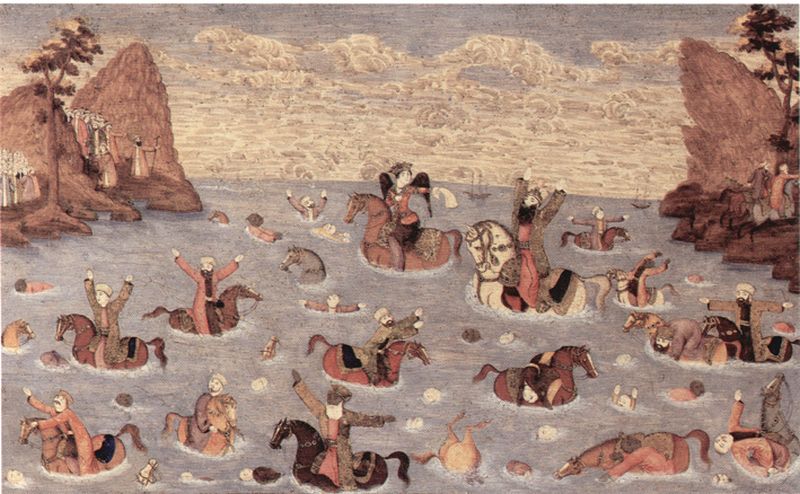
I hadn’t heard, but as I entered the synagogue, the congregation had just risen to hear the Song of the Sea, the chapter of Exodus depicting the splitting of the Red Sea, which is read on the final day of Passover each year when our tradition believes the event took place. Of course, I thought, Trump’s warning had to be issued on the eve of this miraculous commemoration, of course it involved another body of water being opened up to free passage. Of course, if the ceasefire holds, this would mean that the war had run for a course of 40 days more or less, a time period associated with transformation in the Bible. The Hebrew word for Egypt is “Mitzrayim,” which in Jewish thought is often read as “meitzarim,” or “narrow straits.” Could it just be a coincidence that a Strait is at the center of the current conflict? Even my friend’s toddler with his grubby stick started to take on cosmic significance – a mini Moses raising his staff before the splitting of the sea.

Pharaoh and His Army Drown in the Sea. Isfahan, Iran. 19th Century. Property of the Israel Museum

Personally, I have never been one for modern miracle stories, for Bible codes or hidden predictions embedded in numerical patterns in the Torah. I teach literature, so naturally I love stories and myths. But I understand them as just that, human attempts to find patterns in the world in which we live and imbue it with meaning and significance. Yet, at some point since I moved to Israel, my mindset has begun to shift. There is something about being in a land with so much Biblical significance that makes a person start to feel like she is living in the Bible herself.

Take the start of this recent conflagration with Iran, on the morning of the Shabbat before Purim commonly known as “Shabbat Zachor,” “the Sabbath of Remembering.” On this Shabbat we are required to “remember what Amalek did to you on your journey after you left Egypt” (Deut. 25:17). Amalek has been having a bit of a moment lately in the American anti-semite camp. Despite the fact that the injunction to remember Amalek is mentioned in the same Bible that both Jews and Christians cherish, Tucker Carlson and others have been latching onto it as yet another example of Israeli and Jewish treachery. This despite the straightforward nature of the commandment – to destroy an evil nation that, if given the chance, would gladly murder us first, with a particularly malicious focus on abusing the weak, elderly, infirm, etc. In truth, the commandment to “blot out the memory of Amalek” has never really made it to the rotation of practical commandments for religious Jews. We recall it every year as a kind of symbolic reminder of the limits of moral relativism – that we are commanded to wipe out evil as best as we can.

This past Shabbat Zachor was the most memorable one of my life. Synagogues all around the country closed early as sirens rang out, and it was clear that most Israeli Jews would not be able to hear the biblically mandated passage read aloud from a Torah scroll in its proper context. In my case, word got out that it was going to be read on a nearby street corner, and at noon sharp dozens of neighbors emerged from their homes and safe rooms as if out of nowhere. Just as the Torah reader unfurled his scroll and began to chant, an early missile warning rang out. I assumed everyone would run home but one older man shouted “just keep going,” and the biblical verses were read out in a clear and precise fashion. Upon completion, the actual oncoming missile siren blared and everyone listening disappeared almost as suddenly as they had emerged. Later that evening we would discover the improbable news that the Iranian supreme leader Ali Khamenei and his senior leadership had been killed that same morning by an Israeli strike. Of course, this occurred right around the same time Zachor is normally read in synagogue.

The Purim which followed was a constrained one as the war with Iran increased in intensity and rockets rained down all across Israel. Celebrations were cancelled, public readings of the Scroll of Esther were curtailed, children across the country were devastated that they would not be able to show off their costumes to their teachers and friends. Purim in the Bible takes place not in the Land of Israel but in Persia, the ancient forerunner of Iran. Purim celebrates the improbable overturning of the plot of Haman, the evil advisor to the Persian King Ahashverosh, to destroy the Jewish people. The catchphrase of the holiday is “v’nahafoch hu,” “and it was reversed.” And indeed, what we experienced was the great reversal of a terrible lot that had been cast against the Jews by the neo-Persian Islamist empire. Decades of Iranian sponsored terrorism, money and training funneled to Hamas and Hezbollah and other terror groups, all for the purpose of strangling Israel and murdering its Jews. Finally, our fortunes were reversed, thanks in significant part to the assistance of a great world power and friend (Esther and Mordechai didn’t do it alone either). Now, the sovereign Jewish state directed and influenced the sort of situation in which we previously found ourselves the victim.

One Funny Meme Among Many

Since we were stuck inside for a great deal of that Purim, humorous memes circulated like wildfire. Khamenei contains the same letters as Haman, Trump likened to Ahashverosh (in addition to his relative Cyrus the Great), Benjamin Netanyahu to the righteous Mordechai (who the Bible says is from the tribe of Benjamin). Who then is Esther? Ivanka Trump? Miriam Adelson? At a certain point the analogies turned into Purim parody but no one could doubt that something remarkable was happening. Legends of the past were turning into reality, past and present mingling. One friend said “Purim may have been cancelled but this was the truest Purim we’ve ever had.”

For many of us, these feelings have been gestating since the breakout of October 7th, for some of us even longer. While Hamas chose the timing of their assault to coincide with the Jewish holiday of Simchat Torah, it was left to us to parse the significance of it occurring at the climax of the Jewish holiday and yearly Torah reading cycle. Precisely two years later, the anticipation toward the freeing of the final batch of hostages during Sukkot, also known by its Rabbinic name “the time of our joy,” made for one of the most joyous Sukkot celebrations many of us have ever experienced. This idea isn’t a new one in Judaism. The requirement to remember the Exodus from Egypt is a case in point. We don’t only remember the details of the story, or relay the miracles wrought by God. At the Passover seder we say, “in every generation, a person is obligated to see himself as if he has personally left Egypt.” Jewish tradition supposes a kind of reliving, not only a remembering, of the events of the Bible in every subsequent generation.

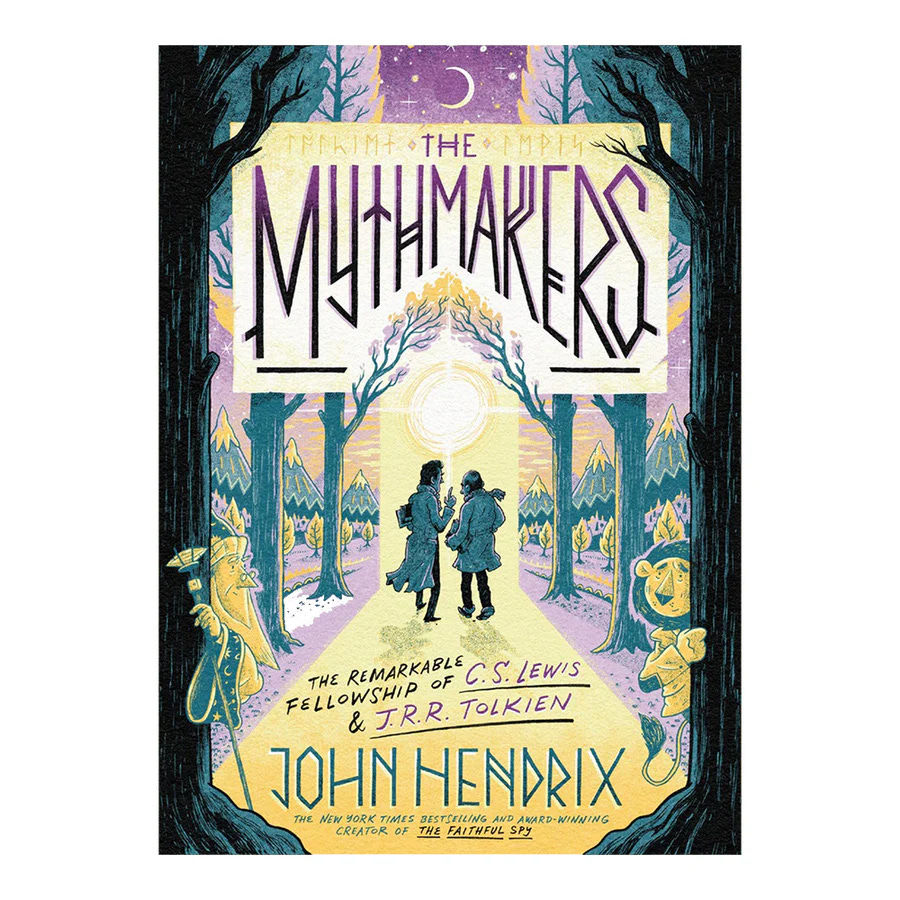
This past year I bought my myth and fantasy loving son a beautiful book called The Mythmakers, a graphic novel by John Hendrix which depicts the famed literary friendship of C.S. Lewis and J.R.R. Tolkien. The book aims, among other things, to get to the heart of what myth is – stories for which the category of “fact” or “fiction” is irrelevant because they explore the way a culture understands itself and its history. A true myth, the book’s wise Gandalf-line narrator explains, “takes place in a ‘time out of time’ and a ‘place out of place’ – separated from our reachable world.” This is part of the magic of myth, that something so completely distant and foreign can also feel so incredibly familiar. The book contains an entertaining visual romp through examples of ancient myths that include among them the book of Genesis and Jonath and the Whale.

What I’ve realized, I suppose, after the events of the last few years, is that moving to Israel means that the events of the Bible stop being myths and start to be something else, maybe something closer to prophecy – or a blueprint, a pattern, for the world we live in. This is different from the relationship that Jews outside of Israel have to the weekly Torah portion, which they read, find personal connections in, or use to generate a wise insight that connects to life in some meaningful way. That sort of reading treats the text essentially as myth, even if you happen to believe the myth is true even on a literal level. What’s going on now in Israel is actually a bit more prosaic than myth, maybe even less intellectually exciting. We don’t need to perform convoluted hermeneutic somersaults to see the connections between the Jewish story here in Israel and our foundational texts – rather the connection is simple and palpable. As sophisticated readers, we shouldn’t need the current war against Iran to be completely geographically aligned with our ancient Persian struggle in order to draw parallels (though it happens to be). The terrorists of Hamas don’t have to be actually located in ancient Philistine territory in order to be associated with those enemies (though they are). They don’t have to voluntarily call themselves Palestinians in order to recall those bloodthirsty adversaries of the biblical Israelites (though they do). We know how to read texts and draw subtle inferences, create complicated analogies, and find meaning where it isn’t obvious. But what is there to say when the parallels are so simple and present?

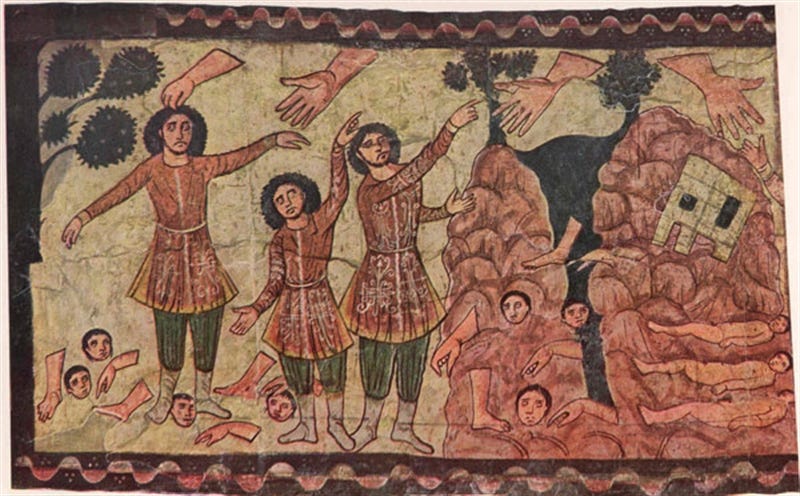
Another Biblical text we read over the Passover holiday is Ezekiel 37, the vision of the dry bones. The vision takes place after the first destruction of the Jewish temple, when the Jewish people are in the Babylonian exile. God places the prophet Ezekiel in a valley full of bones and asks him “O human being, can these bones live again.” We all know the answer, on a symbolic level. Old ideas can be refreshed; a once vanquished people can be reborn. Ezekiel probably has a sense of where God is going with this and starts prophesying. In the midst of his prophecy he is startled by a strange sound, “suddenly there was a sound of rattling, and the bones came together, bone to matching bone.” To Ezekiel’s surprise this rich and literary parable has taken a literal turn: the breath of God enters the bones and they actually come to life. God does not say “as if.” He tells the people of Israel: “I will put my breath into you and you shall live again, and I will set you upon your own soil.”

Ezekiel Sees the Dry Bones (Dura Europos Synagogue, 244 CE)

The nice thing about myth is that, with enough exposure, you learn to read between the lines- to recognize where a narrative is heading and what it asks of us. Living the story in medias res (in the middle of things) is never as clear. Does this current ceasefire spell some kind of meaningful turning point for the Jewish people or is it just one pause in a long grind of missiles and war? Which of today’s leaders, like an aging and delusional Saul, is nearing his end—and who, if anyone, might emerge as a Davidic alternative? Living the Bible in real time doesn’t give us unique prophetic access to what the future holds. It doesn’t immunize us from mistakes, nor does it make our pain or grief over loss any less acute. But it assures us that what’s taking place now is far from random: that God’s magnificent plan for the Jewish people is still unfolding, and that the center of the Jewish story remains where it’s always been, here in the Land of Israel.