Last week when President Trump announced his intention to clean out and rebuild the Gaza Strip, I don’t think I was alone in feeling something I had not felt in a long time. It was not the elation of giving it to ones enemies, or the smug satisfaction of political validation. It was a rather fragile feeling, somewhat tentative, one might even say naive. Throughout the war we have experienced crushing blows but also astounding, miraculous, successes. Yet in these victories there is often a cyclical dynamic: we conquer territory only to withdraw weeks later, we kill terrorists only for their ranks to be replenished by a seemingly infinite supply of hateful young jihadists. Even our genuine exhilaration at the return of a few of our hostages is marred by our fear of what’s to come from from the murderous and unrepentant terrorists who are being released in turn. As always, we trust in God and our military and wish for the best, but common sense tells us that, in good measure, the problems we face today aren’t going anyway time soon.
For real hope to blossom, we need to understand that change is on the horizon. Trump’s proposal, whether or not its likely to materialize, offers a rare vision that could potentially break the cycle in which we find ourselves. I was therefore surprised to notice a few American Rabbis and “Jewish professionals” pontificating on the matter with critical accusations of ethnic cleansing and the like. On second thought I suppose it’s not that surprising. Only someone who is not particularly starved for hope could look such a gift horse in the mouth. If Trump’s Gaza proposal leaves you ethically outraged, or even indifferent, this simply demonstrates your own removal from the pit of despair in which Israelis find ourselves since October 7th. In the days following his announcement, I have not spoken to any Israeli, on the right or the left, who does not feel just a little bit hopeful, or at least tickled, that a world leader finally has the courage to propose a way out of our current morass.
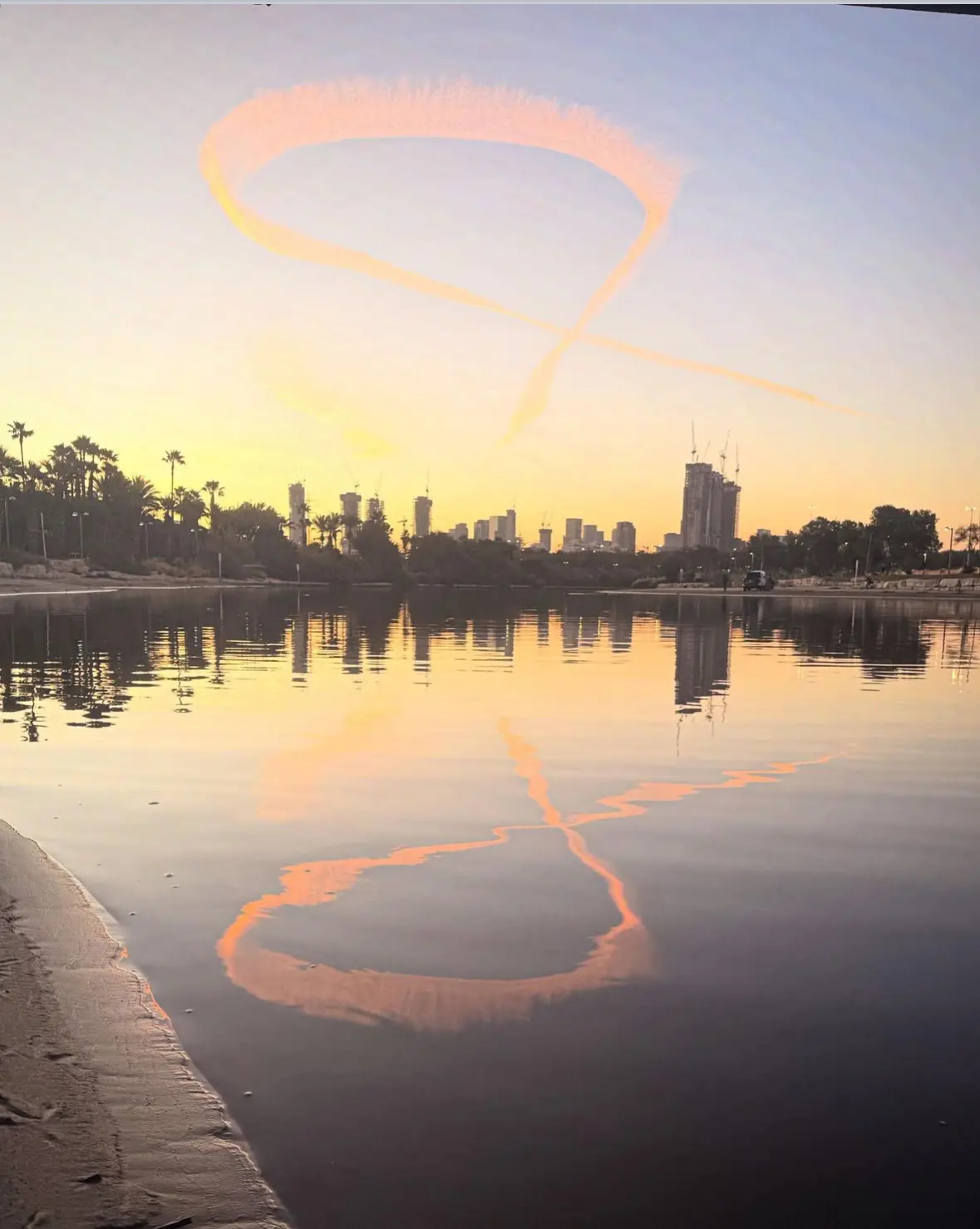
I don’t know if it is providence or simply an all-knowing algorithm, but last week a new song popped into my Spotify playlist called “Ribbon of Hope,” “Chut shel Tikvah,” written by the popular Israeli singer-songwriter Aaron Razel and his wife Efrat. The song was actually composed about a year ago, around the time of the first hostage release, when Razel and his wife were enjoying a beautiful day together on the Tel Aviv boardwalk. I understand those kinds of days as I’ve experienced many of them myself since October 7th. A lovely day when you have the chance to appreciate the beauty and wonder of daily life in Israel, with the sickening knowledge that all around us families are grieving, soldiers are fighting for their lives (and ours) on the battlefield and that dozens of our brethren are wasting away in the depths of Hamas torture dens. Yet this day was different, as Razel sings, there was a sense that something monumental is about to change.
Soon the gates will open
and soon
the sun will rise again
the wild flowers will fill the fields
with colors anew
until they do
we won’t forget the pain.
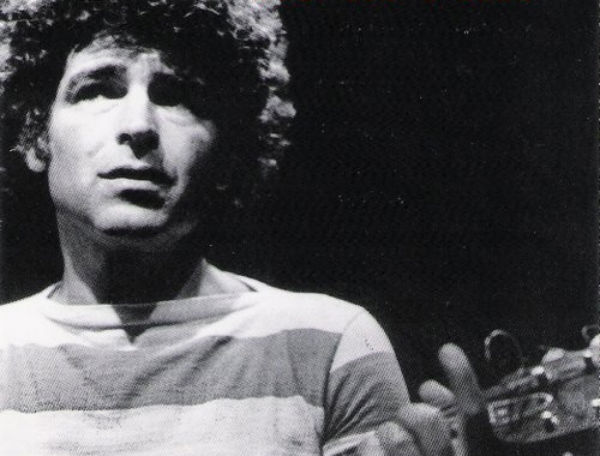
The song has a kind of 1960s, folksy feel, amplified by harmonica interludes by the famous Israeli musician Ehud Banai. Although it owes a debt to peace anthems from the past, there’s a difference here, a respect for the necessity of war and also, I think, a kind of underlying ambiguity that is not necessarily apparent on first listen.
Above in the skies
are the voices of war
while in our hearts
we long for comfort
And I, like a captured child
tie to my window
a ribbon of hope
Two allusions here may be familiar to listeners. One is the “ribbon of hope,” which likely references the Book of Joshua’s story of the harlot Rachav, who saves the Israelite spies in Jericho and hangs a red string from her window. Interestingly, in Joshua the Hebrew word tikvah means cord – but hints at the hope that Rachav and her family can ultimately be saved from the wicked society on whose edge they dwell. The ribbon in the song also is reminiscent of the yellow ribbon that has morphed into the ubiquitous symbol of the Israeli hostages imprisoned by Hamas.
The phrase “captured child,” is a translation of “tinok shenishba,” a Rabbinic term that refers to a Jew who was kidnapped by gentiles as a child and as a result cannot be Halakhically held responsible for his lack of Jewish observance. It could be that the Razels chose “tinok shenishba,” just for its associations with innocence and captivity, though I wonder if something else is being suggested here. The term “captured child” is used in Rabbinic literature in reference to sin, it allows us to relieve responsibility from adults who simply don’t know better.
Perhaps some of the implication here is that a certain kind of hope is indeed naive, and perhaps even wrong. We hope and pray for the safe release of our hostages, even if we know that under the current parameters it comes at a cost that is unforgivable. We dream of an end to the war, even if we know that ending it prematurely means passing on the baton to the next generation, that is to our own children and grandchildren. Yellow ribbons have become mixed symbols in our divisive national context. We all long for the return of our hostages alive and in good health. But the cars that sport yellow ribbons often have washed out anti-Bibi bumper stickers as well. Hostage Square is just around the corner from Kaplan Street, and despite many many fine efforts to steer things differently, the Hostages and Missing Families Forum is hopelessly politicized and pointed often in the precise direction of its potential allies.
Finding shared sources of hope and consolation in this environment can be challenging. Which perhaps is why the Razels chose to newly rededicate the song to Agam Berger, a 19 year old observation soldier and gifted violinist who was released in a recent prisoner exchange. Reports about Agam have captivated the Israeli public since they filtered out after the first hostage deal, how she refused to eat unkosher meat or clean or cook for her captors on Shabbat, how she lovingly braided the hair of female hostages before they were released, even though she was forced to remain. Her first message to the world upon her release (in exchange for 50 craven terrorists) was “I chose the path of faith and in the path of faith I returned.”
Amidst all the protests, uproar at the Knesset, burning trashcans on the Ayalon, we are presented with the image of one brave young woman clinging to her faith, using it to hold up herself and others, and in doing so uplifting her nation as well. This also is a version of hope because it presents us with another path. If the hostage crisis has been used as yet another wedge to pointlessly drive us apart, perhaps the purity and heroism of these individuals can also help us find a way to move forward together.
The new addition of the song includes an added stanza that honors Agam. The line “who is this coming up from the desert” is a quote from the Song of Songs, and can just as easily be applied to the Jewish people leaving their Egyptian captivity. In the song it also refers to Agam:
And I ask
who is she
who is she
who rises up out of the desert
And I hear
I am she
I am she
clear as a lake (agam) of rivers.
Both Agam the person and also the sparkling water imagery with which she is associated, adds the presence of something refreshing and new. A new shot at national unity, at spiritual consciousness, and for her and her family, a new chance at life – it is not a coincidence that the Hebrew words mikvah and tikvah are related. And now, “on the horizon/ are days of hope/the waves whisper their faith.”
Personally I don’t know anything about what the coming years, months, or even days will bring. None of us do. But we can be grateful for the mere chance to be a teeny bit closer to breaking away from a rotten paradigm that has brought so much bloodshed and destruction – toward something new, “rising up from the desert.” Maybe things won’t exactly pan out in the way that the American president, and all of us, dream (there may also be some differences there). As for me, I’m still going to cling to ribbons of hope.
It was an honor to review Koren Press’s outstanding new book One Day in October for the Jerusalem Post Magazine this past week. While the book is not necessarily “literary” in nature, it is brilliantly written and edited, and moved me in a way that few books have. This piece is actually an abbreviated version of a longer review essay that will hopefully appear in the Jerusalem Report in the coming weeks. Grateful to be part of this “עם של אריות,” “nation of lions,” whose incredible bravery continues to exhibit itself each and every day.
The upcoming holiday of Shavuot evokes the receiving of the Torah on Har Sinai, flowers and greenery, and of course delicious dairy food. It is also the holiday of “malkhut,” or kingship, when we read the book of Ruth, which recounts the backstory behind the emergence of the royal house of David. Shavuot is the culmination of 49 days of counting the Omer, a seasonal agricultural offering in the Temple wherein each week of seven weeks is categorized by one of the Kabbalistic “sefirot”. The final one of these sefirot is Malkhut, described by the Zohar as “having nothing of her own.” Notwithstanding its connotations of royalty, Malkhut is understood to be a void that receives all of the preceding weeks’ sefirot. While Passover celebrates the miracle of liberation from Egypt, Shavuot emphasizes groundedness in the Land of Israel. In contrast to hastily baked matzot, Shavuot features the wheat harvest and the bread and first fruits (“bikkurim”) offerings in the Temple. Its theme of malkhut prompts us to think about the nature of leadership in our own time – that which we have and that which we lack. It prompts us to question what true kingship might look like in a modern era.
In the early days after October 7th, for many of us here in Israel, our feelings of shock, horror and grief were also accompanied by a sense of having been set adrift. With greater urgency than ever, we asked- the question of who, if anyone, was steering our national ship. One didn’t have to be a member of the anti-Bibi camp to feel that our leadership had failed us. Moreover, it wasn’t clear who, if anyone, might be able to lead us out of this morass. A friend commented that “this was the first time in my life that I realized we had a problem that even a group of the most brilliant Jews in the world together in a room couldn’t solve.” In the months since the massacre, these questions have in many ways been exacerbated, as Israel finds itself mired in an even deeper set of conflicts – balancing international pressure with achieving its military goals in Gaza and of course the question of how best to go about retrieving the hostages, to the extent that our efforts may yield any fruits at all. It’s not that these issues don’t have solutions per se, it’s that the leaders needed to implement these solutions, who can rally their nation, unify factions, leverage diplomatic relationships, inspire trust and move forward with confidence, often seem to be missing from the room.
Counterintuitively, as our politicians continue to bicker and the international picture looks bleaker by the day, we find ourselves surrounded by heroes. It wasn’t only the countless tales of heroism from the day itself: the brothers Elhanan Hy”d and Menahem Kalmanson who jumped into their cars on October 7 and drove from the settlement of Otniel to battle terrorists and evacuate dozens of survivors of kibbutz border communities. Aner Shapira Hy”d, who caught and threw back seven explosive grenades while hiding in a shelter near Re’im with two dozen others until he was killed by the eighth. Or Amit Mann Hy”d, the paramedic with an angelic voice who was killed treating patients in the makeshift clinic she refused to abandon in Be’eri on that day. In December of this year, Hanukkah time, the singer Ruchama ben Yosef released a wonderful song called “VaYehi Or,” “Let There be Light,” where she addresses the theological implications of October 7th for a person of faith: “a great miracle did not occur, we did not find the jar of oil.” Instead of discovering a miracle from above, ben Yosef sings, “we discovered ourselves.”
News reports out of Israel are, more often than not, depressing. Yet the closer in you stand to events the more you can see how in many ways the days since October 7th have demonstrated a national love affair with our soldiers. These young men and women, representatives of every single sector of Israeli society, jumped into action on October 7th and have not since stopped sacrificing to protect our beloved country. Included in this category are their families who also sacrifice and in the most tragic cases mourn, all also in the name of duty to our country and nation. Israeli civil society has also been roused into activity, supporting the many populations left vulnerable by the ongoing threats from Hamas and Hezbollah. When you evaluate it top-down, the picture in Israel does not look great. But from the bottom-up we have a society that continues to be strong, resilient and for the most part united.
This dichotomy is one that we have seen before in Jewish history, and it is nowhere better exemplified than in the book of Ruth. Ruth is a story about two brave women who transcend tragic circumstances in order to make a lasting contribution to the Jewish people. The Book of Ruth is also, as mentioned above, a story of malkhut. It depicts the transition from the Book of Judges, wherein centralized leadership is lacking – “in those days there was no king in Israel, everyone did as he pleased” – to the Book of Samuel, which depicts the beginning of the Davidic Monarchy.
In his wonderful book Rising Moon (previously reviewed here) Rabbi Moshe Miller explores the nature of malkhut as it manifests itself in the Book of Ruth. True kingship, according to Miller, is not the exercise of power by a single individual. “Rather,” he writes, “it must emerge from society in ways that are infinitely complex, entirely unpredictable, and almost impossible to trace.” Miller suggests that the best way to understand malkhut is by drawing on the philosophical and scientific category of “emergence,” which describes complex systems, like beehives or ant colonies, that are not reducible to the sum of their parts:
“Individual bees or ants are incapable of functioning alone; they cannot reproduce; they cannot find food. They exist only as units within a larger whole. Put these units together, and suddenly, as if by magic, they begin differentiating, each individual performing a specific task according to the needs of the integrated system, the super-organism. When a hive attacks a person, it comes after him like a single organism; when ants go on a march, their relentless miles-long movement is that of a unified power, an army. Malkhut is the name we use to describe a system in which components work synergistically to produce a whole that is greater than its components.”
Miller points to the statement in the Talmud, Bava Batra 15B, “Whoever says that Malkhat Sheva (lit. Queen of Sheba) refers to a woman is mistaken. Rather it means the Kingdom of Sheba.” The implication here is that malkhut does not refer to the reign of an individual king or queen, rather, malkhut is what enables a nation to act in a united and cohesive fashion.
This particular vision of kingship as a kind of emergent collective phenomenon is not necessarily characteristic of the institution and reign of historical kings generally, or even in Israel in particular. Not every melekh represents malkhut in this sense of the word. The reign of Israel’s first king Saul, for example, was initiated by the urging of a frustrated nation, tired of Philistine abuse, against the better instincts of its prophet Samuel. Despite Samuel’s warnings about the potential pitfalls of monarchy the people insist “we must have a king over us, that we may be like all the other nations: Let our king rule over us and go out at our head and fight our battles.” (1 Sam. 8:19-20). Note the language here: to be “like all the other nations” with a top-down authority figure to “fight our battles.” Saul, from the powerful and clannish tribe of Benjamin, is genuinely a remarkable figure – the best ancient Israel has to offer in some ways – and he does end up succeeding in many battles. His great failure is when he spares King Agag of Amalek and his flocks, a lethal combination of misplaced pity and eagerness to draw short term approval from his own troops. Saul is like many leaders we know: genuinely impressive and talented, but ultimately representing a paradigm of leadership that does not emerge organically and thus could not withstand the test of shifting generations.
David the Judean, on the other hand, represents a different model. He emerges, not from a position of prominence, but seemingly out of nowhere. He attracts the admiration of all who encounter him, but he elicits love rather than intimidation. While the first physical description of Saul is that he “was a head taller than anyone else in the nation,” (1 Sam. 9:2) one of our first visual encounters with David is as a miniature shepherd standing up to a giant. David defeats the Philistine ubermensch Goliath without a sword or spear or javelin – for these the Israelites were dependent on Philistine metalsmiths who forbade the transfer of advanced weaponry to the subjected populations of Israel. Instead he attributes his success to God and nothing else. David will also make his own share of mistakes, which are in some ways even more serious than those made by Saul. But his kingship endures because it is not reducible to him as an individual or even the Judeans as a tribe. As a leader he embodies the spirit of his nation. In contrast with Saul, he is the embodiment of the bottom-up form of leadership we see incubating in Israel today. And while a feature of true malkhut is that it seemingly emerges out of the ether, the Bible does provide us with a prequel of sorts, and that is contained in the book of Ruth.
The book of Ruth provides a genealogy for the Davidic line, rooted in the union of Boaz, a wealthy Judean landowner, and Ruth, a Moabite convert. The circumstances in the early verses of the Book of Ruth are rather bleak – they depict famine, intermarriage, and the premature death of Elimelech, the husband of Naomi, and their two sons Machlon and Kilyon. The Rabbis of the Talmud detect another layer of discord in this time period, reading the book’s opening line of “it happened in the days when the judges judged” as “this was a generation that judged its judges” (Bava Batra 15b). That is, even the nominal forms of leadership at this time were unsteady and up for debate. This reading of course evokes the postmodern erosion of institutional authority across the West, or perhaps the recent debates about judicial reform that rocked Israel until more pressing concerns arose. Yet even more evocatively, the context from which Ruth and Naomi emerge is one of grief and suffering. Having lost nearly everything, they leave Moab in a state of poverty and degradation. Naomi urges her daughters-in-law Ruth and Orphah, whom Jewish tradition describes as Moabite princesses, to turn back – “My lot is far more bitter than yours, for the hand of the Lord has struck out against me.” (1:13)
The Book of Ruth records several moments of chesed, lovingkindness, which ultimately serve to transform this situation of atomization and hopelessness into one of transcendence. The first such act is when Ruth chooses, despite their reversal of circumstances, to stand with Naomi: “for where you go, I will go, and where you lodge, I will lodge; your people shall be my people, and your God my God.” (1:16) Ruth’s bravery here, which will ultimately produce the crowning glory of the Jewish people, begins with an act of love for and solidarity with Naomi. Ruth’s behavior forms both a parallel to and contrast with the previous actions of Elimelech who left his ancestral home in order to seek his fortune in Moab. Both figures leave their homelands, but for Elimelech it’s in order to improve his economic situation, whereas Ruth at this point is stepping into the abyss. All she knows is that she stands with Naomi, and this simple, visceral act of loyalty, it turns out, will have more of an impact on the course of Jewish history than the battles and treaties of far more senior figures in positions of leadership.
Next, in the barley fields of Bethlehem, it’s Boaz’s turn to shine. He sees Ruth gleaning on behalf of her mother-in-law, his own distant relative, and is moved by her story, “I have been told of all that you did for your mother-in-law after the death of your husband, how you left your father and mother and the land of your birth and came to a people you had not known before.” (2:11). Boaz makes sure Ruth is treated with dignity and generosity – he even invites her to share a meal. Boaz is willing to forgo the conventional status hierarchies and sees glowing virtue in a person that others are bound to ignore. The fact that this takes place in the grain fields is significant. Whereas as others look up to the skies, or to regents or kings for inspiration, Boaz looks down and it’s there that he finds Ruth, bent to the ground but driven by something noble and profound.
The climactic moment of chesed in the book is one in which it’s not quite clear which character is doing the giving and which is receiving. Ruth, following Naomi’s suggestion, lays at Boaz’s feet in the middle of night and in a position of great vulnerability, asks him to fulfill his role as a “redeeming kinsman.” (3:9) That is, as a relative of Naomi’s, Boaz is asked to marry childless widow Ruth and thus rescue their family name from oblivion. This is complicated by various factors. For one, Ruth is far younger than him, and far lower in stature. She is also a Moabite, a nation whose members Israelites are forbidden to marry by Torah law. Yet Boaz’s reacts to Ruth’s unusual entreaty with gratitude, “Be blessed of the Lord, daughter!” he exclaims, “your latest deed of loyalty is greater than the first.” Like the starry eyed couple at the end of O’ Henry’s famous story “The Gift of the Magi,” the dichotomy between giver and receiver collapses in this nighttime scene. This moment of generosity and the erasure of ego will eventually result in the overturning of a legal paradigm in Ruth’s case. Boaz’s heartfelt antinomianism will ultimately usher in the birth of the David, the beginning of true kingship, which also points toward the eventual messianic age.
So what do these collected moments of chesed have to do with Jewish leadership and with the difficult times we live in today? In all of these cases it’s the loyalty, heroism and ingenuity of regular people, rooted to their land and to each other, that manages to change the course of history. Elimelech and Naomi’s original flight from Bethlehem, the tragic deaths of Elimelech and his sons, Naomi and Ruth’s downward spiral into penury, all of these things should have served to dissolve their family bonds and separate the characters in the book from one another. Instead, something marvelous happens. In their pain they grow closer, and the bonds they build together, some of which existed previously (like Boaz and Naomi’s familial ties) some of which are forged anew, end up forming the matrix from which malkhut will eventually emerge. Still it will take several generations for David to be born. And perhaps, even now, we are only in the early or midway stages of this process of forging a context from which a truly enduring paradigm of Jewish sovereignty, malkhut in its loftiest sense, may emerge.
In recent months, there’s hardly anyone here in Israel who hasn’t been touched by loss. Attending funerals or visiting shiva houses of bereaved families of IDF soldiers, even those we do not personally know, is a new national pastime. We show up to demonstrate that we share in the suffering of these families, we are grateful for the heroism of their sons, husbands and fathers, and we would like to think that maybe one more visitor or attendee might ease their burden just an infinitesimal bit. In such circumstances it’s often difficult to find the right words to say. One of the handful of lines that repeats itself is “we should be worthy of their sacrifice.” It’s possible to interpret this phrase along the lines of what we see in the book of Ruth. When confronted with tragedy that hits too close to home, all of us in a society, not only those directly affected, may take one of two paths. We can sink into feelings of despair and hopelessness, which are, admittedly, justifiable. Or we can use this painful opportunity to strengthen our bonds and form a kind of web that connects us with those we have lost, with each other, and with future generations yet to come. This latter movement characterizes the modality of malkhut, whether it may one day manifest itself in a David-like leader, or whether it’s already manifesting all around us. As Naomi blesses Boaz halfway through the book, “Blessed be he of the Lord, who has not failed in His kindness to the living or to the dead” (2:20). The emergence of malkhut will not bring back those we have lost, but it ensures that their contributions are embedded within a larger living organism that allows them, in a sense, to still be with us.
A moving new rendition of Naomi Shemer’s “Shiro Shel Aba,” sung by the students of Yeshivat Har Etzion high school in memory of their beloved teacher Shai Pizem H”YD who fell in battle in Gaza in December. Note the new additional lyrics added by Rabbi Amichai Gordon and Rabbi Chaim Navon. This is an eloquent expression of the relationship between malkhut and loss that I was trying to articulate above:
“אם בקרב נפלת רע, רע יקר מפז, אם בקרב נפלת רע, רע יקר מפז, לא לשווא אחי נפלת בין נהר לים, כי מן הדמים האלה ייבנה העם ייבנה, ייבנה, ייבנה העם”
If, my friend, you fell in battle – a friend dearer than gold If, my friend, you fell in battle – a friend dearer than gold You did not fall in vain my brother – between river and sea For it is this blood that will build the nation May the Nation be rebuilt May the Nation be rebuilt
Anatoly Kaplan was the rare Jewish artist who managed to explore Jewish themes under the eyes of Soviet censors
My review of a wonderful art exhibit at Beit Avi Chai which appeared in the Fall 2023 Issue of Lubavitch International Magazine was recently posted to the web. The exhibit is called “The Enchanted Artist” and it was a the first major exhibit in Israel devoted to the artwork of Anatoly Kaplan, who according to the curators was “the only artist in the Soviet Union to put Jewish culture at the forefront of his work and to be recognized by the Soviet regime despite that.” Kaplan’s paintings are remarkable for how nimbly they incorporate Jewish themes while evading the Soviet censors, and they are also simply remarkable in their own right. It was a pleasure to learn more about Kaplan and also think about how the pressures that weighed upon Kaplan also drove the evolution of Chabad Lubavitch itself: “In a sense, Chabad’s collective memory and ethos were forged in the crucible of communism, in the midst of immense hardship that led to heroism—the sheer difficulty of Jewish observance driving home its precious necessity.”
“In a gray, dimly lit room, a mother ties a red kerchief atop her daughter’s school dress. Behind them, even more deeply in shadow, sits a bearded man wrapped in a traditional black and white tallit, bent over a prayerbook.
The scene seems innocent enough, and yet, small details hint to the influence of powerful forces beyond the domestic sphere: The red kerchief was an obligatory symbol of membership in the Communist youth movement. The religious man is surrounded by two red curtains, which both serve to frame his figure and also suggest that he may need to hide at a moment’s notice. Even in 1976, when this painting was created by Russian-Jewish artist Anatoly Kaplan, it was nearly impossible to be an observant Jew in the Soviet Union. Like much of Kaplan’s work, Interior draws us into a world of tensions, memories, and contradictions inherent in the experience of Jews in Communist Russia.”
Some reflections on the Simchat Torah Massacre from my own vantage point here in Israel
On a beautiful Thursday during the middle days of Sukkot, my family took a day trip to the Golan Heights. We visited a newly developed national park called Sussita, which contains the ruins of the ancient Graeco-Roman city Hippos. It was also the site of a daring defeat of Syrian troops by ordinary residents of the nearby Kibbutz Ein Gev in Israel’s War of Independence. The site’s vivid explanatory movie had my older children mesmerized, but afterwards they started to ask questions. Are there still enemy soldiers waiting in those hilltops? Could it happen again? Could ordinary people have to fight like that to save their homes and their families? I answered, of course, by reassuring them: we live in different times today. It’s true there are people who wish to harm us but we live in a strong country with many layers of protection between children like you and those enemies. We admire the heroes of the past, but we’re grateful that we don’t have to live in such dramatic times.
On Simchat Torah two days later that reassuring narrative would collapse, and we entered a new reality, or perhaps returned to a very old one…
The full essay can be found in Mosaic Magazine as part of their excellent Gaza War symposium.
“On a bright spring day in a swanky Tel Aviv neighborhood, a handsome man sporting a trim beard and a perfectly perched black yarmulke alights from an expensive SUV. He kisses his beautiful and modestly clad wife, as three smartly dressed yeshiva boys across the street watch, swoon, and dream of similar lives for themselves. “A yeshiva boy who married well?” one suggests. “No, no—he earned it for himself!” his friend explains: After being expelled from a prestigious yeshiva for owning a smartphone, he flew to Rome, camped out for a week on the doorstep of Borsalino headquarters, and earned the right to open the first official Israeli chain of stores for the high-end Italian hatmaker. Although he is too busy earning money to study in yeshiva full time, he still dedicates time every day to study Talmud. “The modern haredi,” the boys say, sighing. “He enjoys both worlds. He has this and yet he also has that!” As they wave to him crossing the street, a large truck comes out of nowhere and plows into him. And so the show’s question remains: Is it really possible to have both this and that?”
Please check out the absolutely wonderful latest issue of Jewish Review of Books for a review of the second season of Shababnikim, a fabulous Israel television series with much more depth than initially meets the eye.
In a new symposium at The Lehrhaus entitled “Reclaiming Torah u-Madda,” I was given the chance to reflect on the state of “Torah U-Madda” (the relationship between Torah and Western culture) in the Modern Orthodox community today. I sought to address this topic on a philosophical level, through an analysis of a wonderful story by Isaac Bashevis Singer, as well as through some “real-world” examples of how these ideas might play out in practice. My latter comments generated more controversy than I would have liked. I would like to emphasize that my account of what has challenged me personally about my native community is not meant to constitute a comprehensive indictment of all that is wrong with Modern Orthodoxy. My goal in the essay is to introduce a philosophical framework and then briefly suggest how this framework might cohere in real-life scenarios. I don’t mind disagreement about the relevance of these scenarios but I am even more interested in discussing the worldview that underlies them.
Please see here for the full article. And I recommend perusing all of the terrific contributions to this forum.
At the height of the coronavirus pandemic last April, when celebrities around the world were lecturing us via tweet to stay home and wear a mask, British novelist J. K. Rowling took a different approach. As kids were forced to forego school and interactions with friends, she published a new children’s book and released it in free installments for families stuck at home. The novel, The Ickabog, was published in full this past Thanksgiving. Proceeds from sales of the book are donated to communities hurt most by COVID-19.
Rowling has said that the Ickabog story first came to her years ago, when her own children were young. She wrote the book during the period in which she wrote the Harry Potter books, and claims to have made no serious modifications since that time. Yet intentionally or not, The Ickabog may be the most serious literary indictment of the mass response to the COVID-19 epidemic published to date.
The cover of JK Rowling’s The Ickabog. This may be a stretch but note the corona (Latin: crown) artfully woven into the book logo.
I bought the book as a gift for my Harry Potter-loving 9-year-old, and first picked it up on the Sabbath after Hannukah. My family had just returned from Jerusalem, where the lack of tourists and the still-considerable virus restrictions cast a pallor on this normally magical time of year. After months of closures, the street vendors of Jaffa and Ben Yehudah streets finally had their Judaica and souvenirs proudly on display, albeit with few takers. Seemingly half of the usually bustling restaurants were temporarily shuttered or closed for good. I wasn’t in the mood to read more of the endless news about the pandemic, so I turned to my son’s Rowling book looking for a light fantasy escape.
“In the last two weeks of seger (lockdown) in Israel, an almost laughably long list of public figures have admitted to violating the Covid-19 lockdown restrictions. Some of them are lawmakers who are themselves directly responsible for initiating the lockdown.”
Earlier this year, our family left a suburban Jewish community in New Jersey that we loved in order to fulfill a dream of making aliyah to Israel. In the years leading up to our move, we frequently discussed the merits and drawbacks of life in Israel versus the US. We discussed matters like the dangers of living in an isolated enclave surrounded by enemy states versus our seemingly comfortable and secure American lives. My husband often pointed out the spiritual dangers of life in the diaspora as well as the potential for established ways of life to degenerate rapidly, even in advanced Western societies. We boarded our aliyah flight against the backdrop of a common web of excitement, anticipation, and doubt.
Once in Israel, however, our commonplace constellation of concerns was complicated, perhaps overshadowed, by a new set of events. A wave of antisemitic incidents in the New York City area in late 2019 left us to glued to American news sources for updates. I grew up in the idyllic religious community of Monsey; in my mind it was the peaceful foil to whatever uncertainty we encountered in Israel. Yet the attack on a local Hanukkah party by a machete-wielding lunatic revealed that this place was hardly immune from hatred and violence. Sitting in Israel with rockets from Gaza falling in the distance, my heart was nevertheless in New York and New Jersey, concerned about family members and friends. I had the stomach-churning sense that the problem was unlikely to dissipate anytime soon….
For the full essay (which includes a discussion of Yehuda Halevi and Yehuda Amichai) see The Lehrhaus.