Parshat Tazria Symposium: Part I, The Midrashic Approach

In April 2015, Congregation Netivot Shalom in Teaneck, NJ hosted a panel discussion on alternative interpretations of the first verses of Parshat Tazria (Leviticus Chapter 12). The panel included Dr. Tammy Jacobowitz, a scholar of Midrash and chair of the Bible department at SAR High School, Dr. Shuli Sandler, a psychoanalyst in private practice, and myself. The discussion was moderated by Rabbi Nati Helfgot. Our shared question was how to approach the difficult section of the “Isha Yoledet,” the woman who gives birth and is obligated to bring a sacrifice (“korban chatat”) to the Tabernacle.

This section is difficult primarily for two reasons. First, it’s unclear why a woman who gives birth would be barred from the Tabernacle and then obligated to bring a korban chatat offering, usually translated as “sin offering,” upon re-entry. What is sinful about giving birth to a child, and must we really consider a miracle such as childbirth to be analogous to other bodily afflictions/emissions that prevent one from approaching the sanctuary? Second, the verses require that a woman who gives birth to a female child remain outside of the Tabernacle for double the amount than she would for a male child. The reason for this discrepancy goes unmentioned.

Rather than try to definitively answer these questions,  the panel suggested three different methodologies for approaching this material, and for approaching the Bible in general. Tammy Jacobowitz looked at this section through a midrashic lens, examining a beautiful midrash from Leviticus Rabbah that reframes this seemingly dry ritual material into a vibrant theological message about God’s place in the childbirth process. Shuli Sandler analyzed this segment with the help of legendary psychoanalytic thinker Donald Winnicott whose views on mother-child bonding immediately after birth involve a necessarily delayed entry into social and communal life. I drew on cultural anthropologist Mary Douglas’s work of Bible analysis Leviticus as Literature to suggest a theory for how the Isha Yoledet, and broader section about ritual impurity that it introduces, may function on a literary level. Taken together, these approaches testify to the multifaceted nature of the Bible, and the value in exercising variegated methodological tools in order to unlock its profound insights.

These three responses will be delivered in two  installments. The Midrashic Response is presented here as Part I of III.

Continue reading “Parshat Tazria Symposium: Part I, The Midrashic Approach” →

“In Your Blood You Shall Live”: Marilynne Robinson and the Jewish Reader

Marilynne Robinson is one of the very few contemporary American novelists to be held in near universal esteem. Her readers have the sense that, as with poetry, not a single word is wasted or extraneous. Additionally, Robinson’s concern with Christianity, unusual in contemporary fiction, also contributes to the rapture that her work inspires. In the tradition of American Protestant poetry, Robinson’s novels don’t simply allude to religious experiences, rather they seek to create such experience for the reader. Robinson’s fiction can open your heart to the possibility of change, of divine grace and redemption. For the Jewish reader, then, encountering Robinson can be a complicated experience.

Lila

However, Jewishly literate readers may actually be positioned to appreciate Robinson’s fourth novel Lila in a way that others would not. Its eponymous heroine is the least Christian character we have encountered thus far in Gilead, the fictional Midwestern town featured in two of Robinson’s prior novels. Lila even goes so far as to call herself a “heathen,” though this does not prevent her from finding strength and solace in the words of the Bible. Lila is particularly drawn to the Hebrew Bible, as opposed to the New Testament, especially the books of Ezekiel and Job. There is a way in which the entire novel may function as a midrash on, or extended imaginative interpretation of, Chapter 16 of Ezekiel. This chapter contains the famous prophecy which likens the Jewish people to a newborn girl abandoned at birth, covered in blood in an open field. In the prophet’s vision, God passes by this scene of desolation and repeatedly declares, “b’damayikh hayi,” or “in your blood you shall live.” There are various ways to translate this evocative phrase, and it’s striking that in her extended literary meditation upon this verse Robinson ultimately departs from the King James Version and other Christian translations in order to read it in a manner similar to the Jewish tradition. This choice, as well as a general celebration of the Hebrew Bible in this work, makes Lila of particular interest from a Jewish perspective.

Continue reading ““In Your Blood You Shall Live”: Marilynne Robinson and the Jewish Reader” →

Judaism as a Visual Religion: Reflections on the Tabernacle and “The Temple”

The Book of Exodus contains some of the most fundamental religious-historical narratives of the Jewish people. However, as significant as these narratives clearly are, the book’s largest component verse-wise describes a detailed set of instructions for how to build, and then the actual construction of, the Tabernacle, or Mishkan.  The looming presence of the Mishkan in such a central text, with its gold, precious gems and other valuable materials, challenges certain medieval and/or modern assumptions about Judaism. Judaism has come to be conceived of as a religion of ideas, a textual rather than a visual tradition that is more concerned with matters of the spirit than physical decoration and embellishment.

Figures_The_erection_of_the_Tabernacle_and_the_Sacred_vessels
The erection of the Tabernacle and the Sacred vessels, as in Exodus 40:17-19; from the 1728 Figures de la Bible

Continue reading “Judaism as a Visual Religion: Reflections on the Tabernacle and “The Temple”” →

The Never-Ending Poem: Yehuda Amichai on Judaism and Art

The connection between contemporary “Jewish” art and our religious tradition may feel tenuous at times. While there is something to be said regarding Jewish cultural output in all of its eclectic manifestations, many modern Jewish authors in particular seem to draw on Jewish motifs or symbols without engaging in the internal discourse of Judaism itself. That is, most of their work can ultimately best be understood within the context of broader secular Western culture. However, the poetry of the modern Israeli writer Yehuda Amichai (1924-2000) maintains a more delicate relationship with traditional Judaism, one which has always intrigued me as a religious reader. The following poem, translated by Chana Bloch, speaks to the complex interaction between Judaism, art and the associations and attachments we bring to religious life in the modern world:

Continue reading “The Never-Ending Poem: Yehuda Amichai on Judaism and Art” →

The Midwives of Parshat Shemot

“You drew me from the womb, made me secure at my mother’s breast. I became your charge at birth; from my mother’s womb You have been my God”

(Psalm 22:10-11)

The very beginning of the book of Exodus is literally “teeming” with fertility, birth and abundance. In the book’s opening verses, curiously, images of inexplicable procreation go hand in hand with extreme suffering. The Passover Haggadah tells us that the story of the exodus is one that begins in “disgrace” and ends in “praise.” Yet in the beginning of Exodus we see a kind of dialectical back-and-forth between blessing and oppression that is a challenge to comprehend.

Continue reading “The Midwives of Parshat Shemot” →

“Not to See By but to Look At”: Hanukkah and the Objectivists

At the beginning of the twentieth-century, modernist poets such as Ezra Pound, T.S. Eliot and William Carlos Williams revolutionized English and American poetry under the banner of “make it new.” For Pound in particular, poetry needed to be emancipated from traditional forms, excess verbiage and hackneyed thought patterns. Unlike the Romantic poet-prophets, for whom the vastness of nature was a reflection of their own inner emotions, modernist poets sought to develop new poetic forms and language to reflect the world in clear, concrete terms.  The new poetic ideal was, at least in theory, to “go in fear of abstractions,” or to “show” rather than to “tell.” In practice, however, both Pound and Eliot inherited many hackneyed tropes from their literary forebears, including a distinct anti-semitic strain that is apparent in both their poetry and other statements.

One offshoot of this initial wave of modernist innovators was a group of American, mostly Jewish, poets with secular inclinations who are sometimes referred to as the “objectivists.” These poets were inspired by Pound and Eliot but also rejected their heavy use of mythology and symbolism, and of course, their anti-semitism. Louis Zukofsky, George Oppen and Charles Reznikoff, among others, found themselves composing verse-libre, free verse, poems with a clear, concrete and also distinctly moral sensibility.

Continue reading ““Not to See By but to Look At”: Hanukkah and the Objectivists” →

Gender and Judaism: A Sophisticated View from the Haredi Camp

Circle Arrow Spiral: Exploring Gender in Judaism by Miriam Kosman Targum Press (2014)

Review by Sarah Rindner

Recent debates about women and the Orthodox rabbinate yielded a range of interesting, impassioned and also banal observations by various Jewish professionals and laypeople. Although sociological and legal arguments abound, a broader philosophical discussion of the nature of gender roles within Judaism is lacking. The assumption in these debates seems to be that the challenge before us is how this issue in Judaism will play out alongside a movement from inequality to equality, from backwardness to progress, in American or Western society. Those who resist this movement and believe that a straightforward march toward gender egalitarianism is neither desirable nor in the spirit of traditional Judaism have yet to articulate what, precisely, a theory of Jewish gender difference could, and should, look like. That is, with the exception of a small coterie of mystically inclined haredi, or ultra-Orthodox, women based in Israel who have been exploring precisely this question for years

Continue reading “Gender and Judaism: A Sophisticated View from the Haredi Camp” →

Dancing in Chains: Deception and Destiny in Parshat Toldot

At the heart of this week’s Torah portion lies a kind of riddle “wrapped in a mystery, inside an enigma,” the significance of which echoes throughout the remainder of the book of Genesis, and perhaps even further than that. The riddle in question relates to Jacob’s deception of his father Isaac in order to take his older brother Esau’s blessing. Isaac at this moment is aged and blind, and he plans to give his favored son Esau an important blessing after Esau brings him a meal he has hunted for him. Yet, as we learned earlier in the parashah, destiny is on the side of Jacob rather than Esau. When Rebecca is pregnant, God tells her in a poetic refrain: 

Two nations are in your womb.
Two separate peoples shall issue from your body;
One people shall be mightier than the other,
And the older shall serve the younger.

Despite Isaac’s preference for his oldest son, Rebecca knows very well that Jacob rather than Esau must be groomed for greatness, and she thus encourages Jacob to pretend to be his brother and take the blessing for himself.  When Isaac learns that Jacob deceived him, he is described as being “seized with a violent trembling” and when Esau discovers his brother’s dissimulation he weeps and responds to his father with the agonizing   “Have you but one blessing, Father? Bless me too, Father!” We know from various events throughout the parashah about Esau’s unsuitability for continuing the legacy of Abraham and Isaac. Before this episode, he sells his birthright to his brother Jacob in exchange for a bowl of lentil soup, later on he displeases his parents by taking two Canaanite wives rather than marrying women from his own tribe. Yet it is difficult not to empathize with Esau’s cries here, and we naturally wonder, why couldn’t Isaac have blessed both Esau and Jacob in equal measure? Was Jacob’s guile the only way to address this imperfect scenario, or could an alternative solution have been found?

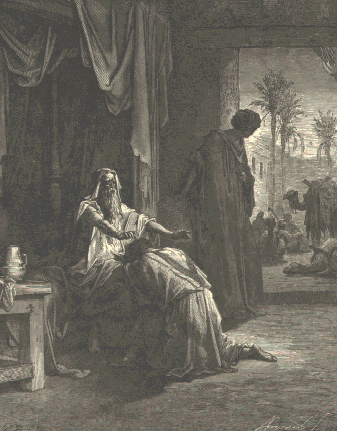
Isaac Blessing Jacob (Gustave Dore, from the 1865 La Sainte Bible)
Isaac Blessing Jacob  (Gustave Dore, from the 1865 La Sainte Bible)

Continue reading “Dancing in Chains: Deception and Destiny in Parshat Toldot” →

To Dwell in Possibility: Avraham, the Soil and the Clan in Parshat Chayei Sarah

Guest Post by Robert M. Blum

Last week, Sarah compared Walt Whitman to Avraham, whose “expansiveness” as a figure and founder of various peoples, including the Israelites, is exemplified by his hospitality in Parshat Vayeira. The conceptual key to this reading and comparison is Lewis Hyde’s notion of “gift exchange,” particularly with respect to art, which differs from market exchange in its spiritual underpinnings as well as the bonds formed through gifts. This notion of a gift economy was actually first developed by Marcel Mauss in his anthropological study of pre-modern societies also titled The Gift. A review of the Avraham narratives in light of Mauss’ broad conception of gift exchange reveals aspects of Avraham and his legacy that seem to be in tension with the expansive Whitmanian figure we encounter in Parshat Vayeira.

Continue reading “To Dwell in Possibility: Avraham, the Soil and the Clan in Parshat Chayei Sarah” →

Avraham, Lot, Walt Whitman and Dionysus:  Models of Hospitality in Parshat Vayeira

I celebrate myself, and sing myself,
And what I assume you shall assume,
For every atom belonging to me as good belongs to you.
I loafe and invite my soul,
I lean and loafe at my ease observing a spear of summer grass.

(Walt Whitman, Leaves of Grass)

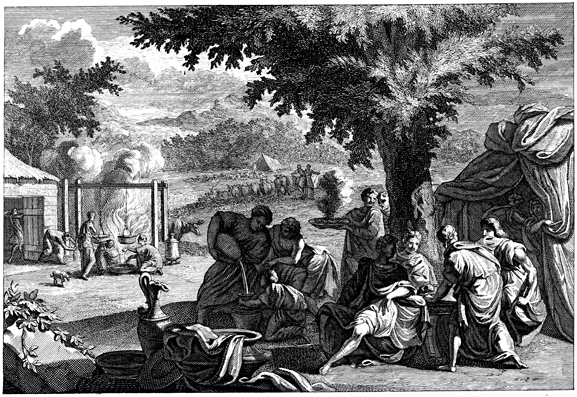
Abraham’s Three Visitors (Jan Goeree, circa 1700)

Avraham’s defining trait in the midrash, and to a certain extent in the text of the Torah itself, is the trait of hospitality. When the three emissaries of God appear to him by the terebinths of Mamre, we hear in detail how he and Sarah rush to make them feel at home. Avraham invites his guests to “lean and loafe” beneath a tree. The midrash is reported to say that the tent of Avraham was open on all four sides so that he and Sarah could welcome guests approaching from any direction. It is striking that Avraham of all people is defined by this trait of openness given that a crucial element of his legacy was shutting the doors on pagan worship and establishing an exclusive covenant with God. Later on in Parshat Vayeira, his nephew Lot echoes Avraham’s spirit of openness when he welcomes two of the emissaries and also treats them with generosity. However, Lot’s openness soon turns into an ugly distortion as we see that in Sodom “hospitality” necessarily involves exploitation and taking advantage of others.

Hospitality rituals were an important feature of the ancient Near Eastern world – and a sense of the importance of these formal and informal customs lingers throughout the Middle East until today. Continue reading “Avraham, Lot, Walt Whitman and Dionysus:  Models of Hospitality in Parshat Vayeira” →