Emily Dickinson and the Wordless Cry of the Shofar

The Bible does not contain very much information about Rosh Hashanah. Nowhere in the Torah is it described as a day of kingship, a day of judgment, or even a new year. The only information we have about the day is that it is a “yom teruah,” or perhaps, “zikhron teruah,” a day of, or remembrance of, teruah. In the Talmud, teruah is defined as yevavah, as a kind of crying (Rosh Hashanah 33b), but the plain meaning of the Chumash seems to be closer to a day of “sounding.” This sounding does not necessarily imply praise, celebration, or even prayer. Yom Teruah is, most literally, a day of sound.  And from the perspective of the Bible, this sound does not have a specific valence, it does not tell us what to think or what to feel.

Continue reading “Emily Dickinson and the Wordless Cry of the Shofar”

Sabbath Rest

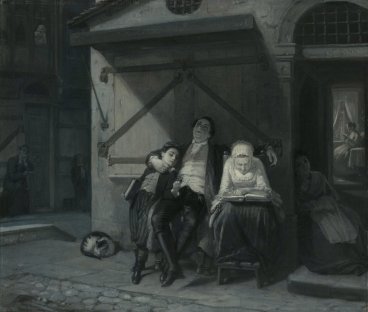
Sabbath-Ruhe auf der Gasse,  1866, Moritz Daniel Oppenheim
Sabbath-Ruhe auf der Gasse (Daniel Moritz Oppenheim, 1866)

This painting, by 19th century German Jewish painter Daniel Moritz Oppenheim, depicts a Jewish family relaxing on a Shabbat afternoon. While the patriarch of the family sits at the center of the tableau, the light in the painting shines on the two women who are reading. There is no way to tell what the women are reading, but art historians assume that the older woman in the foreground is reading a traditional Jewish tome, perhaps a siddur, or the Tzena u’Rena, while the younger woman in the rear is immersed in a contemporary German novel. It’s this assumption, as well as the inscription “1789” above the door mantel, that leads the Jewish Museum catalogue to say the following about the painting :

“Grandmother, hair covered, reads a traditional prayer book for women.  Through the doorway symbolically leading to the future, her modern, bareheaded granddaughter enjoys the latest novel…”

“Seemingly peaceful, this scene harbors dynamic undercurrents.  It honors a political revolution and contains seeds of feminist action.”

While the museum chooses to focus on the discord present in the painting, I am struck by the continuity between the young woman reading a novel, and her perhaps more religious counterpart. Their bodies are hunched in similar positions, and they also share a look of intense absorption that distinguishes them from the rest of their family. Together they present a vision of the Jewish Sabbath that is both vibrant and serene, their absorption in texts is a dynamic alternative to both political action and actual slumber. I suspect that Oppenheim leaves the question of whether they are reading sacred or secular texts intentionally open, it is the act of reading itself that seems to define their experience of the Sabbath. Despite the winds of change that are alluded to in the painting, there is the possibility that this is one tradition that will endure.