In the early hours of June 13 my family and I, like all Israelis, were awakened by the shrill sound of a phone alert. Israel had preemptively attacked Iran’s nuclear facilities. Momentous news, but I promptly put my pillow over my head and went back to sleep. Only when we woke up again later that morning did we realize that something historic had occurred. We also understood that a challenging period lay ahead.
We had only recently moved into a new home and, despite Houthis sporadically firing missiles in our direction, we had grown lax about running to our safe room, what Israelis call a mamad. Ours was filled with dust and leftover construction material. But on the day of the phone alerts—once we’d grasped the gravity of what was happening—we got to work. We spread a plastic mat over the floor, brought in a spare mattress, and set up a pack-and-play crib. The missile fire from Iran began in earnest that evening.
As the days wore on, we adjusted to the confines of this small space where emotions vacillated between fear, comfort from the presence of those we loved, and occasional irritation by those very same people. One mattress turned into four—each of our seven children laid claim to their own little spot. The more time we spent in our safe room, sometimes joined by friends or near strangers who needed a place to shelter, the more we acclimated ourselves to its deprivations and, occasionally, to its surreal benefits. Sociologists talk about the “third place,” which is an additional living space beyond home or work, like a synagogue, for example. These places expose us to people, ideas, and experiences beyond our immediate family and daily routines. During Israel’s twelve-day war with Iran our safe rooms also became a third place, introducing a new mentality and way of being that removed us from our day-to-day lives.
Last week when President Trump announced his intention to clean out and rebuild the Gaza Strip, I don’t think I was alone in feeling something I had not felt in a long time. It was not the elation of giving it to ones enemies, or the smug satisfaction of political validation. It was a rather fragile feeling, somewhat tentative, one might even say naive. Throughout the war we have experienced crushing blows but also astounding, miraculous, successes. Yet in these victories there is often a cyclical dynamic: we conquer territory only to withdraw weeks later, we kill terrorists only for their ranks to be replenished by a seemingly infinite supply of hateful young jihadists. Even our genuine exhilaration at the return of a few of our hostages is marred by our fear of what’s to come from from the murderous and unrepentant terrorists who are being released in turn. As always, we trust in God and our military and wish for the best, but common sense tells us that, in good measure, the problems we face today aren’t going anyway time soon.
For real hope to blossom, we need to understand that change is on the horizon. Trump’s proposal, whether or not its likely to materialize, offers a rare vision that could potentially break the cycle in which we find ourselves. I was therefore surprised to notice a few American Rabbis and “Jewish professionals” pontificating on the matter with critical accusations of ethnic cleansing and the like. On second thought I suppose it’s not that surprising. Only someone who is not particularly starved for hope could look such a gift horse in the mouth. If Trump’s Gaza proposal leaves you ethically outraged, or even indifferent, this simply demonstrates your own removal from the pit of despair in which Israelis find ourselves since October 7th. In the days following his announcement, I have not spoken to any Israeli, on the right or the left, who does not feel just a little bit hopeful, or at least tickled, that a world leader finally has the courage to propose a way out of our current morass.
I don’t know if it is providence or simply an all-knowing algorithm, but last week a new song popped into my Spotify playlist called “Ribbon of Hope,” “Chut shel Tikvah,” written by the popular Israeli singer-songwriter Aaron Razel and his wife Efrat. The song was actually composed about a year ago, around the time of the first hostage release, when Razel and his wife were enjoying a beautiful day together on the Tel Aviv boardwalk. I understand those kinds of days as I’ve experienced many of them myself since October 7th. A lovely day when you have the chance to appreciate the beauty and wonder of daily life in Israel, with the sickening knowledge that all around us families are grieving, soldiers are fighting for their lives (and ours) on the battlefield and that dozens of our brethren are wasting away in the depths of Hamas torture dens. Yet this day was different, as Razel sings, there was a sense that something monumental is about to change.
Soon the gates will open
and soon
the sun will rise again
the wild flowers will fill the fields
with colors anew
until they do
we won’t forget the pain.
The song has a kind of 1960s, folksy feel, amplified by harmonica interludes by the famous Israeli musician Ehud Banai. Although it owes a debt to peace anthems from the past, there’s a difference here, a respect for the necessity of war and also, I think, a kind of underlying ambiguity that is not necessarily apparent on first listen.
Above in the skies
are the voices of war
while in our hearts
we long for comfort
And I, like a captured child
tie to my window
a ribbon of hope
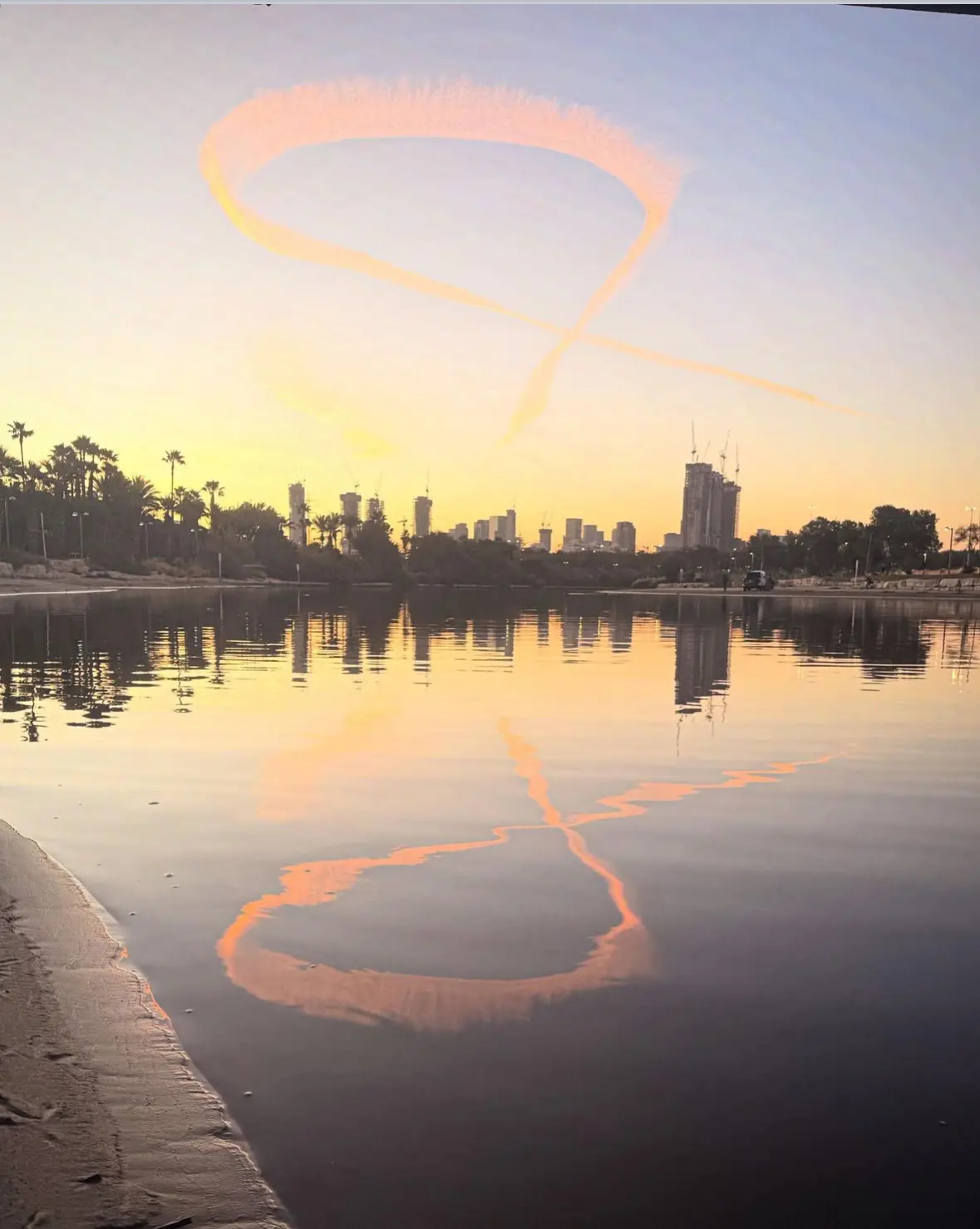
Two allusions here may be familiar to listeners. One is the “ribbon of hope,” which likely references the Book of Joshua’s story of the harlot Rachav, who saves the Israelite spies in Jericho and hangs a red string from her window. Interestingly, in Joshua the Hebrew word tikvah means cord – but hints at the hope that Rachav and her family can ultimately be saved from the wicked society on whose edge they dwell. The ribbon in the song also is reminiscent of the yellow ribbon that has morphed into the ubiquitous symbol of the Israeli hostages imprisoned by Hamas.
The phrase “captured child,” is a translation of “tinok shenishba,” a Rabbinic term that refers to a Jew who was kidnapped by gentiles as a child and as a result cannot be Halakhically held responsible for his lack of Jewish observance. It could be that the Razels chose “tinok shenishba,” just for its associations with innocence and captivity, though I wonder if something else is being suggested here. The term “captured child” is used in Rabbinic literature in reference to sin, it allows us to relieve responsibility from adults who simply don’t know better.
Perhaps some of the implication here is that a certain kind of hope is indeed naive, and perhaps even wrong. We hope and pray for the safe release of our hostages, even if we know that under the current parameters it comes at a cost that is unforgivable. We dream of an end to the war, even if we know that ending it prematurely means passing on the baton to the next generation, that is to our own children and grandchildren. Yellow ribbons have become mixed symbols in our divisive national context. We all long for the return of our hostages alive and in good health. But the cars that sport yellow ribbons often have washed out anti-Bibi bumper stickers as well. Hostage Square is just around the corner from Kaplan Street, and despite many many fine efforts to steer things differently, the Hostages and Missing Families Forum is hopelessly politicized and pointed often in the precise direction of its potential allies.
Finding shared sources of hope and consolation in this environment can be challenging. Which perhaps is why the Razels chose to newly rededicate the song to Agam Berger, a 19 year old observation soldier and gifted violinist who was released in a recent prisoner exchange. Reports about Agam have captivated the Israeli public since they filtered out after the first hostage deal, how she refused to eat unkosher meat or clean or cook for her captors on Shabbat, how she lovingly braided the hair of female hostages before they were released, even though she was forced to remain. Her first message to the world upon her release (in exchange for 50 craven terrorists) was “I chose the path of faith and in the path of faith I returned.”
Amidst all the protests, uproar at the Knesset, burning trashcans on the Ayalon, we are presented with the image of one brave young woman clinging to her faith, using it to hold up herself and others, and in doing so uplifting her nation as well. This also is a version of hope because it presents us with another path. If the hostage crisis has been used as yet another wedge to pointlessly drive us apart, perhaps the purity and heroism of these individuals can also help us find a way to move forward together.
The new addition of the song includes an added stanza that honors Agam. The line “who is this coming up from the desert” is a quote from the Song of Songs, and can just as easily be applied to the Jewish people leaving their Egyptian captivity. In the song it also refers to Agam:
And I ask
who is she
who is she
who rises up out of the desert
And I hear
I am she
I am she
clear as a lake (agam) of rivers.
Both Agam the person and also the sparkling water imagery with which she is associated, adds the presence of something refreshing and new. A new shot at national unity, at spiritual consciousness, and for her and her family, a new chance at life – it is not a coincidence that the Hebrew words mikvah and tikvah are related. And now, “on the horizon/ are days of hope/the waves whisper their faith.”
Personally I don’t know anything about what the coming years, months, or even days will bring. None of us do. But we can be grateful for the mere chance to be a teeny bit closer to breaking away from a rotten paradigm that has brought so much bloodshed and destruction – toward something new, “rising up from the desert.” Maybe things won’t exactly pan out in the way that the American president, and all of us, dream (there may also be some differences there). As for me, I’m still going to cling to ribbons of hope.
It’s now been two weeks since we heard the news of the murdered hostages – six holy souls who were executed in cold blood after enduring eleven months of torture at the hands of their Islamist captors. The news hit everyone in Israel quite hard, and it cast a shadow over the normally hopeful first day of school. Since then quite a few more innocent Israelis have been murdered or killed, including a policeman whose own daughter was killed defending the Sderot police station on October 7th. Yet even as a society that has been completely bombarded with tragedy over the past year, the uniquely cruel nature of these deaths, compounded by newly released footage of the horrific conditions in which they are kept, has left many of us struggling to find the conceptual vocabulary to reflect on the events unfolding around us.
Almog Sarusi H”YD
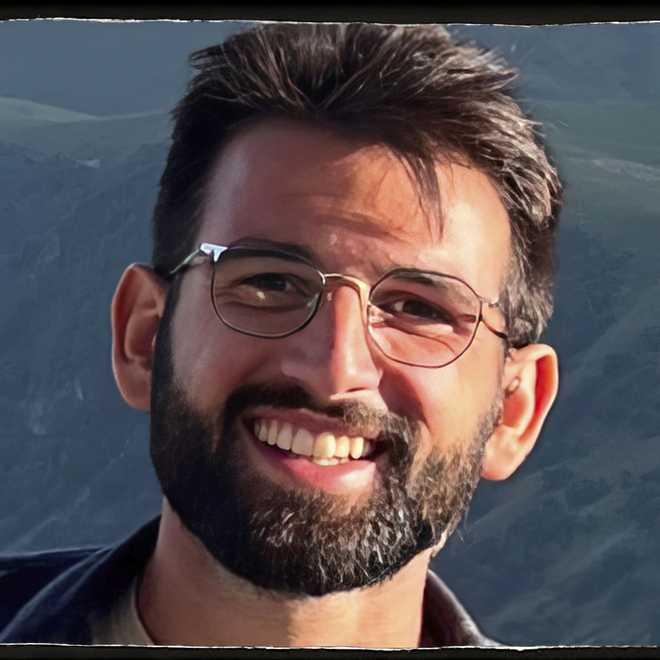
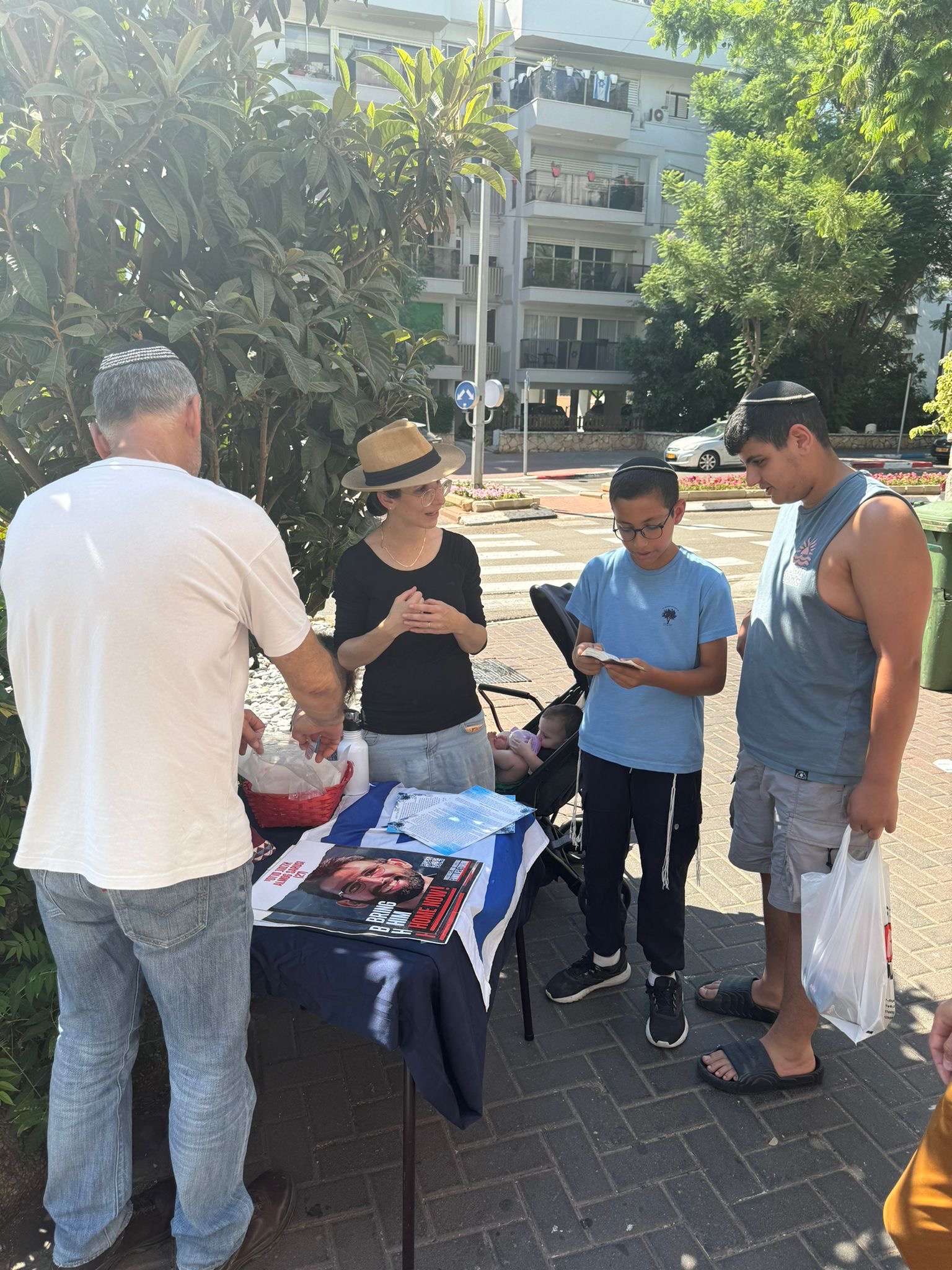
Since everyone in Israel is separated only a few short degrees, one name that particularly seared me on September 1st was of the hostage Almog Sarusi, a handsome 27 year old who was abducted from the Nova festival. Almog’s father Yigal owns an electrical shop in Ra’anana, around the corner from where I live. Almog was a charming, thoughtful, engineering student who loved nothing more than to explore Israel, play guitar, and spend quality time with his family and friends. He attended the music festival with his longtime girlfriend Shachar and stayed behind to help her when she was shot and severely wounded (she later died.) Since his abduction, his parents fought tirelessly on his behalf, exhausting every political and spiritual resource they could muster. The Sarusis don’t define themselves as “dati,” or religious. Yet Yigal nobly stood nearly every Friday on the corner outside his electrical shop requesting passers by say a tefilla or a bracha in the merit of his son Almog’s safe return. My friend Tamar accompanied him and provided home-baked cookies and boundless energy to find recruits on the sidewalk. Unlike some of the other hostages, there were no videos released of Almog during his captivity, and we didn’t know with any certainty the status of the young man for whom we prayed. My first thoughts when I heard the news on September 1st was that perhaps these prayers did keep Almog and the others alive for 11 grueling months. My subsequent thoughts, of course, threw me into a theological rut from which it was harder to emerge.
Canvassing for tefillot on Ostrovsky Street
The 1943 short story “The Secret Miracle” by the Argentine writer Jorge Luis Borges depicts a Jewish man named Jaromir Hladik, a moderately well-known author and playwright, who is earmarked for execution by the Nazis. Hladik is terrified by the prospect of death, but he is also terrified that he will not have the chance to finish his magnum opus, a verse drama called The Enemies. In the darkness of jail cell he prays to God ,“Thou who art the centuries and time itself,” to give him some extra time. And indeed, in a “secret miracle,” God gives him a year to complete his play in the privacy of his own mind: “the German bullet would kill him, at the determined hour, but in Hladik’s mind a year would pass between the order to fire and the discharge of the rifles.” The story raises interesting questions about whether there’s such a thing as a perfect work of art, even if it is entirely disconnected from an audience or context. By extension, it also explores the meaning of consciousness, and celebrates the value of life, of perception, and of artistic creativity for its own sake. These lofty concepts contrast with the Nazis for whom all of this could be snuffed out for the most shallow of reasons. At the end of the story, Hladik is murdered like countless other Holocaust victims. In an act of magical realism, he experiences a secret miracle that allows him to observe, feel, and create, albeit unbeknownst to anyone else, for a precious additional year’s time.
The six recently murdered hostages survived nearly a year under the most horrific conditions and are now dead. Recalling the “secret miracle” of the Borges story, what did those 11 months mean for Almog, Hersh, Eden, Ori, Alex and Carmel? What kind of torture did they endure? Amidst their suffering, what sort of sanctuary did they find, in their thoughts, in their environment, and with each other? What gave them strength, and what sort of discoveries did they make, about themselves and each other, about life, and about God?
Almog’s family sat shiva in a park next to pastoral green walking paths in Ra’anana. Many people from all walks of life came to pay their respects. We sat for a bit with Almog’s father Yigal, who spoke with remarkable composure, deftly balancing sensitivity to the various parties in front of him: two bashful seminary-age girls, another pair of women with tall head coverings who had driven in from the Shomron, and Noam Tibon, the retired army general turned October 7th hero who is firmly on the left politically. Yigal spoke about Almog’s love for the land of Israel, his sensitivity for others, how his army friends call him “Abba,” because he was the sort to always take care of those around him. He also spoke about the complexities of his own efforts to free his son. He did not believe in a hostage deal “at any cost,” but he believed that in the absence of complete victory over Hamas then the hostages had to be prioritized. His comments kept drifting to the 6 martyrs, the 6 “kedoshim” he called them. He said that Almog loved to have deep conversations, and he imagined what sorts of things they spoke about together. In his better moments, he thought of Carmel Gat doing yoga exercises with them, of how they must have given each other strength and solace until the end.
He also spoke about how even in this most devastating of circumstances, “miracles” had occurred. It’s a miracle his family could bury Almog with his body intact. That only several short days after he was killed they could stand at his gravesite and give him a proper funeral that paid tribute to his many wonderful qualities. And maybe other miracles too, he wondered aloud. I thought of his weekly efforts to canvas for tefillot near his shop on Ostrovsky Street.
It’s hard to say what constitutes a miracle and what is precisely the opposite. Even in the Borges story, one can dwell on the “miracle” experienced by the protagonist, or the pure and unadulterated evil that led to his predicament in the first place and ultimately his murder. I have heard so many wonderful October 7 miracle stories and it is hard not to be moved by them. But then there are the “non-miracles,” the Nova escapee who survived hours in the woods only to be killed by a fresh wave of terrorists, the hostages who were killed just hours before their rescuers arrived. In these circumstances we are left looking for more modest sources of consolation. Maybe this is the meaning of a “secret miracle,” not only a miracle that happens in secret, but a miracle that we manage to see or experience even when everything else seems to have gone wrong. Moments of strength, courage and love in a dark and claustrophobic tunnel. Even the sheer miracle or life itself, sustained for so long in an environment so hostile to it. Or the miracle of the resilience of the Jewish people. A father in immeasurable pain who raises his eyes to God and also to others, managing to transcend an impossible circumstance with an expansiveness of spirit that itself is also a kind of a miracle.
Some reflections on the Simchat Torah Massacre from my own vantage point here in Israel
On a beautiful Thursday during the middle days of Sukkot, my family took a day trip to the Golan Heights. We visited a newly developed national park called Sussita, which contains the ruins of the ancient Graeco-Roman city Hippos. It was also the site of a daring defeat of Syrian troops by ordinary residents of the nearby Kibbutz Ein Gev in Israel’s War of Independence. The site’s vivid explanatory movie had my older children mesmerized, but afterwards they started to ask questions. Are there still enemy soldiers waiting in those hilltops? Could it happen again? Could ordinary people have to fight like that to save their homes and their families? I answered, of course, by reassuring them: we live in different times today. It’s true there are people who wish to harm us but we live in a strong country with many layers of protection between children like you and those enemies. We admire the heroes of the past, but we’re grateful that we don’t have to live in such dramatic times.
On Simchat Torah two days later that reassuring narrative would collapse, and we entered a new reality, or perhaps returned to a very old one…
The full essay can be found in Mosaic Magazine as part of their excellent Gaza War symposium.
My young daughter was playing in my mother’s living room and approached me holding a battered prayer book she found on the shelf. When I realized what it was, I gasped. I hadn’t thought of it in years, but the siddur is a family treasure. My grandmother, Raizel Berger, a native of the Maramures region of Romania, was sent to Auschwitz along with her family in 1944. She managed to smuggle a small siddur into the camp by hiding it in her stocking garter. The young women in her bunker, mostly Chasidic Jews from Romania and Hungary, took turns praying from it each night. One of the girls worked in the kitchen and snuck out a potato sack to use as a cover for the siddur, onto which she used a rough yarn to beautifully embroider a Star of David in the center. The pages of the siddur are delicate with age, but the section of Tehillim (Psalms) is particularly worn from repeated use.
After the war, my grandmother married my grandfather, a Holocaust survivor from Poland. They moved to the United States and had four daughters in quick succession. The siddur continued to be used on a daily basis in their brownstone home in Brooklyn. Each holiday, my grandparents lit dozens of Yizkor candles for their many murdered family members. But their resilience to transition into loving parents and industrious new immigrants almost immediately after surviving such horrors still baffles the mind. So too the siddur, once hidden in the bowels of a dark dungeon and used by inmates of the most horrific and debased place on earth, transitioned to use for mundane, though still holy, daily prayers. In unsentimental fashion typical of Jews of my grandparents’ type, the siddur was not treated as a talisman. At some point, someone even scrawled a phone number on the inside cover…





 The Book of Books