Ribbons of Hope

Last week when President Trump announced his intention to clean out and rebuild the Gaza Strip, I don’t think I was alone in feeling something I had not felt in a long time. It was not the elation of giving it to ones enemies, or the smug satisfaction of political validation.  It was a rather fragile feeling, somewhat tentative, one might even say naive. Throughout the war we have experienced crushing blows but also astounding, miraculous, successes. Yet  in these victories there is often a cyclical dynamic: we conquer territory only to withdraw weeks later, we kill terrorists only for their ranks to be replenished by a seemingly infinite supply of hateful young jihadists. Even our genuine exhilaration at the return of a few of our hostages is marred by our fear of what’s to come from from the murderous and unrepentant terrorists who are being released in turn. As always, we trust in God and our military and wish for the best, but common sense tells us that, in good measure, the problems we face today aren’t going anyway time soon. 

For real hope to blossom, we need to understand that change is on the horizon. Trump’s proposal, whether or not its likely to materialize, offers a rare vision that could potentially break the cycle in which we find ourselves. I was therefore surprised to notice a few American Rabbis and “Jewish professionals” pontificating on the matter with critical accusations of ethnic cleansing and the like. On second thought I suppose it’s not that surprising. Only someone who is not particularly starved for hope could look such a gift horse in the mouth. If Trump’s Gaza proposal leaves you ethically outraged, or even indifferent, this  simply demonstrates your own removal from the pit of despair in which Israelis find ourselves since October 7th. In the days following his announcement, I have not spoken to any Israeli, on the right or the left, who does not feel just a little bit hopeful, or at least tickled, that a world leader finally has the courage to propose a way out of our current morass. 

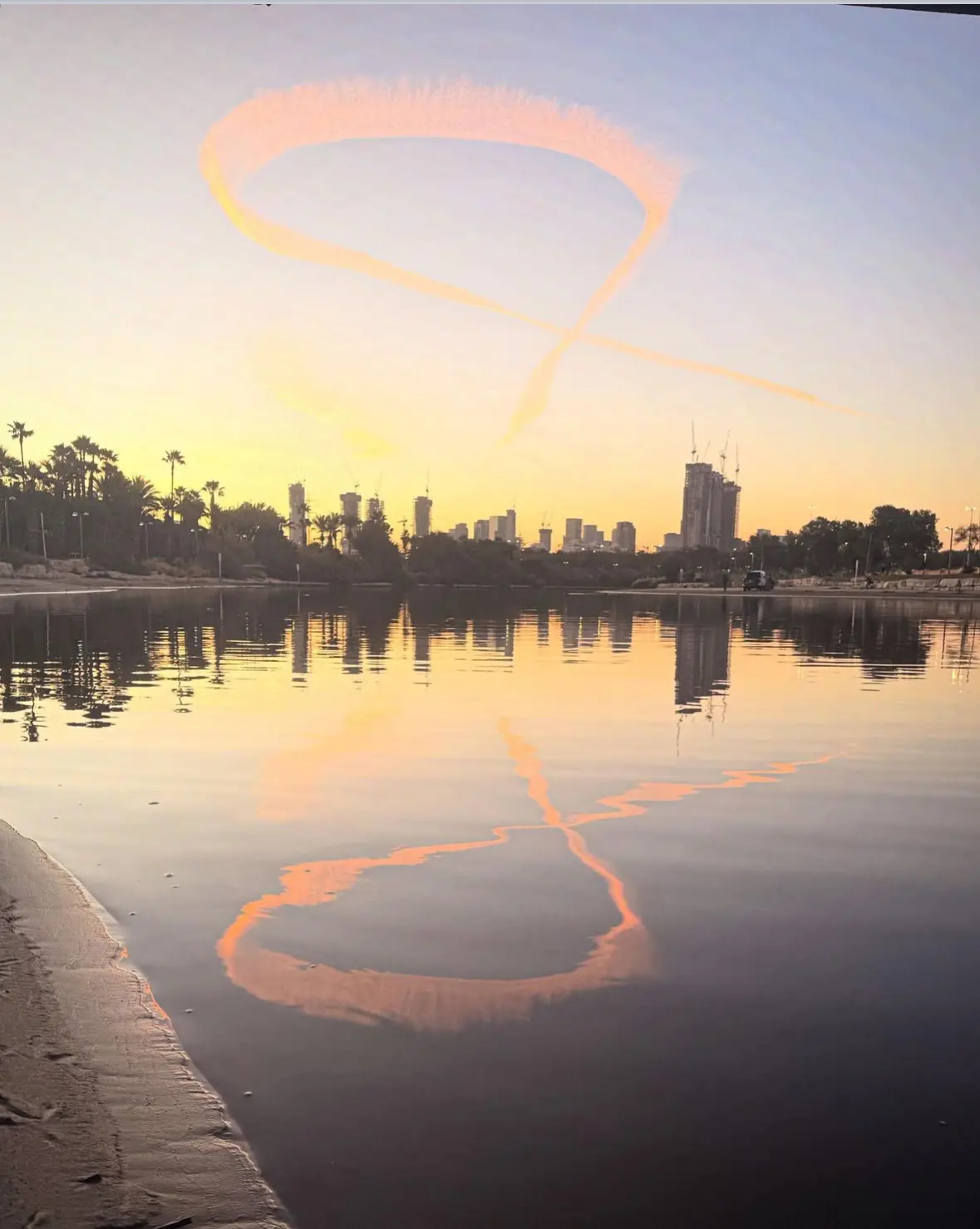
I don’t know if it is providence or simply an all-knowing algorithm, but last week a new song popped into my Spotify playlist called “Ribbon of Hope,” “Chut shel Tikvah,” written by the popular Israeli singer-songwriter Aaron Razel and his wife Efrat. The song was actually composed about a year ago, around the time of the first hostage release, when Razel and his wife were enjoying a beautiful day together on the Tel Aviv boardwalk. I understand those kinds of days as I’ve experienced many of them myself since October 7th. A lovely day when you have the chance to appreciate the beauty and wonder of daily life in Israel, with the sickening knowledge that all around us families are grieving, soldiers are fighting for their lives (and ours) on the battlefield and that dozens of our brethren are wasting away in the depths of Hamas torture dens. Yet this day was different, as Razel sings, there was a sense that something monumental is about to change. 

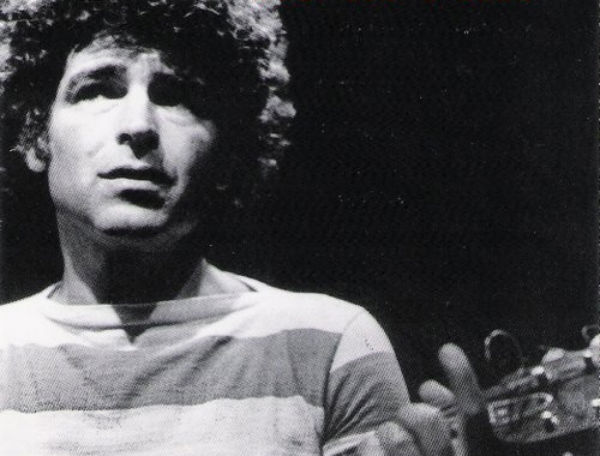
The song has a kind of 1960s, folksy feel, amplified by harmonica interludes by the famous Israeli musician Ehud Banai. Although it owes a debt to peace anthems from the past, there’s a difference here, a respect for the necessity of war and also, I think, a kind of underlying ambiguity that is not necessarily apparent on first listen. 

Two allusions here may be familiar to listeners. One is the “ribbon of hope,” which likely references the Book of Joshua’s story of the harlot Rachav, who saves the Israelite spies in Jericho and hangs a red string from her window. Interestingly, in Joshua the Hebrew word tikvah means cord – but hints at the hope that Rachav and her family can ultimately be saved from the wicked society on whose edge they dwell.   The ribbon in the song also is reminiscent of the yellow ribbon that has morphed into the ubiquitous symbol of the Israeli hostages imprisoned by Hamas. 

The phrase “captured child,” is a translation of “tinok shenishba,” a Rabbinic term that refers to a Jew who was kidnapped by gentiles as a child and as a result cannot be Halakhically held responsible for his lack of Jewish observance. It could be that the Razels chose “tinok shenishba,” just for its associations with innocence and captivity, though I wonder if something else is being suggested here. The term “captured child” is used in Rabbinic literature in reference to sin, it allows us to relieve responsibility from adults who simply don’t know better.  

Perhaps some of the implication here is that a certain kind of hope is indeed naive, and perhaps even wrong. We hope and pray for the safe release of our hostages, even if we know that under the current parameters it comes at a cost that is unforgivable. We dream of an end to the war, even if we know that ending it prematurely means passing on the baton to the next generation, that is to our own children and grandchildren. Yellow ribbons have become mixed symbols in our divisive national context. We all long for the return of our hostages alive and in good health. But the cars that sport yellow ribbons often have washed out anti-Bibi bumper stickers as well. Hostage Square is just around the corner from Kaplan Street, and despite many many fine efforts to steer things differently, the Hostages and Missing Families Forum is hopelessly politicized and pointed often in the precise direction of its potential allies. 

Finding shared sources of hope and consolation in this environment can be challenging. Which perhaps is why the Razels chose to newly rededicate the song to Agam Berger, a 19 year old observation soldier and gifted violinist who was released in a recent prisoner exchange. Reports about Agam have captivated the Israeli public since they filtered out after the first hostage deal, how she refused to eat unkosher meat or clean or cook for her captors on Shabbat, how she lovingly braided the hair of female hostages before they were released, even though she was forced to remain. Her first message to the world upon her release (in exchange for 50 craven terrorists) was “I chose the path of faith and in the path of faith I returned.” 

Amidst all the protests, uproar at the Knesset, burning trashcans on the Ayalon, we are presented with the image of one brave young woman clinging to her faith, using it to hold up herself and others, and in doing so uplifting her nation as well. This also is a version of hope because it presents us with another path. If the hostage crisis has been used as yet another wedge to pointlessly drive us apart, perhaps the purity and heroism of these individuals can also help us find a way to move forward together.  

The new addition of the song includes an added stanza that honors Agam. The line “who is this coming up from the desert” is a quote from the Song of Songs, and can just as easily be applied to the Jewish people leaving their Egyptian captivity. In the song it also refers to Agam:

Both Agam the person and also the sparkling water imagery with which she is associated,  adds the presence of something refreshing and new. A new shot at national unity, at spiritual consciousness, and for her and her family, a new chance at life – it is not a coincidence that the Hebrew words mikvah and tikvah are related. And now, “on the horizon/ are days of hope/the waves whisper their faith.” 

Personally I don’t know anything about what the coming years, months, or even days will bring. None of us do. But we can be grateful for the mere chance to  be a teeny bit closer to breaking away from a rotten paradigm that has brought so much bloodshed and destruction – toward something new, “rising up from the desert.” Maybe things won’t exactly pan out in the way that the American president, and all of us, dream (there may also be some differences there). As for me, I’m still going to cling to ribbons of hope. 

The Muses of October 7

“Some may find art galleries irrelevant amidst the geopolitical challenges Israel now faces, the profound physical and emotional injuries faced by its citizens, our ongoing fear for the hostages and for the soldiers fighting in Gaza and the north. But the art of October 7, like the phenomenal music that has emerged in its wake, is urgent and searing. It provides a visual prism through which we can try to understand our times, to memorialize those who were murdered and to scream over its injustice. ״

Walk the streets of Israel post-October 7 and one experiences a country transformed. This transformation manifests in many aspects of our lives: our political allegiances, our sense of certainty and security, and our attitudes toward one another. But our streets have also literally, physically, been transformed. Cars are bedecked in Israeli flags and bumper stickers that commemorate fallen loved ones and friends. The now iconic red-and-black hostage posters line storefronts and traffic poles (in Israel they don’t get ripped down). Army green is everywhere—at times every fifth person walking down the street seems to be in uniform and carrying a large weapon. And street art and graffiti that focuses on the hostages or the ongoing military campaign is ubiquitous. Grassroots memorials take various forms—from yizkor candles to red poppies (the classic symbol of military loss is also a common wildflower in the south of Israel) to countless other manifestations. This spontaneous public art is intense and concentrated in certain places, such as Hostage Square in Tel Aviv and the Nova massacre memorial in Re’im. But it also can be found on random street corners and benches, in malls or in doctor’s offices. Art is everywhere, a direct outcome of a nation that is actively grieving horrific events and continuing crises. 

Ziva Jelin, Panorama: Pavement and Mud, 2018, acrylic and tar on canvas. Photo credit: Ron Plitnitzki.

A new exhibit, recently opened at the ANU Museum of the Jewish People in Tel Aviv, seeks to explore this creative phenomenon in real time. The exhibit is simply titled “October 7.” It begins by considering the notion that art is irrelevant at the height of wartime, as expressed by the proverb “When the cannons are heard, the muses are silent.” Orit Shaham Gover, the chief curator of ANU, proposes this alternative: “As the cannons are heard, the voices of the muses are emerging all the more clearly from deep down in the throat.”

A full review of this moving exhibit can be read in Moment Magazine.

A Religious Musical in Secular Tel Aviv

Traditional lines between the secular and religious populations are fading, particularly in the realms of music and art.

I’d like to belatedly share excerpts from an article that appeared a few months back in Mosaic Magazine. The growing popularity of religious singers among secular audiences here in Israel has been noted elsewhere. One hopes that this rising trend can serve to combat some of the tragic division we see in Israeli society right now.

“This past Sukkot, a crowd of about 500 children, parents, and grandparents gathered in the Recanati Theater in the Tel Aviv Museum of Art. The audience was made up of affluent and mostly secular residents of north Tel Aviv and its suburbs—stylishly dressed, sipping lattes and organic juice sold at the trendy coffee shop nearby. To an outside observer, the scene would be almost indistinguishable from a family-oriented play or concert in Park Slope, Brooklyn. The content, however, was distinctly Israeli: a jukebox musical called Aluf ha-Olam (literally, “Champion of the World”), based on the songs of the religious Zionist singer Hanan Ben-Ari, written and performed by Israel’s most prestigious children’s dramatic company, the Orna Porat Theater. Tickets for Aluf ha-Olam are in high demand and sell out quickly, so I booked seats for me and my children several months in advance. One could sense from the anticipation in the theater that many others had done the same.

Hanan Ben-Ari is one of Israel’s best-known musical performers, albeit without the international break-through appeal of peers like the religious music sensation Ishai Ribo. His strength is in his songwriting; catchy tunes, drawn from eclectic influences, and coherent, powerful lyrics that comment on personal, often spiritual, struggles…

…Ben-Ari’s penchant for infusing lyrics about universal topics with the language of the synagogue and yeshiva tends to obscure the boundaries between sacred and secular idioms. His 1980s-inspired feel-good ballad “Dream like Joseph,” for instance, argues that every story in the Bible reflects some basic human experience: “everyone leaves his father’s home/ everyone nearly sacrifices his child/ deep within is a little Sodom/ that he wishes to erase already/ and angels will rescue him…”

…Thus the prospect of translating Hanan Ben-Ari’s music into an Israeli secular vernacular, as Aluf ha-Olam seeks to do, is daunting, and perplexing. It raises the question of whether Ben-Ari’s biblicism and Jewish allusions are charming embellishments or so central to his work that they cannot be disentangled from it. But merely to ask this question is to acknowledge that Israeli society’s shared cultural touchstones appear to be growing more and more Jewish, and traditional lines between the secular and religious populations are fading, particularly in the realms of music and art…”

For the full article see here.

Shababnikim Season Two: Welcome to Rehavia

“On a bright spring day in a swanky Tel Aviv neighborhood, a handsome man sporting a trim beard and a perfectly perched black yarmulke alights from an expensive SUV. He kisses his beautiful and modestly clad wife, as three smartly dressed yeshiva boys across the street watch, swoon, and dream of similar lives for themselves. “A yeshiva boy who married well?” one suggests. “No, no—he earned it for himself!” his friend explains: After being expelled from a prestigious yeshiva for owning a smartphone, he flew to Rome, camped out for a week on the doorstep of Borsalino headquarters, and earned the right to open the first official Israeli chain of stores for the high-end Italian hatmaker. Although he is too busy earning money to study in yeshiva full time, he still dedicates time every day to study Talmud. “The modern haredi,” the boys say, sighing. “He enjoys both worlds. He has this and yet he also has that!” As they wave to him crossing the street, a large truck comes out of nowhere and plows into him. And so the show’s question remains: Is it really possible to have both this and that?”

Please check out the absolutely wonderful latest issue of Jewish Review of Books for a review of the second season of Shababnikim, a fabulous Israel television series with much more depth than initially meets the eye.

Holy Folly: Using Humor to Reach for God

In his 1905 philosophical analysis of humor, Jokes and Their Relation to the Unconscious, Sigmund Freud cites a classic Jewish joke: “Two Jews met in a railway carriage at a station in Galicia. ‘Where are you going?’ asked one. ‘To Cracow,’ was the answer. ‘What a liar you are!’ broke out the other. ‘If you say you’re going to Cracow, you want me to believe you’re going to Lemberg. But I know that in fact you’re going to Cracow. So why are you lying to me?’”

On the surface, the joke is a self-deprecating jab at the Jewish tendency to overthink things. But on a deeper level (and for Freud of course there is always a deeper level) the joke comments on the difficulty of discerning truth. He asks, “is it the truth if we describe things as they are without troubling to consider how our hearer will understand what we say?” Freud proposes that jokes like the one above “attack not a person or an institution but the certainty of our knowledge itself.” He is struck by how many jokes of this nature are Jewish ones.

For the full article please see the wonderful Summer edition of Lubavitch International Magazine.

Of Synagogues and Seinfeld: “ANU,” The New Museum of the Jewish People

In March, the Tel Aviv Jewish museum formerly known as the Nahum Goldmann Museum of the Jewish Diaspora(or Beit Hatfutsot) reopened after a ten-year, $100 million renovation. Now called ANU—Museum of the Jewish People, it offers a cheery, inclusive vision of Jewish peoplehood.

For the full review see here, in the wonderful new Summer issue of the Jewish Review of Books.

Covid-19 and J.K. Rowling’s The Ickabog

At the height of the coronavirus pandemic last April, when celebrities around the world were lecturing us via tweet to stay home and wear a mask, British novelist J. K. Rowling took a different approach. As kids were forced to forego school and interactions with friends, she published a new children’s book and released it in free installments for families stuck at home. The novel, The Ickabog, was published in full this past Thanksgiving. Proceeds from sales of the book are donated to communities hurt most by COVID-19.

Rowling has said that the Ickabog story first came to her years ago, when her own children were young. She wrote the book during the period in which she wrote the Harry Potter books, and claims to have made no serious modifications since that time. Yet intentionally or not, The Ickabog may be the most serious literary indictment of the mass response to the COVID-19 epidemic published to date.

The cover of JK Rowling’s The Ickabog. This may be a stretch but note the corona (Latin: crown) artfully woven into the book logo.

I bought the book as a gift for my Harry Potter-loving 9-year-old, and first picked it up on the Sabbath after Hannukah. My family had just returned from Jerusalem, where the lack of tourists and the still-considerable virus restrictions cast a pallor on this normally magical time of year. After months of closures, the street vendors of Jaffa and Ben Yehudah streets finally had their Judaica and souvenirs proudly on display, albeit with few takers. Seemingly half of the usually bustling restaurants were temporarily shuttered or closed for good. I wasn’t in the mood to read more of the endless news about the pandemic, so I turned to my son’s Rowling book looking for a light fantasy escape.

Read the full essay at First Things

Man Shouts What He is Missing: An Anthem for the Corona Lockdown

“In the last two weeks of seger (lockdown) in Israel, an almost laughably long list of public figures have admitted to violating the Covid-19 lockdown restrictions. Some of them are lawmakers who are themselves directly responsible for initiating the lockdown.”

Join me as I try to explore what is going on here, with the help of the iconic Israeli musician Meir Ariel. On Arutz Sheva/Israel National News.

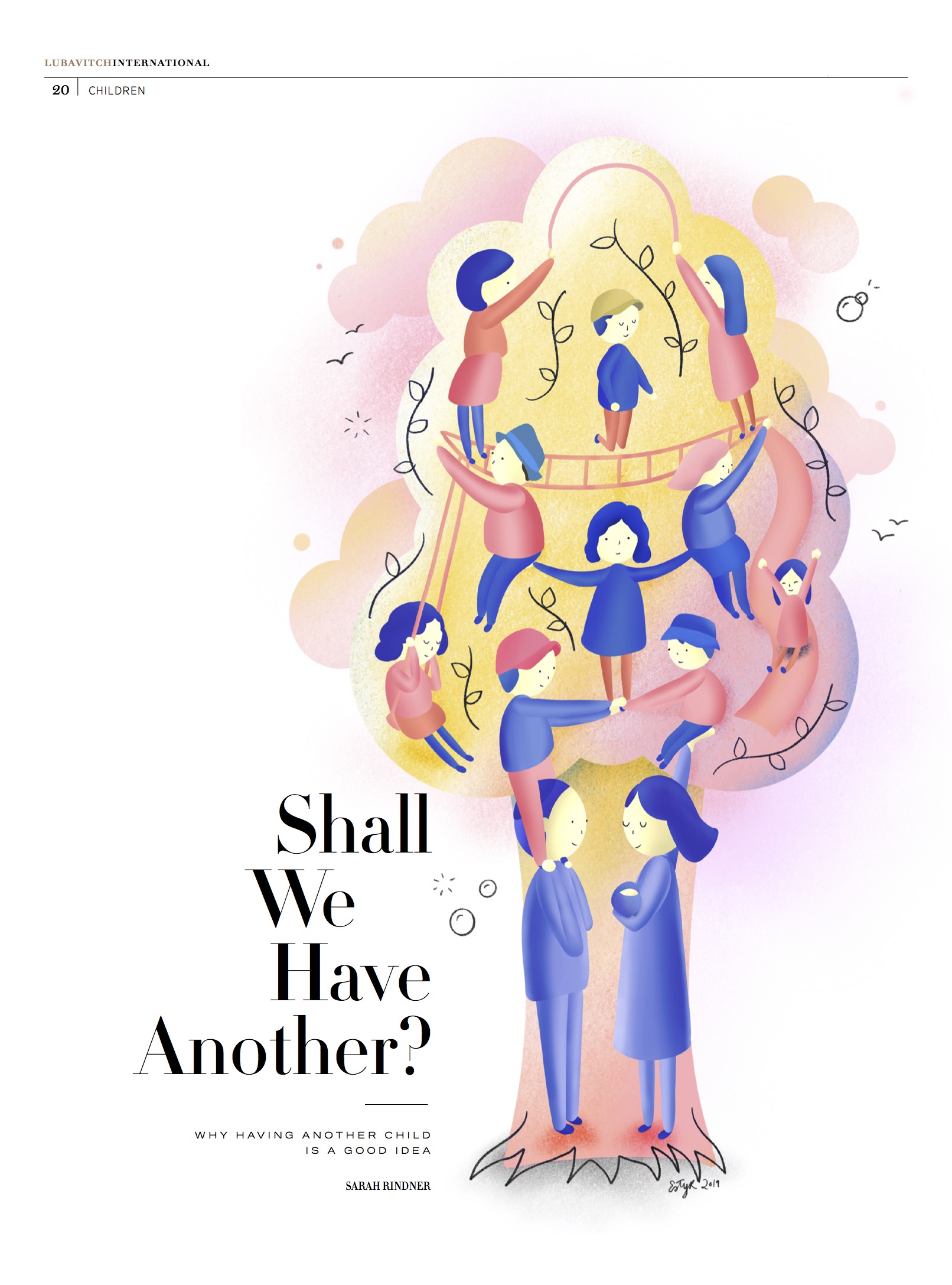
Shall We Have Another? A Case for Children in a Post-Parenting Era

“Ours is physically the healthiest and most affluent society that has ever existed, and, in some ways, raising children is also more convenient than it has ever been. Yet, children are increasingly perceived as a burden.”

Children Article LI Summer 5779(1)

Please see the full article in the Summer edition of Lubavitch International Magazine. 

Tragedy and Comedy in Black and White

Lately it seems to be the season of haredim on screen. My immersion in this very particular oeuvre began with Shtisel, the 2013 runaway hit Israeli TV series, which depicts a haredi family in Jerusalem in all of its complicated, charming dysfunction. (The first two seasons are now available with English subtitles on Netflix.) More recently, Autonomies (2018) presents a dystopian division of Israel into separate secular and religious states. In the United States, two recent documentaries showcase radically divergent ways of understanding the New York Hasidic community and the experience of marginal figures within it. Haredi Jews are not always interchangeable with Hasidic ones, and Israeli soap operas are different than American art-house documentaries. Yet in considering all of these offerings, certain patterns inevitably emerge. Counterintuitively, the more serious offerings in this genre are the ones with a lighter touch.

Read the full article in Jewish Review of Books.