The Bible Lands Museum in Jerusalem is known for its collection of Near Eastern antiquities from the Biblical period. Yet amidst its galleries stands a startling cultural artifact of far more recent origin.
Kuma—meaning “Rise”—is a nearly ten-foot-long scroll depicting a dense, vivid, intellectually rich, and aesthetically stunning account of Jewish history. Its full title, “Kuma, Mei Afatzim ve-Kankantum,” refers to the materials used to prepare ink for Torah scrolls and other sacred texts. Evoking an unfurled Torah scroll, Kuma is the high-school senior project of a brilliant young yeshiva student, artist and poet named Eitan Rosenzweig הי”ד. Staff Sgt. Rosenzweig, an Alon Shvut native and student in the Yerucham Yeshivat Hesder, served in the Givati brigade and was killed in Gaza in November 2023, at the age of 21.
Kuma weaves together Jungian theories of the unconscious, the mythologist Joseph Campbell’s concept of the heroic journey, and imagery drawn from Western art and Jewish history—some of which appear elsewhere in the Bible Lands Museum. Kuma also incorporates literary allusions to the Bible, Talmud, modern Hebrew literature, Eastern and Western general philosophy, and more. It is a work of art that one must study rather than merely observe.
It’s now been two weeks since we heard the news of the murdered hostages – six holy souls who were executed in cold blood after enduring eleven months of torture at the hands of their Islamist captors. The news hit everyone in Israel quite hard, and it cast a shadow over the normally hopeful first day of school. Since then quite a few more innocent Israelis have been murdered or killed, including a policeman whose own daughter was killed defending the Sderot police station on October 7th. Yet even as a society that has been completely bombarded with tragedy over the past year, the uniquely cruel nature of these deaths, compounded by newly released footage of the horrific conditions in which they are kept, has left many of us struggling to find the conceptual vocabulary to reflect on the events unfolding around us.
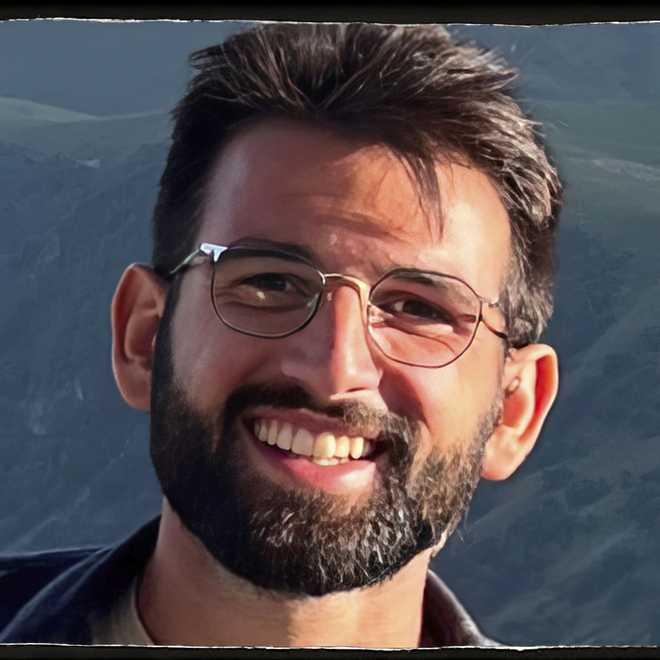
Almog Sarusi H”YD
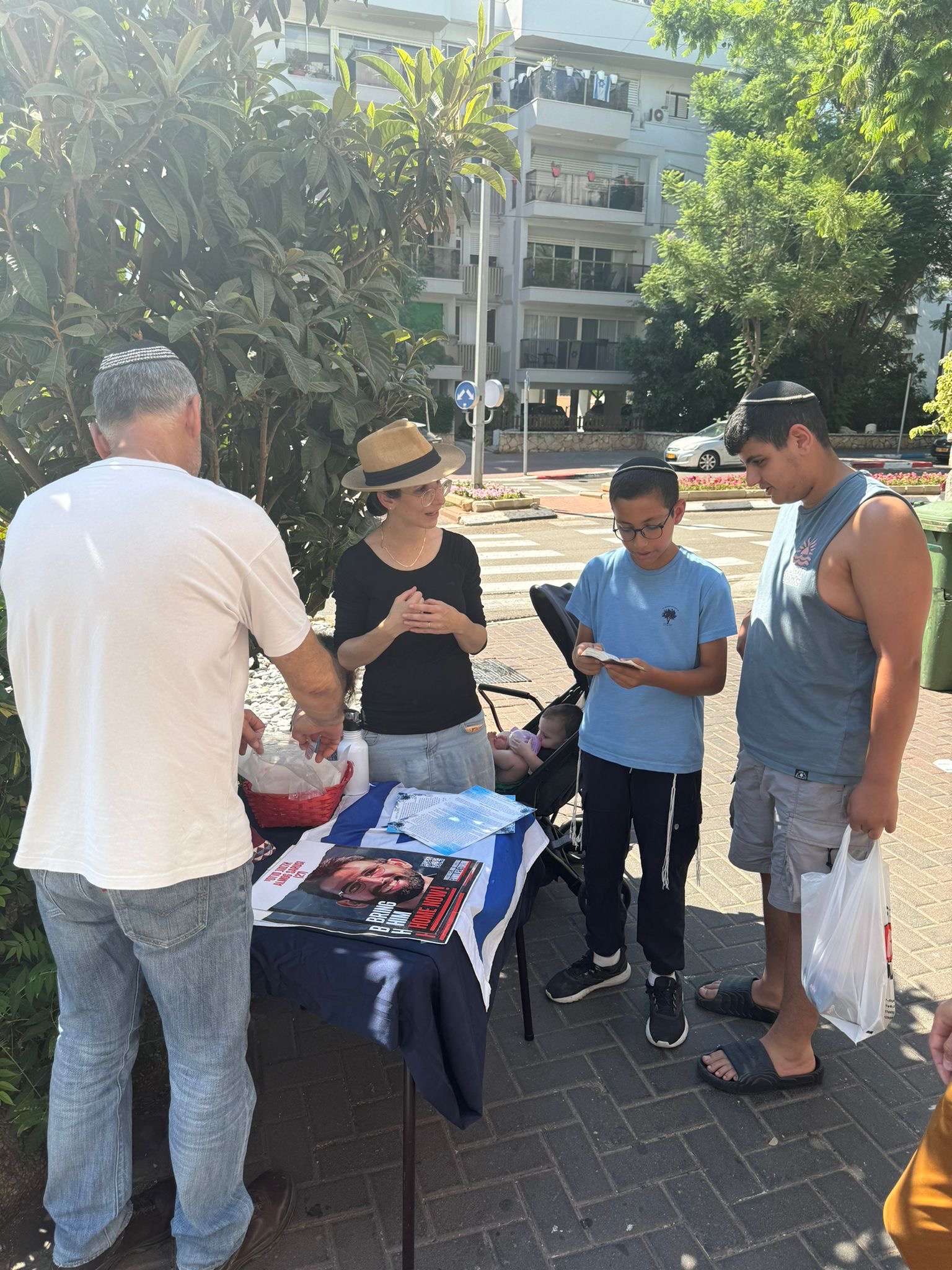
Since everyone in Israel is separated only a few short degrees, one name that particularly seared me on September 1st was of the hostage Almog Sarusi, a handsome 27 year old who was abducted from the Nova festival. Almog’s father Yigal owns an electrical shop in Ra’anana, around the corner from where I live. Almog was a charming, thoughtful, engineering student who loved nothing more than to explore Israel, play guitar, and spend quality time with his family and friends. He attended the music festival with his longtime girlfriend Shachar and stayed behind to help her when she was shot and severely wounded (she later died.) Since his abduction, his parents fought tirelessly on his behalf, exhausting every political and spiritual resource they could muster. The Sarusis don’t define themselves as “dati,” or religious. Yet Yigal nobly stood nearly every Friday on the corner outside his electrical shop requesting passers by say a tefilla or a bracha in the merit of his son Almog’s safe return. My friend Tamar accompanied him and provided home-baked cookies and boundless energy to find recruits on the sidewalk. Unlike some of the other hostages, there were no videos released of Almog during his captivity, and we didn’t know with any certainty the status of the young man for whom we prayed. My first thoughts when I heard the news on September 1st was that perhaps these prayers did keep Almog and the others alive for 11 grueling months. My subsequent thoughts, of course, threw me into a theological rut from which it was harder to emerge.
Canvassing for tefillot on Ostrovsky Street
The 1943 short story “The Secret Miracle” by the Argentine writer Jorge Luis Borges depicts a Jewish man named Jaromir Hladik, a moderately well-known author and playwright, who is earmarked for execution by the Nazis. Hladik is terrified by the prospect of death, but he is also terrified that he will not have the chance to finish his magnum opus, a verse drama called The Enemies. In the darkness of jail cell he prays to God ,“Thou who art the centuries and time itself,” to give him some extra time. And indeed, in a “secret miracle,” God gives him a year to complete his play in the privacy of his own mind: “the German bullet would kill him, at the determined hour, but in Hladik’s mind a year would pass between the order to fire and the discharge of the rifles.” The story raises interesting questions about whether there’s such a thing as a perfect work of art, even if it is entirely disconnected from an audience or context. By extension, it also explores the meaning of consciousness, and celebrates the value of life, of perception, and of artistic creativity for its own sake. These lofty concepts contrast with the Nazis for whom all of this could be snuffed out for the most shallow of reasons. At the end of the story, Hladik is murdered like countless other Holocaust victims. In an act of magical realism, he experiences a secret miracle that allows him to observe, feel, and create, albeit unbeknownst to anyone else, for a precious additional year’s time.
The six recently murdered hostages survived nearly a year under the most horrific conditions and are now dead. Recalling the “secret miracle” of the Borges story, what did those 11 months mean for Almog, Hersh, Eden, Ori, Alex and Carmel? What kind of torture did they endure? Amidst their suffering, what sort of sanctuary did they find, in their thoughts, in their environment, and with each other? What gave them strength, and what sort of discoveries did they make, about themselves and each other, about life, and about God?
Almog’s family sat shiva in a park next to pastoral green walking paths in Ra’anana. Many people from all walks of life came to pay their respects. We sat for a bit with Almog’s father Yigal, who spoke with remarkable composure, deftly balancing sensitivity to the various parties in front of him: two bashful seminary-age girls, another pair of women with tall head coverings who had driven in from the Shomron, and Noam Tibon, the retired army general turned October 7th hero who is firmly on the left politically. Yigal spoke about Almog’s love for the land of Israel, his sensitivity for others, how his army friends call him “Abba,” because he was the sort to always take care of those around him. He also spoke about the complexities of his own efforts to free his son. He did not believe in a hostage deal “at any cost,” but he believed that in the absence of complete victory over Hamas then the hostages had to be prioritized. His comments kept drifting to the 6 martyrs, the 6 “kedoshim” he called them. He said that Almog loved to have deep conversations, and he imagined what sorts of things they spoke about together. In his better moments, he thought of Carmel Gat doing yoga exercises with them, of how they must have given each other strength and solace until the end.
He also spoke about how even in this most devastating of circumstances, “miracles” had occurred. It’s a miracle his family could bury Almog with his body intact. That only several short days after he was killed they could stand at his gravesite and give him a proper funeral that paid tribute to his many wonderful qualities. And maybe other miracles too, he wondered aloud. I thought of his weekly efforts to canvas for tefillot near his shop on Ostrovsky Street.
It’s hard to say what constitutes a miracle and what is precisely the opposite. Even in the Borges story, one can dwell on the “miracle” experienced by the protagonist, or the pure and unadulterated evil that led to his predicament in the first place and ultimately his murder. I have heard so many wonderful October 7 miracle stories and it is hard not to be moved by them. But then there are the “non-miracles,” the Nova escapee who survived hours in the woods only to be killed by a fresh wave of terrorists, the hostages who were killed just hours before their rescuers arrived. In these circumstances we are left looking for more modest sources of consolation. Maybe this is the meaning of a “secret miracle,” not only a miracle that happens in secret, but a miracle that we manage to see or experience even when everything else seems to have gone wrong. Moments of strength, courage and love in a dark and claustrophobic tunnel. Even the sheer miracle or life itself, sustained for so long in an environment so hostile to it. Or the miracle of the resilience of the Jewish people. A father in immeasurable pain who raises his eyes to God and also to others, managing to transcend an impossible circumstance with an expansiveness of spirit that itself is also a kind of a miracle.
The upcoming holiday of Shavuot evokes the receiving of the Torah on Har Sinai, flowers and greenery, and of course delicious dairy food. It is also the holiday of “malkhut,” or kingship, when we read the book of Ruth, which recounts the backstory behind the emergence of the royal house of David. Shavuot is the culmination of 49 days of counting the Omer, a seasonal agricultural offering in the Temple wherein each week of seven weeks is categorized by one of the Kabbalistic “sefirot”. The final one of these sefirot is Malkhut, described by the Zohar as “having nothing of her own.” Notwithstanding its connotations of royalty, Malkhut is understood to be a void that receives all of the preceding weeks’ sefirot. While Passover celebrates the miracle of liberation from Egypt, Shavuot emphasizes groundedness in the Land of Israel. In contrast to hastily baked matzot, Shavuot features the wheat harvest and the bread and first fruits (“bikkurim”) offerings in the Temple. Its theme of malkhut prompts us to think about the nature of leadership in our own time – that which we have and that which we lack. It prompts us to question what true kingship might look like in a modern era.
In the early days after October 7th, for many of us here in Israel, our feelings of shock, horror and grief were also accompanied by a sense of having been set adrift. With greater urgency than ever, we asked- the question of who, if anyone, was steering our national ship. One didn’t have to be a member of the anti-Bibi camp to feel that our leadership had failed us. Moreover, it wasn’t clear who, if anyone, might be able to lead us out of this morass. A friend commented that “this was the first time in my life that I realized we had a problem that even a group of the most brilliant Jews in the world together in a room couldn’t solve.” In the months since the massacre, these questions have in many ways been exacerbated, as Israel finds itself mired in an even deeper set of conflicts – balancing international pressure with achieving its military goals in Gaza and of course the question of how best to go about retrieving the hostages, to the extent that our efforts may yield any fruits at all. It’s not that these issues don’t have solutions per se, it’s that the leaders needed to implement these solutions, who can rally their nation, unify factions, leverage diplomatic relationships, inspire trust and move forward with confidence, often seem to be missing from the room.
Counterintuitively, as our politicians continue to bicker and the international picture looks bleaker by the day, we find ourselves surrounded by heroes. It wasn’t only the countless tales of heroism from the day itself: the brothers Elhanan Hy”d and Menahem Kalmanson who jumped into their cars on October 7 and drove from the settlement of Otniel to battle terrorists and evacuate dozens of survivors of kibbutz border communities. Aner Shapira Hy”d, who caught and threw back seven explosive grenades while hiding in a shelter near Re’im with two dozen others until he was killed by the eighth. Or Amit Mann Hy”d, the paramedic with an angelic voice who was killed treating patients in the makeshift clinic she refused to abandon in Be’eri on that day. In December of this year, Hanukkah time, the singer Ruchama ben Yosef released a wonderful song called “VaYehi Or,” “Let There be Light,” where she addresses the theological implications of October 7th for a person of faith: “a great miracle did not occur, we did not find the jar of oil.” Instead of discovering a miracle from above, ben Yosef sings, “we discovered ourselves.”
News reports out of Israel are, more often than not, depressing. Yet the closer in you stand to events the more you can see how in many ways the days since October 7th have demonstrated a national love affair with our soldiers. These young men and women, representatives of every single sector of Israeli society, jumped into action on October 7th and have not since stopped sacrificing to protect our beloved country. Included in this category are their families who also sacrifice and in the most tragic cases mourn, all also in the name of duty to our country and nation. Israeli civil society has also been roused into activity, supporting the many populations left vulnerable by the ongoing threats from Hamas and Hezbollah. When you evaluate it top-down, the picture in Israel does not look great. But from the bottom-up we have a society that continues to be strong, resilient and for the most part united.
This dichotomy is one that we have seen before in Jewish history, and it is nowhere better exemplified than in the book of Ruth. Ruth is a story about two brave women who transcend tragic circumstances in order to make a lasting contribution to the Jewish people. The Book of Ruth is also, as mentioned above, a story of malkhut. It depicts the transition from the Book of Judges, wherein centralized leadership is lacking – “in those days there was no king in Israel, everyone did as he pleased” – to the Book of Samuel, which depicts the beginning of the Davidic Monarchy.
In his wonderful book Rising Moon (previously reviewed here) Rabbi Moshe Miller explores the nature of malkhut as it manifests itself in the Book of Ruth. True kingship, according to Miller, is not the exercise of power by a single individual. “Rather,” he writes, “it must emerge from society in ways that are infinitely complex, entirely unpredictable, and almost impossible to trace.” Miller suggests that the best way to understand malkhut is by drawing on the philosophical and scientific category of “emergence,” which describes complex systems, like beehives or ant colonies, that are not reducible to the sum of their parts:
“Individual bees or ants are incapable of functioning alone; they cannot reproduce; they cannot find food. They exist only as units within a larger whole. Put these units together, and suddenly, as if by magic, they begin differentiating, each individual performing a specific task according to the needs of the integrated system, the super-organism. When a hive attacks a person, it comes after him like a single organism; when ants go on a march, their relentless miles-long movement is that of a unified power, an army. Malkhut is the name we use to describe a system in which components work synergistically to produce a whole that is greater than its components.”
Miller points to the statement in the Talmud, Bava Batra 15B, “Whoever says that Malkhat Sheva (lit. Queen of Sheba) refers to a woman is mistaken. Rather it means the Kingdom of Sheba.” The implication here is that malkhut does not refer to the reign of an individual king or queen, rather, malkhut is what enables a nation to act in a united and cohesive fashion.
This particular vision of kingship as a kind of emergent collective phenomenon is not necessarily characteristic of the institution and reign of historical kings generally, or even in Israel in particular. Not every melekh represents malkhut in this sense of the word. The reign of Israel’s first king Saul, for example, was initiated by the urging of a frustrated nation, tired of Philistine abuse, against the better instincts of its prophet Samuel. Despite Samuel’s warnings about the potential pitfalls of monarchy the people insist “we must have a king over us, that we may be like all the other nations: Let our king rule over us and go out at our head and fight our battles.” (1 Sam. 8:19-20). Note the language here: to be “like all the other nations” with a top-down authority figure to “fight our battles.” Saul, from the powerful and clannish tribe of Benjamin, is genuinely a remarkable figure – the best ancient Israel has to offer in some ways – and he does end up succeeding in many battles. His great failure is when he spares King Agag of Amalek and his flocks, a lethal combination of misplaced pity and eagerness to draw short term approval from his own troops. Saul is like many leaders we know: genuinely impressive and talented, but ultimately representing a paradigm of leadership that does not emerge organically and thus could not withstand the test of shifting generations.
David the Judean, on the other hand, represents a different model. He emerges, not from a position of prominence, but seemingly out of nowhere. He attracts the admiration of all who encounter him, but he elicits love rather than intimidation. While the first physical description of Saul is that he “was a head taller than anyone else in the nation,” (1 Sam. 9:2) one of our first visual encounters with David is as a miniature shepherd standing up to a giant. David defeats the Philistine ubermensch Goliath without a sword or spear or javelin – for these the Israelites were dependent on Philistine metalsmiths who forbade the transfer of advanced weaponry to the subjected populations of Israel. Instead he attributes his success to God and nothing else. David will also make his own share of mistakes, which are in some ways even more serious than those made by Saul. But his kingship endures because it is not reducible to him as an individual or even the Judeans as a tribe. As a leader he embodies the spirit of his nation. In contrast with Saul, he is the embodiment of the bottom-up form of leadership we see incubating in Israel today. And while a feature of true malkhut is that it seemingly emerges out of the ether, the Bible does provide us with a prequel of sorts, and that is contained in the book of Ruth.
The book of Ruth provides a genealogy for the Davidic line, rooted in the union of Boaz, a wealthy Judean landowner, and Ruth, a Moabite convert. The circumstances in the early verses of the Book of Ruth are rather bleak – they depict famine, intermarriage, and the premature death of Elimelech, the husband of Naomi, and their two sons Machlon and Kilyon. The Rabbis of the Talmud detect another layer of discord in this time period, reading the book’s opening line of “it happened in the days when the judges judged” as “this was a generation that judged its judges” (Bava Batra 15b). That is, even the nominal forms of leadership at this time were unsteady and up for debate. This reading of course evokes the postmodern erosion of institutional authority across the West, or perhaps the recent debates about judicial reform that rocked Israel until more pressing concerns arose. Yet even more evocatively, the context from which Ruth and Naomi emerge is one of grief and suffering. Having lost nearly everything, they leave Moab in a state of poverty and degradation. Naomi urges her daughters-in-law Ruth and Orphah, whom Jewish tradition describes as Moabite princesses, to turn back – “My lot is far more bitter than yours, for the hand of the Lord has struck out against me.” (1:13)
The Book of Ruth records several moments of chesed, lovingkindness, which ultimately serve to transform this situation of atomization and hopelessness into one of transcendence. The first such act is when Ruth chooses, despite their reversal of circumstances, to stand with Naomi: “for where you go, I will go, and where you lodge, I will lodge; your people shall be my people, and your God my God.” (1:16) Ruth’s bravery here, which will ultimately produce the crowning glory of the Jewish people, begins with an act of love for and solidarity with Naomi. Ruth’s behavior forms both a parallel to and contrast with the previous actions of Elimelech who left his ancestral home in order to seek his fortune in Moab. Both figures leave their homelands, but for Elimelech it’s in order to improve his economic situation, whereas Ruth at this point is stepping into the abyss. All she knows is that she stands with Naomi, and this simple, visceral act of loyalty, it turns out, will have more of an impact on the course of Jewish history than the battles and treaties of far more senior figures in positions of leadership.
Next, in the barley fields of Bethlehem, it’s Boaz’s turn to shine. He sees Ruth gleaning on behalf of her mother-in-law, his own distant relative, and is moved by her story, “I have been told of all that you did for your mother-in-law after the death of your husband, how you left your father and mother and the land of your birth and came to a people you had not known before.” (2:11). Boaz makes sure Ruth is treated with dignity and generosity – he even invites her to share a meal. Boaz is willing to forgo the conventional status hierarchies and sees glowing virtue in a person that others are bound to ignore. The fact that this takes place in the grain fields is significant. Whereas as others look up to the skies, or to regents or kings for inspiration, Boaz looks down and it’s there that he finds Ruth, bent to the ground but driven by something noble and profound.
The climactic moment of chesed in the book is one in which it’s not quite clear which character is doing the giving and which is receiving. Ruth, following Naomi’s suggestion, lays at Boaz’s feet in the middle of night and in a position of great vulnerability, asks him to fulfill his role as a “redeeming kinsman.” (3:9) That is, as a relative of Naomi’s, Boaz is asked to marry childless widow Ruth and thus rescue their family name from oblivion. This is complicated by various factors. For one, Ruth is far younger than him, and far lower in stature. She is also a Moabite, a nation whose members Israelites are forbidden to marry by Torah law. Yet Boaz’s reacts to Ruth’s unusual entreaty with gratitude, “Be blessed of the Lord, daughter!” he exclaims, “your latest deed of loyalty is greater than the first.” Like the starry eyed couple at the end of O’ Henry’s famous story “The Gift of the Magi,” the dichotomy between giver and receiver collapses in this nighttime scene. This moment of generosity and the erasure of ego will eventually result in the overturning of a legal paradigm in Ruth’s case. Boaz’s heartfelt antinomianism will ultimately usher in the birth of the David, the beginning of true kingship, which also points toward the eventual messianic age.
So what do these collected moments of chesed have to do with Jewish leadership and with the difficult times we live in today? In all of these cases it’s the loyalty, heroism and ingenuity of regular people, rooted to their land and to each other, that manages to change the course of history. Elimelech and Naomi’s original flight from Bethlehem, the tragic deaths of Elimelech and his sons, Naomi and Ruth’s downward spiral into penury, all of these things should have served to dissolve their family bonds and separate the characters in the book from one another. Instead, something marvelous happens. In their pain they grow closer, and the bonds they build together, some of which existed previously (like Boaz and Naomi’s familial ties) some of which are forged anew, end up forming the matrix from which malkhut will eventually emerge. Still it will take several generations for David to be born. And perhaps, even now, we are only in the early or midway stages of this process of forging a context from which a truly enduring paradigm of Jewish sovereignty, malkhut in its loftiest sense, may emerge.
In recent months, there’s hardly anyone here in Israel who hasn’t been touched by loss. Attending funerals or visiting shiva houses of bereaved families of IDF soldiers, even those we do not personally know, is a new national pastime. We show up to demonstrate that we share in the suffering of these families, we are grateful for the heroism of their sons, husbands and fathers, and we would like to think that maybe one more visitor or attendee might ease their burden just an infinitesimal bit. In such circumstances it’s often difficult to find the right words to say. One of the handful of lines that repeats itself is “we should be worthy of their sacrifice.” It’s possible to interpret this phrase along the lines of what we see in the book of Ruth. When confronted with tragedy that hits too close to home, all of us in a society, not only those directly affected, may take one of two paths. We can sink into feelings of despair and hopelessness, which are, admittedly, justifiable. Or we can use this painful opportunity to strengthen our bonds and form a kind of web that connects us with those we have lost, with each other, and with future generations yet to come. This latter movement characterizes the modality of malkhut, whether it may one day manifest itself in a David-like leader, or whether it’s already manifesting all around us. As Naomi blesses Boaz halfway through the book, “Blessed be he of the Lord, who has not failed in His kindness to the living or to the dead” (2:20). The emergence of malkhut will not bring back those we have lost, but it ensures that their contributions are embedded within a larger living organism that allows them, in a sense, to still be with us.
A moving new rendition of Naomi Shemer’s “Shiro Shel Aba,” sung by the students of Yeshivat Har Etzion high school in memory of their beloved teacher Shai Pizem H”YD who fell in battle in Gaza in December. Note the new additional lyrics added by Rabbi Amichai Gordon and Rabbi Chaim Navon. This is an eloquent expression of the relationship between malkhut and loss that I was trying to articulate above:
“אם בקרב נפלת רע, רע יקר מפז, אם בקרב נפלת רע, רע יקר מפז, לא לשווא אחי נפלת בין נהר לים, כי מן הדמים האלה ייבנה העם ייבנה, ייבנה, ייבנה העם”
If, my friend, you fell in battle – a friend dearer than gold If, my friend, you fell in battle – a friend dearer than gold You did not fall in vain my brother – between river and sea For it is this blood that will build the nation May the Nation be rebuilt May the Nation be rebuilt
Walk the streets of Israel post-October 7 and one experiences a country transformed. This transformation manifests in many aspects of our lives: our political allegiances, our sense of certainty and security, and our attitudes toward one another. But our streets have also literally, physically, been transformed. Cars are bedecked in Israeli flags and bumper stickers that commemorate fallen loved ones and friends. The now iconic red-and-black hostage posters line storefronts and traffic poles (in Israel they don’t get ripped down). Army green is everywhere—at times every fifth person walking down the street seems to be in uniform and carrying a large weapon. And street art and graffiti that focuses on the hostages or the ongoing military campaign is ubiquitous. Grassroots memorials take various forms—from yizkor candles to red poppies (the classic symbol of military loss is also a common wildflower in the south of Israel) to countless other manifestations. This spontaneous public art is intense and concentrated in certain places, such as Hostage Square in Tel Aviv and the Nova massacre memorial in Re’im. But it also can be found on random street corners and benches, in malls or in doctor’s offices. Art is everywhere, a direct outcome of a nation that is actively grieving horrific events and continuing crises.
Ziva Jelin, Panorama: Pavement and Mud, 2018, acrylic and tar on canvas. Photo credit: Ron Plitnitzki.
A new exhibit, recently opened at the ANU Museum of the Jewish People in Tel Aviv, seeks to explore this creative phenomenon in real time. The exhibit is simply titled “October 7.” It begins by considering the notion that art is irrelevant at the height of wartime, as expressed by the proverb “When the cannons are heard, the muses are silent.” Orit Shaham Gover, the chief curator of ANU, proposes this alternative: “As the cannons are heard, the voices of the muses are emerging all the more clearly from deep down in the throat.”
Some reflections on the Simchat Torah Massacre from my own vantage point here in Israel
On a beautiful Thursday during the middle days of Sukkot, my family took a day trip to the Golan Heights. We visited a newly developed national park called Sussita, which contains the ruins of the ancient Graeco-Roman city Hippos. It was also the site of a daring defeat of Syrian troops by ordinary residents of the nearby Kibbutz Ein Gev in Israel’s War of Independence. The site’s vivid explanatory movie had my older children mesmerized, but afterwards they started to ask questions. Are there still enemy soldiers waiting in those hilltops? Could it happen again? Could ordinary people have to fight like that to save their homes and their families? I answered, of course, by reassuring them: we live in different times today. It’s true there are people who wish to harm us but we live in a strong country with many layers of protection between children like you and those enemies. We admire the heroes of the past, but we’re grateful that we don’t have to live in such dramatic times.
On Simchat Torah two days later that reassuring narrative would collapse, and we entered a new reality, or perhaps returned to a very old one…
The full essay can be found in Mosaic Magazine as part of their excellent Gaza War symposium.
The Tomb has become a shrine for thousands of pilgrims, just as Rachel herself has become the religion’s ultimate matriarch. Why?
In 1995, when the Oslo process was in full swing, then-Prime Minister Yitzḥak Rabin was planning to hand over several West Bank cities to the Palestinian Authority. Among them was Bethlehem, where the site venerated by Jews as the tomb of the biblical matriarch Rachel is located.
Disturbed at the thought that Israel would relinquish the tomb, Rabbi Ḥanan ben Porat, an influential settlement activist, met with Rabin to convince him to leave it under Israeli control. On the way to this meeting, Porat was unexpectedly joined by Rabbi Menachem Porush, a Knesset member for the ultra-Orthodox, and formally non-Zionist, United Torah Judaism party.
At the meeting itself, Porat put forth a series of arguments, most of them security-related, to persuade Rabin that handing over Rachel’s Tomb would be a mistake. But Porush, to Rabin’s surprise, began to weep and grabbed the prime minister’s hands: “Yitzḥak, it’s Mama Rachel, Mama Rachel!” In Porat’s telling, Rabin was so moved that he changed the agreement so that the site would remain under full Israeli control—a decision in which the Palestinians concurred.
The biblical accountof Rachel’s death can be found in this week’s Torah reading of Vayishlaḥ (Genesis 32:4–36:43), which begins with Jacob’s tense reunion with his brother Esau. After years of enmity, the two embrace and weep and then go their separate ways. Shortly afterward, Jacob’s beloved wife Rachel dies while giving birth to her second son, Benjamin. She is not buried in the family tomb in the Makhpelah Cave, where Jacob will be buried alongside his other wife—Rachel’s sister Leah—and where Abraham, Isaac, Sarah, and Rebecca were already interred. Instead, Jacob buried her “on the road to Ephrath, now Bethlehem. Over her grave Jacob set up a pillar; it is the pillar at Rachel’s grave to this day.”
It is difficult to find words to respond to the horrific fate that befell 19 year-old Ori Ansbacher. Murdered while she took a walk in the Jerusalem woods. In recent years, we have sadly grown accustomed to such tragedies in Israel. Each martyred victim seems to have been more impossibly sweet than the last. Innocents who, as Agnon once put it, “the enemy was not worthy even to touch.” Yet, the details of this particular tragedy shocks even those ears that are inured to such news. Can I add anything to the cries of mourning that have been echoing across the Jewish world?
Yet, beyond the photos and the loved ones’ memories, Ori left us with a poem. This poem, one among many to be sure, has been publicized in Hebrew and is worth examining closely. Ori’s remarkable personality is laid open within: she offers us a lens into a deep truth that she understood at a young age and was able to crystallize into words.
The poet begins with a call to action, “asi,” so that “your world will be/A world of peace.” Considering the brutal circumstances of her murder, there is something impossibly tragic about this delicate call for peace. Indeed, this is not the externally imposed peace of the activists who seek to displace people like Ori and her family in order to appease an insatiable beast. It is a peace that starts within and emanates outward. Ori understands that the first step she must take to realize this world of peace is to look within and appreciate her own value, “the girl who was” and “the honey that was,” before life became more complicated and challenging. Change is a paradox. One must reach back and reacquire something which was there all along: the sweet core of honey found in an innocent young girl.
For Ori, and perhaps, many of her peers and role-models in the community of Tekoa and beyond, the process of finding internal wholeness precedes seeking perfection from the world around you. It’s the inverse of a certain kind of activism we see among young people in other corners of the world. A world of peace is you something you must try to create for yourself before you can demand it from others. The poem offers affirmation, hopeful but not overblown, that it is possible to reclaim the best parts of ourselves. Something pure and sweet and nourishing with which we may have lost touch.
After Ori’s death, several of her friends and neighbors put her words to music, which they then shared with her family at the shiva. The words and music and voices meld into a beautiful song. And, of course, in this context the song takes on additional shades of meaning: “the girl who was,” the honey that was extracted, a “world of peace” are now invoked ironically with devastating effect. Although those who listen and sing continue to suffer and grieve, the mindset expressed by this song, the sensibility from which it emanates, is a gift. How many great people have we come to know, just in the last three years alone, through their murders by terrorists: Dafna Meir, Hallel Ariel, Miki Mark, Erez Orbach, Elchai Taharlev, Elad Salomon, Adiel Coleman, Rabbi Itamar Ben Gal, Rabbi Raziel Shevach, Kim Levinger, Ari Fuld, Yovel Mor Yosef. The list goes on much further and I do not mean to exclude anyone, only to highlight some names that made an impact on me in particular, perhaps because of similarities in background or mutual acquaintances ensuring that their story would be made known to me. There is a tendency to idealize people after their passing. Yet, these were holy people, each in their own way, in life and in death. Their stories have also introduced us to the communities that produced them, who now gather to mourn. Perhaps it is a geographic issue – many of Israel’s most idealistic citizens live in the areas most vulnerable to Arab attack. Or maybe it is testament to the strong characters of Jewish Israelis more broadly. The lives that were stolen belonged some of the finest people one could encounter, cut down by depraved monsters motivated by hatred and enabled by a political apparatus that is fed too much by the “civilized” world. Yet, in response to that ugliness we see, inexplicably, beauty. Teenagers singing softly at the shiva house, a campaign to bake and share cookies, Torah learning, internal reflection, creativity, and yes some threats to, gasp, build more homes for families in their memory.
“City Wrapped in Light” Poster for a Jerusalem Concert in Memory of Ori
Two years ago hundreds of thousands of women in pink hats gathered in major American cities to fulminate and demand a vague set of rights, most of which they already have. This past year angry mobs descended on Paris, flinging firebombs and destroying property, over rising taxes and stagnant economic conditions. In Israel, innocent children are murdered in cold blood at shockingly regular intervals. There is very little chanting. There are very few demonstrations. Rather tears, poetry, memory and love. When I think about this it’s hard not to feel a bit angry myself. I wonder whether the situation would change with a little more righteous fury and collective indignation. Perhaps it would. But I also remind myself of Ori’s words, even more potent when considering these challenges. The perfection we seek in ourselves has the power to emanate outwards. Only by recognizing and embracing our own inner sweetness, the honey that is there and has always been, will we build the world of peace we so desperately need.
Act
So your world will be
A world of peace
Peace EverlastingRemember
The young woman (alma) you are
The honey that was
Before they drew it, and you out
Reclaim
For yourself anew
That sweetness
That was
Your own
Revive the girl
And create a world
A world of peace
Before negotiating with yourself
And your beloved
Before the treaties
And the violations
And the battles
Make peace
Within yourself
עשי שיהא עולמך עולם של שלום שלום עולמיםזכרי את העלמה שאת את הדבש שהיה לפני שרדו בך
נכסי לעצמך מחדש את המתיקות הזו שהייתה שלך
החיי את העלמה ובראי לך עולם עולם של שלום לפני המשא ומתן שלך עם עצמך ועם אהובך
The way the nest-full every time we stirred
Stood up to us as to a mother-bird
Whose coming home has been too long deferred,
Made me ask would the mother-bird return
And care for them in such a change of scene
And might our meddling make her more afraid.
That was a thing we could not wait to learn.
We saw the risk we took in doing good,
But dared not spare to do the best we could
Robert Frost (“The Exposed Nest”)
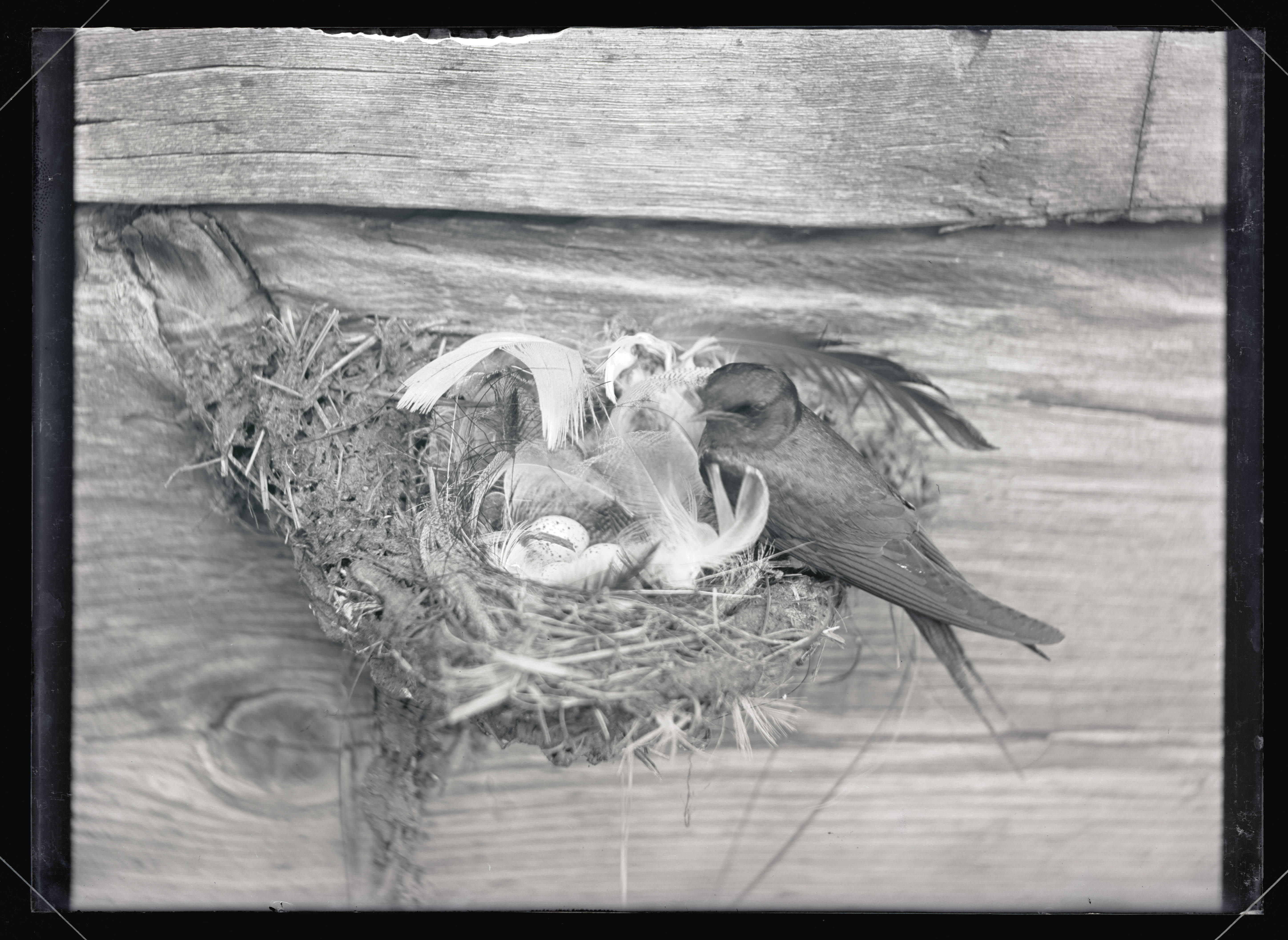
Is a biblical commandment against taking a mother bird with her young intended to teach mercy, or is it about something else?
Since March of this year, the Met Breuer, a new annex of the Metropolitan Museum, has hosted a remarkable exhibit called “Unfinished.” The works of art exhibited consist primarily of unfinished work from the Met’s permanent collection, including paintings by Rembrandt, Titian, Van Gogh, Klimt and many other noteworthy artists. Some of the works included were abruptly abandoned by their creators for various external reasons such as death, illness, or a more lucrative commission elsewhere. They feature unpainted spots of canvas, rough blurry lines or pencil sketches that are still visible. These pieces are striking in how they display the creative process of the artist at work – many display a startling unintended beauty in their incomplete form. Other paintings displayed, particularly the more modern works, were intentionally created with an unfinished or provisional quality, similar to a piece of jazz music.
Two Girls with Parasols (John Singer Sargent, 1888)
Hendrickje Stoffels (Rembrandt van Rijn, mid- 1650’s)
Many of the pieces in the exhibit don’t fit neatly in either category however – they were neither accidentally abandoned nor purposefully designed to feel incomplete. These are works that an artist stops painting because he or she decides that it captures something essential in an unfinished state that would be lost once completed. Often these paintings were not made at the behest of wealthy patrons, or for the purpose of commercial gain, but rather remained in the artist’s personal collection. See John Singer Sargent’s outdoor scene of his sister and her friend for example, or Rembrandt’s intimate portrait of his housekeeper turned life partner Hendrickje Stoffels.
At their best, all three types of paintings challenge the notion that a “perfect” piece of art is always the most effective one. The unpainted spaces and rough backgrounds of these pieces give them a raw or urgent quality. There is a dynamism to them that would be lost in a more refined, yet calcified, final product. Continue reading ““Unfinished-ness” in Art, Judaism and the Poetry of Eve Grubin”→






 The Book of Books