The Riddler

“My teacher used to say that we must learn to stay with a difficult question for forty years. Not to let up, and not to despair. Then there is a chance that we will reach the truth.”
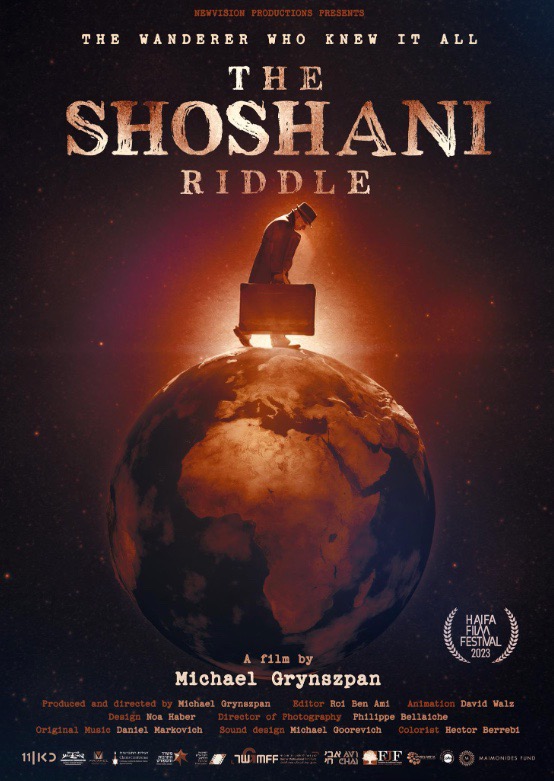
Amid the chaos and trauma of October 7, 2023, one of the innumerable cultural events deferred was the release of a unique documentary about the elusive Monsieur Shoshani. Shoshani’s mysterious persona, brilliance, and iconoclastic disposition have been the stuff of legend since he emerged from Europe after the Holocaust (he is depicted on the movie poster as a hunched-over figure carrying a suitcase). Shoshani was purportedly a master of Jewish tradition, Western philosophy, mathematics, science, and as many as thirty languages. He taught Torah everywhere he went—France, Morocco, Israel, and Uruguay—though what, exactly, he taught and where he came from remain a mystery. His students ranged from scholars and physicists to farmers and Holocaust orphans.

After he met Shoshani, the great French Jewish philosopher Emmanuel Levinas famously said, “I cannot tell what he knows; all I can say is that all that I know, he knows.” His gravestone in Montevideo, Uruguay, reportedly paid for by Elie Wiesel, reads, “His birth and life were sealed in a riddle.”

Although Shoshani’s life remains shrouded in mystery, the curtain seems to be drawing back, at least a bit.In 2021, the National Library of Israel announced Shoshani, whom Levinas once called “the Oral Torah in his entirety,” had left dozens of notebooks behind. Some of these cryptic notes…had been preserved in a secretive trust by four of his students since 1969. Another trove was donated to the National Library by Professor Shalom Rosenberg, an Argentinian-born scholar of Jewish thought at Hebrew University who became close with Shoshani toward the end of his life. For the last fifteen years, French Israeli director Michael Grynszpan has toiled and puzzled over the notebooks and the life of their author. His result is The Shoshani Riddle, which chronicles Grynszpan’s hunt for Shoshani and his attempts to piece together the master’s life story.

For the full review of this wonderful film, please the new Winter issue of Jewish Review of Books.

Shababnikim Season Two: Welcome to Rehavia

“On a bright spring day in a swanky Tel Aviv neighborhood, a handsome man sporting a trim beard and a perfectly perched black yarmulke alights from an expensive SUV. He kisses his beautiful and modestly clad wife, as three smartly dressed yeshiva boys across the street watch, swoon, and dream of similar lives for themselves. “A yeshiva boy who married well?” one suggests. “No, no—he earned it for himself!” his friend explains: After being expelled from a prestigious yeshiva for owning a smartphone, he flew to Rome, camped out for a week on the doorstep of Borsalino headquarters, and earned the right to open the first official Israeli chain of stores for the high-end Italian hatmaker. Although he is too busy earning money to study in yeshiva full time, he still dedicates time every day to study Talmud. “The modern haredi,” the boys say, sighing. “He enjoys both worlds. He has this and yet he also has that!” As they wave to him crossing the street, a large truck comes out of nowhere and plows into him. And so the show’s question remains: Is it really possible to have both this and that?”

Please check out the absolutely wonderful latest issue of Jewish Review of Books for a review of the second season of Shababnikim, a fabulous Israel television series with much more depth than initially meets the eye.

One Life to Live: Torah U-Madda Today

In a new symposium at The Lehrhaus entitled “Reclaiming Torah u-Madda,” I was given the chance to reflect on the state of “Torah U-Madda” (the relationship between Torah and Western culture) in the Modern Orthodox community today. I sought to address this topic on a philosophical level, through an analysis of a wonderful story by Isaac Bashevis Singer, as well as through some “real-world” examples of how these ideas might play out in practice. My latter comments generated more controversy than I would have liked. I would like to emphasize that my account of what has challenged me personally about my native community is not meant to constitute a comprehensive indictment of all that is wrong with Modern Orthodoxy. My goal in the essay is to introduce a philosophical framework and then briefly suggest how this framework might cohere in real-life scenarios. I don’t mind disagreement about the relevance of these scenarios but I am even more interested in discussing the worldview that underlies them.

Please see here for the full article. And I recommend perusing all of the terrific contributions to this forum.

Jewish Destiny in a Cheek Swab

Recently, junior congresswoman Alexandra Ocasio-Cortez invoked distant Jewish roots at a Queens synagogue as a preamble to celebrating the mash-up of Puerto Rican culture and by extension all cultures: “I think what it goes to show is that so many of our destinies are tied beyond our understanding.” Last year, a minor fuss erupted after New York State Senate candidate Julia Salazar made dubious claims to Jewish ancestry.

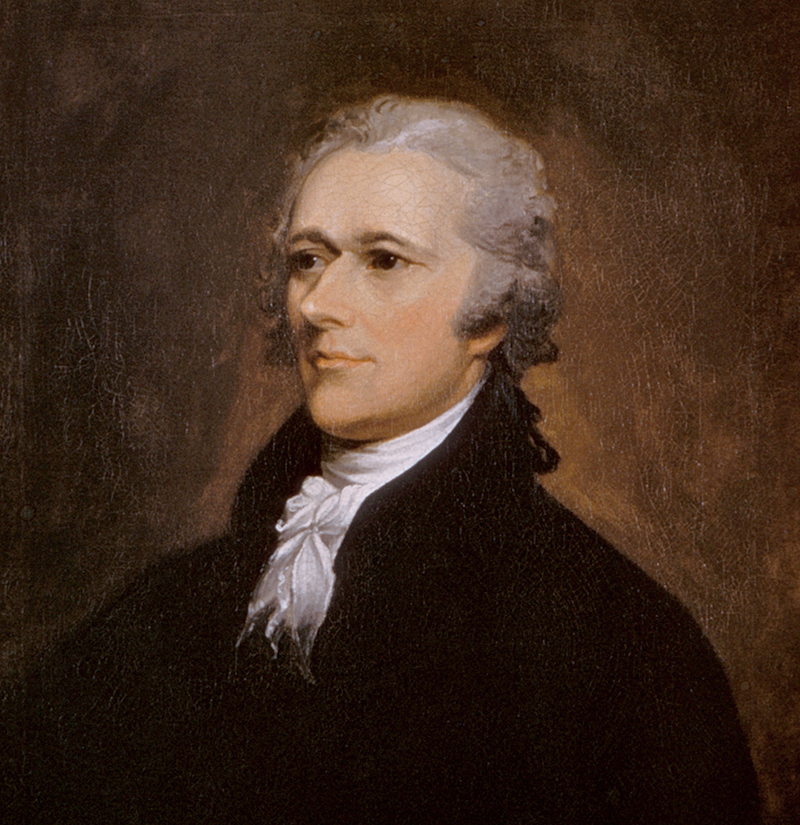
Portrait of Alexander Hamilton.
Alexander Hamilton.

Such claims, some more credible than others, have been made by various politicians and public figures. Indeed, possible Jewish ancestry has fascinated both Jews and non-Jews when it comes to American historical figures, reaching as far back as Alexander Hamilton (not to speak of my fellow columnist Stuart Schoffman’s fascinating piece on Lincoln). A recent study suggests that one in four Latin Americans has some Jewish ancestry, most likely a vestige of Jewish conversos fleeing the Inquisition to settle in the New World.

There’s something tantalizing about the prospect of uncovering your past with a cheek swab. DNA evidence is refreshingly precise in contrast with the hazy knowledge afforded by family legends and hearsay. Thanks to popular DNA analysis platforms like 23andMe, one can uncover deep connections to hundreds of individuals, of the past and present, whom you have never met. Putting aside the genuinely amazing stories of immediate family reunions that have emerged from 23andMe, the phenomenon also speaks to those with more distant threads to unravel. In one promotional video on 23andMe’s website a Lebanese American man who always wondered about his mother’s gray eyes and his love for Martin Scorsese movies is astounded to learn that he is 9 percent Italian. In that same report he finds some Ashkenazi Jewish heritage as well, a discovery he suggests might hold some promise for peace in the Middle East.

I recently purchased my own 23andMe DNA kit in a Black Friday sale and mailed it in just as Ocasio-Cortez released her Jewish heritage announcement. While I don’t struggle with any glaring mysteries about my past, the thought that these results might offer some new knowledge about myself kindled my excitement. But what kind of knowledge, really? And why the excitement?

Read the full article in the Jewish Review of Books.

.

The Bible’s New Attitude Toward Slavery

In the first part of the book of Exodus, after centuries of slavery in Egypt, God rescues the Israelites amid miracles and wonders. Their freedom, however, is not an end in itself but a precondition of their true national calling: the worship of God. Thus Moses first leads the Israelites not to the Promised Land but to Mount Sinai, where God reveals Himself and gives them the Ten Commandments. In this week’s Torah reading of Mishpatim(Exodus 21-24), which follows immediately thereafter, the Israelites are given the outline of an entire legal system, complete with instructions on tort law, financial regulations, the prohibition on witchcraft, and the agricultural holidays—a first taste of the legislation that will take up much of the remainder of the Pentateuch.

It is surprising, then, that Mishpatim, which inaugurates the legislative portion of the book of liberation, begins by speaking of slavery: “When you acquire a Hebrew slave, he shall serve six years; in the seventh year he shall go free, without payment.” This topic consumes the first 27 verses of the parashah, which in itself suggests just how far the Israelites have come: from being slaves themselves in a foreign land to being prospective owners of slaves in their own land, governed by their own laws.

At a glance, it might even seem that the oppressed have become, or are about to become, the oppressors. Yet a closer look shows that the placement of this passage is neither haphazard nor contradictory but instead forms a crucial link between the narrative and the legal segments of Exodus—beginning with the very first verse, which mentions not just slavery but also emancipation…

The full essay is posted in Mosaic Magazine