Some reflections on the Simchat Torah Massacre from my own vantage point here in Israel
On a beautiful Thursday during the middle days of Sukkot, my family took a day trip to the Golan Heights. We visited a newly developed national park called Sussita, which contains the ruins of the ancient Graeco-Roman city Hippos. It was also the site of a daring defeat of Syrian troops by ordinary residents of the nearby Kibbutz Ein Gev in Israel’s War of Independence. The site’s vivid explanatory movie had my older children mesmerized, but afterwards they started to ask questions. Are there still enemy soldiers waiting in those hilltops? Could it happen again? Could ordinary people have to fight like that to save their homes and their families? I answered, of course, by reassuring them: we live in different times today. It’s true there are people who wish to harm us but we live in a strong country with many layers of protection between children like you and those enemies. We admire the heroes of the past, but we’re grateful that we don’t have to live in such dramatic times.
On Simchat Torah two days later that reassuring narrative would collapse, and we entered a new reality, or perhaps returned to a very old one…
The full essay can be found in Mosaic Magazine as part of their excellent Gaza War symposium.
Traditional lines between the secular and religious populations are fading, particularly in the realms of music and art.
I’d like to belatedly share excerpts from an article that appeared a few months back in Mosaic Magazine. The growing popularity of religious singers among secular audiences here in Israel has been noted elsewhere. One hopes that this rising trend can serve to combat some of the tragic division we see in Israeli society right now.
“This past Sukkot, a crowd of about 500 children, parents, and grandparents gathered in the Recanati Theater in the Tel Aviv Museum of Art. The audience was made up of affluent and mostly secular residents of north Tel Aviv and its suburbs—stylishly dressed, sipping lattes and organic juice sold at the trendy coffee shop nearby. To an outside observer, the scene would be almost indistinguishable from a family-oriented play or concert in Park Slope, Brooklyn. The content, however, was distinctly Israeli: a jukebox musical called Aluf ha-Olam (literally, “Champion of the World”), based on the songs of the religious Zionist singer Hanan Ben-Ari, written and performed by Israel’s most prestigious children’s dramatic company, the Orna Porat Theater. Tickets for Aluf ha-Olam are in high demand and sell out quickly, so I booked seats for me and my children several months in advance. One could sense from the anticipation in the theater that many others had done the same.
Hanan Ben-Ari is one of Israel’s best-known musical performers, albeit without the international break-through appeal of peers like the religious music sensation Ishai Ribo. His strength is in his songwriting; catchy tunes, drawn from eclectic influences, and coherent, powerful lyrics that comment on personal, often spiritual, struggles…
…Ben-Ari’s penchant for infusing lyrics about universal topics with the language of the synagogue and yeshiva tends to obscure the boundaries between sacred and secular idioms. His 1980s-inspired feel-good ballad “Dream like Joseph,” for instance, argues that every story in the Bible reflects some basic human experience: “everyone leaves his father’s home/ everyone nearly sacrifices his child/ deep within is a little Sodom/ that he wishes to erase already/ and angels will rescue him…”
…Thus the prospect of translating Hanan Ben-Ari’s music into an Israeli secular vernacular, as Aluf ha-Olam seeks to do, is daunting, and perplexing. It raises the question of whether Ben-Ari’s biblicism and Jewish allusions are charming embellishments or so central to his work that they cannot be disentangled from it. But merely to ask this question is to acknowledge that Israeli society’s shared cultural touchstones appear to be growing more and more Jewish, and traditional lines between the secular and religious populations are fading, particularly in the realms of music and art…”
“On a bright spring day in a swanky Tel Aviv neighborhood, a handsome man sporting a trim beard and a perfectly perched black yarmulke alights from an expensive SUV. He kisses his beautiful and modestly clad wife, as three smartly dressed yeshiva boys across the street watch, swoon, and dream of similar lives for themselves. “A yeshiva boy who married well?” one suggests. “No, no—he earned it for himself!” his friend explains: After being expelled from a prestigious yeshiva for owning a smartphone, he flew to Rome, camped out for a week on the doorstep of Borsalino headquarters, and earned the right to open the first official Israeli chain of stores for the high-end Italian hatmaker. Although he is too busy earning money to study in yeshiva full time, he still dedicates time every day to study Talmud. “The modern haredi,” the boys say, sighing. “He enjoys both worlds. He has this and yet he also has that!” As they wave to him crossing the street, a large truck comes out of nowhere and plows into him. And so the show’s question remains: Is it really possible to have both this and that?”
Please check out the absolutely wonderful latest issue of Jewish Review of Books for a review of the second season of Shababnikim, a fabulous Israel television series with much more depth than initially meets the eye.
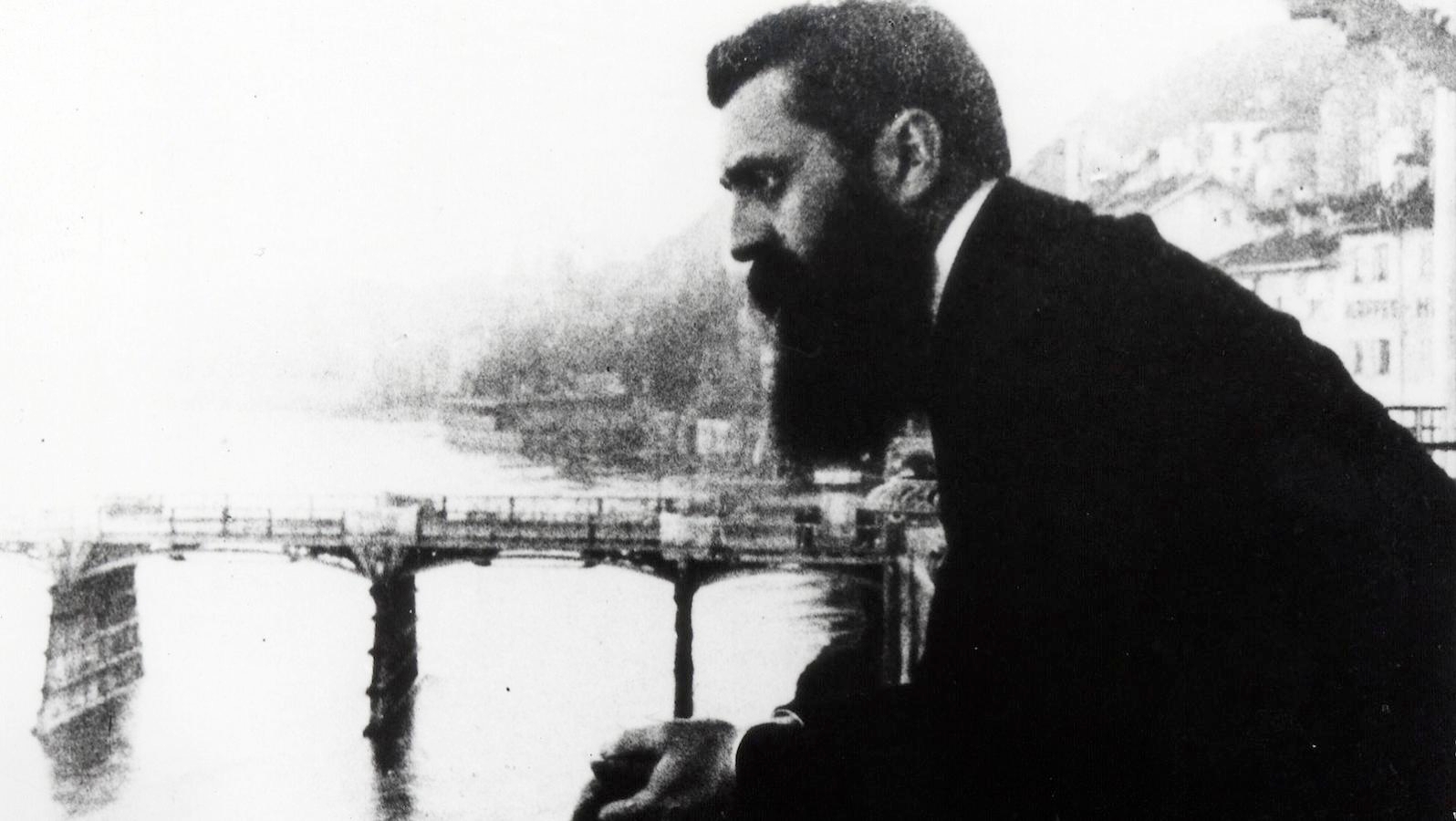
This past February 14th marked the 116th anniversary of the publication of Theodor Herzl’s manifesto The Jewish State, which lay the groundwork for the modern Zionist movement and the state of Israel. That same evening a special event took place in the Jerusalem Theater: a performance of Herzl’s play The New Ghetto, written in 1894, just a few short weeks before he began composing The Jewish State. It is commonly understood that the turning point for Herzl—the moment he realized there was no escaping from anti-Semitism even in enlightened Western Europe—was the Dreyfus Affair that began in the fall of 1894. Yet The New Ghetto, written shortly beforehand, is proof that, as some scholars have argued, a proto-Zionist sensibility had already been roiling in Herzl’s mind.
Last month’s production was a historic privilege for those who attended it: it was the first time the play has ever been performed in Israel.
For more about this wonderful performance, as well as an intriguing parallel with Tom Stoppard’s newest play Leopoldstadt, please see my new essay in Mosaic Magazine.
In March, the Tel Aviv Jewish museum formerly known as the Nahum Goldmann Museum of the Jewish Diaspora(or Beit Hatfutsot) reopened after a ten-year, $100 million renovation. Now called ANU—Museum of the Jewish People, it offers a cheery, inclusive vision of Jewish peoplehood.
Artwork by Sarah Kranz for Lubavitch International Magazine
This Is How It Begins . . .
SARAH RINDNER
Two summers ago, while my family finalized our aliyah to Israel from the New Jersey suburbs, a few favorite songs found themselves repeating on our Spotify playlist. One was a catchy song by Israeli singer Udi Davidi called “See My Light,” which is in fact filled with rabbinic teachings about redemption. The refrain is a quote from Rabbi Hiyya’s statement in the Yerushalmi Talmud (Berachot 4:2): “This is how Israel’s redemption begins, little by little, everywhere it goes, it goes and multiplies.”
The song gave me a little comfort as I spent the weeks packing up our life in the USA. When we first landed in Israel, and in the ensuing months, I certainly did not hear the bells of redemption ringing. Yet now, more accustomed to daily life and perhaps more sensitive to the spiritual nuances of the atmosphere here, not a few days pass by before I sense a little spark, a frisson, of redemption, geulah. These moments happen when I am out in nature, exploring the historically overloaded landscape of Israel. Vistas which appear in the Bible, were won and lost by numerous civilizations, and still remain a pleasant option for a Jewish family outing.
I feel redemption when my otherwise fully American children recite a verse from the Torah by heart like it is second nature, their natural sweetness blending with the sweetness of our tradition in a way that can’t be separated. Even as shops and businesses are shuttered because of the government’s response to the coronavirus, what should be a glum public mood is elevated by the goodness of the people of Israel. A young, secular smoothie-stand owner brought to his knees in debt still gives a free daily shake to every beggar who approaches his shop. Witnessing such an act of kindness, I looked at him with surprise and he pointed upward, “None of this is from us, you know?” I think I do know, little by little.
Tune into the Koren Publishers YouTube station for some wonderful Tanakh learning, both this past Sunday and this upcoming week. Featuring Rabbi Benny Lau, Professor Nechama Price, Professor Yoel Elitzur, Dr. Tova Ganzel, Rabbi Michael Hattin and Raabi Yaakov Beasley.
At the height of the coronavirus pandemic last April, when celebrities around the world were lecturing us via tweet to stay home and wear a mask, British novelist J. K. Rowling took a different approach. As kids were forced to forego school and interactions with friends, she published a new children’s book and released it in free installments for families stuck at home. The novel, The Ickabog, was published in full this past Thanksgiving. Proceeds from sales of the book are donated to communities hurt most by COVID-19.
Rowling has said that the Ickabog story first came to her years ago, when her own children were young. She wrote the book during the period in which she wrote the Harry Potter books, and claims to have made no serious modifications since that time. Yet intentionally or not, The Ickabog may be the most serious literary indictment of the mass response to the COVID-19 epidemic published to date.
The cover of JK Rowling’s The Ickabog. This may be a stretch but note the corona (Latin: crown) artfully woven into the book logo.
I bought the book as a gift for my Harry Potter-loving 9-year-old, and first picked it up on the Sabbath after Hannukah. My family had just returned from Jerusalem, where the lack of tourists and the still-considerable virus restrictions cast a pallor on this normally magical time of year. After months of closures, the street vendors of Jaffa and Ben Yehudah streets finally had their Judaica and souvenirs proudly on display, albeit with few takers. Seemingly half of the usually bustling restaurants were temporarily shuttered or closed for good. I wasn’t in the mood to read more of the endless news about the pandemic, so I turned to my son’s Rowling book looking for a light fantasy escape.
Several years ago, a blog called Judaism Without Apologies began to circulate on social media. The blog began by juxtaposing two Jewish characters’ lives and ideals: Shimen, a Gerer Hasid of sorts and Holocaust survivor living on the Upper West Side of Manhattan, and Heidi, a cosmopolitan Princeton graduate who thinks of herself as a citizen of the world.
A photograph by George Kalinsky of my own Polish Holocaust survivor grandfather at the Siyum HaShas in 1990. I imagine Shimen having a similar intense, independent-minded look.
The series was narrated by the American Israeli computer scientist Moshe Koppel, who had attended Shimen’s Gerer shtiebel in his youth. After obtaining a PhD in mathematics, Koppel spent a year at Prince- ton’s Institute for Advanced Study, where he met the original Heidi, the first of many he would encounter in the years to come. Koppel’s blog may have been rooted in comic sociology, but it quickly morphed into a serious discussion of moral philosophy, game theory, cultural anthropology, the nature of language, and ultimately an argument about the future of Judaism itself. Despite its rather niche appeal, the blog’s unique fusion of a no-holds-barred attitude with serious erudition attracted some diehard fans. Koppel has just published an expanded book-length version, which presents a cleaned-up and even more compelling defense of the old-fashioned Judaism Koppel imbibed in the shtiebel.
Shimen, a real-life acquaintance of Koppel (Heidi is a composite), is at the heart of the book. He survived the Lodz Ghetto and Auschwitz, but his wife and two precious children did not. After the war, Shimen picked up a handgun and collected Jewish children who had been hidden by Polish families and returned them to their communities. Elie Wiesel, who prayed in Shimen’s Gerer shtiebel from time to time, once told a story about celebrating Rosh Hashanah in Auschwitz without wine. An inmate announced, “we’ll take out tin cups and fill them with tears. And that is how we’ll make our kiddush . . . heard before God.” That, apparently, was Shimen. Koppel writes of Polish Hasidic Holocaust survivors like him:
[They] were intense, they were angry, they could be funny in a biting sort of way. . . . But one thing they had no patience for was high-minded pieties. They despised pomposity and self-righteousness. Their devotion to Yiddishkeit, old-fashioned Judaism, as a way of life, and to the Jews as a people, were as natural and instinctive as drawing breath.
“Shortly before the 1991 Gulf War, Rabbi Yaakov Smith, a father of six and an emissary of the Chabad Hasidic movement in the Old City of Jerusalem, hosted a Shabbat dinner. As the guests were leaving, one took Smith aside and said something that would reverberate with his host: “That was an amazing act you performed. Whatever is wrong, take care of yourself.” Fast forward thirty years and Yaakov has become Yiscah Smith, a transgender person who still lives and teaches in Jerusalem. Smith’s transformation is the subject of the documentary I Was Not Born a Mistake, created by the Israeli filmmakers Rachel Rusinek and Eyal Ben-Moshe. The film premiered at the Jerusalem Film Festival this past Hanukkah and made its U.S. debut in January.: