The Riddler

“My teacher used to say that we must learn to stay with a difficult question for forty years. Not to let up, and not to despair. Then there is a chance that we will reach the truth.”
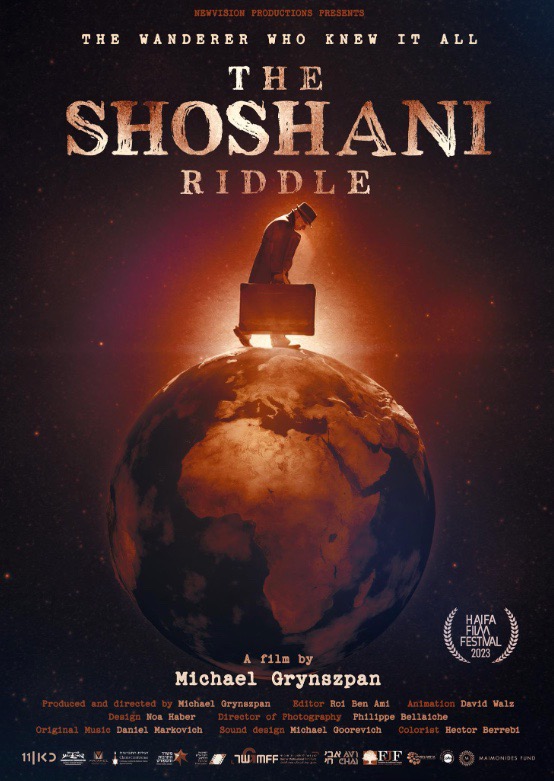
Amid the chaos and trauma of October 7, 2023, one of the innumerable cultural events deferred was the release of a unique documentary about the elusive Monsieur Shoshani. Shoshani’s mysterious persona, brilliance, and iconoclastic disposition have been the stuff of legend since he emerged from Europe after the Holocaust (he is depicted on the movie poster as a hunched-over figure carrying a suitcase). Shoshani was purportedly a master of Jewish tradition, Western philosophy, mathematics, science, and as many as thirty languages. He taught Torah everywhere he went—France, Morocco, Israel, and Uruguay—though what, exactly, he taught and where he came from remain a mystery. His students ranged from scholars and physicists to farmers and Holocaust orphans.

After he met Shoshani, the great French Jewish philosopher Emmanuel Levinas famously said, “I cannot tell what he knows; all I can say is that all that I know, he knows.” His gravestone in Montevideo, Uruguay, reportedly paid for by Elie Wiesel, reads, “His birth and life were sealed in a riddle.”

Although Shoshani’s life remains shrouded in mystery, the curtain seems to be drawing back, at least a bit.In 2021, the National Library of Israel announced Shoshani, whom Levinas once called “the Oral Torah in his entirety,” had left dozens of notebooks behind. Some of these cryptic notes…had been preserved in a secretive trust by four of his students since 1969. Another trove was donated to the National Library by Professor Shalom Rosenberg, an Argentinian-born scholar of Jewish thought at Hebrew University who became close with Shoshani toward the end of his life. For the last fifteen years, French Israeli director Michael Grynszpan has toiled and puzzled over the notebooks and the life of their author. His result is The Shoshani Riddle, which chronicles Grynszpan’s hunt for Shoshani and his attempts to piece together the master’s life story.

For the full review of this wonderful film, please the new Winter issue of Jewish Review of Books.
The Rabbi Who Chose Trans Orthodoxy

“Shortly before the 1991 Gulf War, Rabbi Yaakov Smith, a father of six and an emissary of the Chabad Hasidic movement in the Old City of Jerusalem, hosted a Shabbat dinner. As the guests were leaving, one took Smith aside and said something that would reverberate with his host: “That was an amazing act you performed. Whatever is wrong, take care of yourself.” Fast forward thirty years and Yaakov has become Yiscah Smith, a transgender person who still lives and teaches in Jerusalem. Smith’s transformation is the subject of the documentary I Was Not Born a Mistake, created by the Israeli filmmakers Rachel Rusinek and Eyal Ben-Moshe. The film premiered at the Jerusalem Film Festival this past Hanukkah and made its U.S. debut in January.:

Read the full review at First Things.

Mikva the Musical

On a June evening in the suburban Orthodox mecca of Teaneck, NJ, a long line of women snaked outside a small independent theater that rarely sees much of a crowd. They were waiting to see Mikva the Musical, which came to the U.S. for a weeklong, women-only run following a successful stint in Israel.

Of course, the terms “mikveh” and “musical” don’t normally go together. A mikveh is a ritual bath, in which, among its other functions, married observant Jewish women immerse themselves each month after completing their menstrual cycles. It’s not something one associates with showtunes and zippy dance numbers: precisely the surprising juxtaposition that gives the play much of its humor and charm.

Read the full article in Mosaic Magazine.

Shas: The Movie

Screen Shot 2019-04-11 at 2.55.07 PM

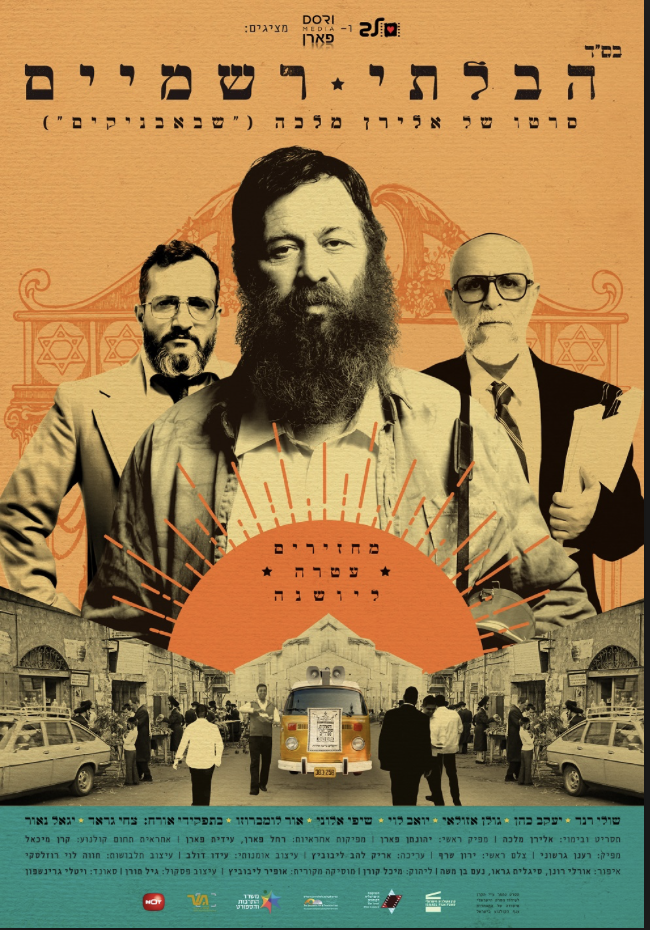
As a particularly raucous Israeli election season enters the homestretch, a recent Israeli film, now making the Jewish film festival circuit with subtitles, provides some perspective. It’s called The Unorthodox (Ha-bilti Rishmiyim, literally “Those Without Permission”) and tells the little known story of the founding of the Shas political party, a punning acronym for “Torah observant Sephardim.”

See the Jewish Review of Books for the full review.

Tragedy and Comedy in Black and White

Lately it seems to be the season of haredim on screen. My immersion in this very particular oeuvre began with Shtisel, the 2013 runaway hit Israeli TV series, which depicts a haredi family in Jerusalem in all of its complicated, charming dysfunction. (The first two seasons are now available with English subtitles on Netflix.) More recently, Autonomies (2018) presents a dystopian division of Israel into separate secular and religious states. In the United States, two recent documentaries showcase radically divergent ways of understanding the New York Hasidic community and the experience of marginal figures within it. Haredi Jews are not always interchangeable with Hasidic ones, and Israeli soap operas are different than American art-house documentaries. Yet in considering all of these offerings, certain patterns inevitably emerge. Counterintuitively, the more serious offerings in this genre are the ones with a lighter touch.

Read the full article in Jewish Review of Books.

Welcome to the Jungle: Shababniks Meet the Spotlight

This article appeared yesterday on The Lehrhaus. The first episode of Shababnikim may be viewed with subtitles here.

shabab2-1519156338

Sarah Rindner

Israel has produced several fabulous television series in recent years, perhaps especially those which depict fictional lives of religious Jews. These include the iconic Srugim, which tracks the Friends-like relationships between a group of single friends navigating the South Jerusalem “national religious” dating scene. The entertaining, if somewhat melodramatic, Kathmandu follows the legitimately exciting lives of a Chabad couple living and working in Nepal. Shtisel, both hysterically funny and understated, set a new bar for subtlety and depth in exploring the dynamics of a rather dysfunctional but wholly endearing hasidic-haredi family in Jerusalem.

Shababnikim, one of the latest additions to the mix, is a slickly produced and fast-paced series that chronicles the adventures, both external and internal, of four twenty-something denizens of an elite haredi yeshiva in Jerusalem. The aesthetics, four studs sauntering off to some irrelevant destination with the backdrop of a throbbing rock soundtrack, recalls the HBO series Entourage. The substance spans the gamut from romantic comedy to profound observations about Judaism, the relationship between the religious and secular worlds, and what it means to be a man. In other words, it’s the kind of series that could only exist in present-day Israel, and it’s the invention of a talented religious graduate of the Ma’aleh film school named Eliran Malka.

For the full review see here


The Problem with the Tablets

tencommandmentscover-0

“For Cecil B. DeMille,the revelation at Sinai was a purely solitary affair. Charlton Heston’s Moses ascends the mountain on an individual spiritual quest; he hears the Ten Commandments as the Israelites are preparing to worship the golden calf. The scene certainly captures part of the biblical narrative, but it ignores entirely the collective and communal aspect of the moment, as well as the tension between the people’s desire for direct knowledge of God and their quite correct fear of what such knowledge entails. It also ignores the all-important prelude to the revelation: the covenant between God and Israel, for which Moses is nothing more than a go-between.”

For the full article, see this week’s Mosaic Magazine.


Crazy Beautiful Startup: A Review of The Wedding Plan


In the Summer 2017 issue of the Jewish Review of Books, I review The Wedding Plan, the latest from Israeli filmmaker Rama Burshtein.

theweddingplan-cur

Excerpt:

Born in New York and raised in Israel, Burshtein currently lives with her family among a small cluster of Hasidic families in the predominantly secular Tel Aviv. Early in her career, she worked in the ultra-Orthodox cottage industry of films made by and for women, but when Fill the Void came out she crossed over to the international film festival and art house cinema scene, without losing touch with her initial audience. It was possible to enjoy Fill the Void as the tale of an unexpected love story amid tragic circumstances in an exotic setting, but it also spoke to her original audience. That film’s soundtrack was punctuated by a modern Israeli rendition of the song  “Im Eshkacheikh” (If I Forget Thee O Jerusalem), which is often sung under the wedding canopy. For those conversant with Jewish tradition, the song powerfully expressed the connection between the film’s plot and the tension between joy and tragedy already evoked in the Jewish wedding ceremony itself.

A similarly poignant countertext in The Wedding Plan is the hymn “Eshet Chayil” (Proverbs 31), which is traditionally sung each Friday night before Shabbat dinner. Like the film itself, it sings the praises of a faithful “woman of valor.” Early in the film, Michal confesses her desire for a husband to sing “Eshet Chayil” to her, and the film closes with a rendition of the song. While the traditional performance of the song presupposes a husband to sing it, the woman of valor’s husband is not really described in the hymn. It is she who takes care of all of her family’s needs, engages in complex business ventures, cares for the poor, elevates her husband’s standing, and is, consequently, cloaked in strength and majesty, as well as wisdom and kindness. In incorporating this song, Burshtein places her idiosyncratic heroine in the tradition of great Jewish women, but not without some gentle irony. How far, after all, is Michal from that desperate bachelor who proposed to her, and every other woman, on the first date?

Click here to read the article in full

Moana and the Call of Jewish Destiny

This article originally appeared on TheLehrhaus.Com

Animated Disney films, with all of their fantasy and froth, often contain some deep ideas or archetypes. Moana, the latest offering from Disney studios, is no exception. Moana, the protagonist whose name means “ocean” in several Polynesian languages, is a girl who is destined to assume leadership of the fictional South Pacific island of Motunui. Yet she feels drawn to the sea. She undertakes a series of adventures along with a demi-god “trickster” named Maui in order to restore equilibrium to their increasingly imperiled natural environment. All of this is set against a mash-up of pre-modern Polynesian traditions and myths that, according to scholars and critics, is accurately and respectfully depicted. The film’s animation is gorgeous—like Moana, the viewer also feels the call of the shimmering Pacific ocean and expansive sky. All in all, it is an enjoyable film, setting aside some of the pagan elements which go with the territory.

moana-singing-boats-shore

More interestingly, the film also breaks from, or improves upon, the typical Disney formula whereby a princess is stuck in some sort of repressive environment but yearns to break free. The central expression of this trope in Moana is the song “How Far I’ll Go,” composed by Lin-Manuel Miranda of Hamilton fame:

Continue reading “Moana and the Call of Jewish Destiny”