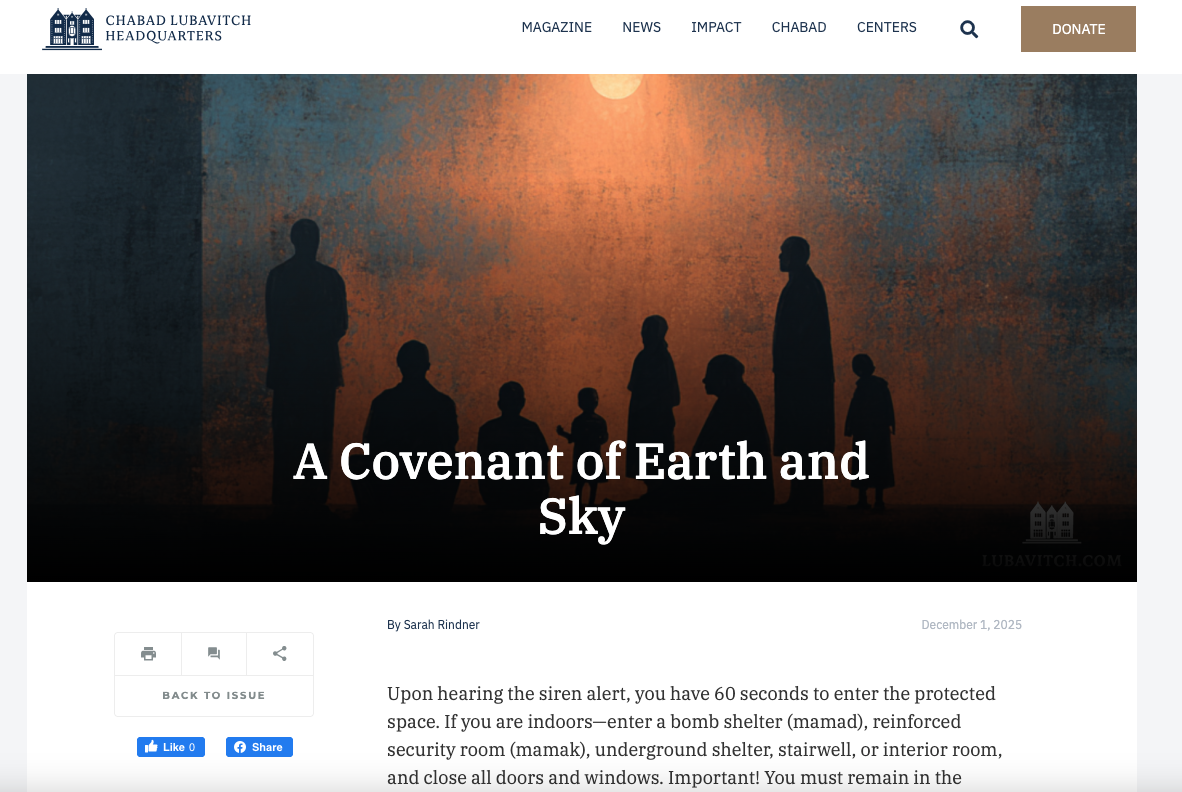
A Covenant of Earth and Sky

In the early hours of June 13 my family and I, like all Israelis, were awakened by the shrill sound of a phone alert. Israel had preemptively attacked Iran’s nuclear facilities. Momentous news, but I promptly put my pillow over my head and went back to sleep. Only when we woke up again later that morning did we realize that something historic had occurred. We also understood that a challenging period lay ahead.

We had only recently moved into a new home and, despite Houthis sporadically firing missiles in our direction, we had grown lax about running to our safe room, what Israelis call a mamad. Ours was filled with dust and leftover construction material. But on the day of the phone alerts—once we’d grasped the gravity of what was happening—we got to work. We spread a plastic mat over the floor, brought in a spare mattress, and set up a pack-and-play crib. The missile fire from Iran began in earnest that evening.

As the days wore on, we adjusted to the confines of this small space where emotions vacillated between fear, comfort from the presence of those we loved, and occasional irritation by those very same people. One mattress turned into four—each of our seven children laid claim to their own little spot. The more time we spent in our safe room, sometimes joined by friends or near strangers who needed a place to shelter, the more we acclimated ourselves to its deprivations and, occasionally, to its surreal benefits. Sociologists talk about the “third place,” which is an additional living space beyond home or work, like a synagogue, for example. These places expose us to people, ideas, and experiences beyond our immediate family and daily routines. During Israel’s twelve-day war with Iran our safe rooms also became a third place, introducing a new mentality and way of being that removed us from our day-to-day lives.

Read the full article, just recently posted online, from the Fall issue of Lubavitch International Magazine.
Children of the Book

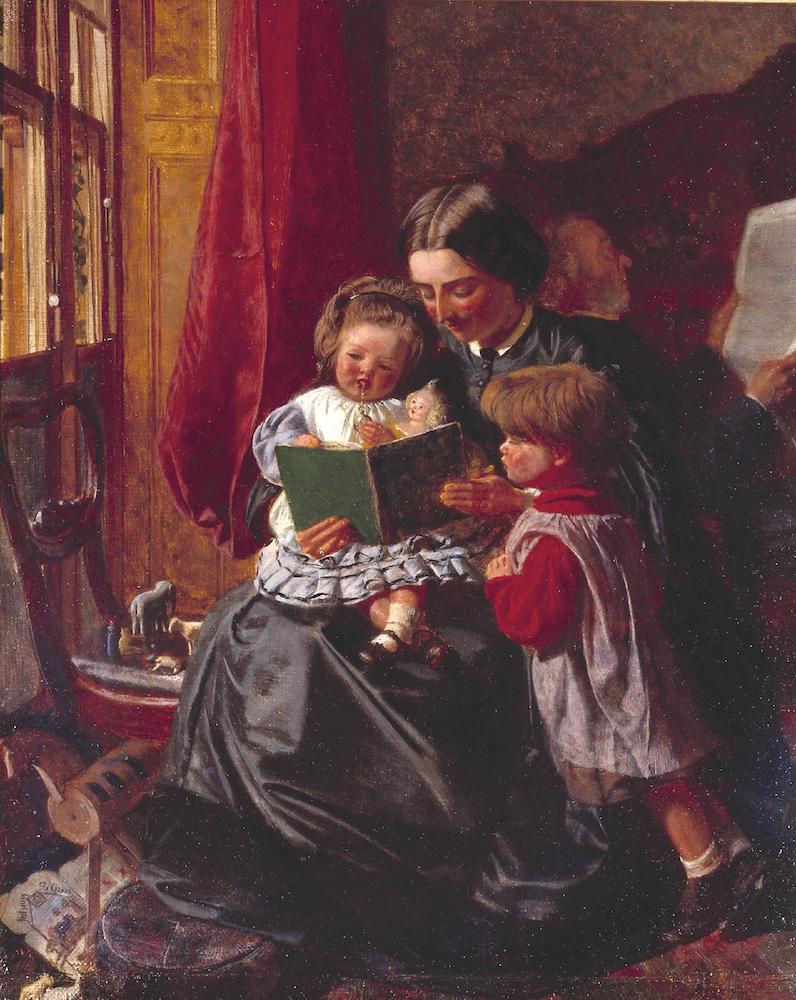
“Books, even works of genius, are not incandescent orbs that exist independently in some kind of ether. For books to have enduring value, they must be read by people. For those readers to exist, they must be born and raised.”

Was a pleasure to review Ilana Kurshan’s fantastic new book for the Summer issue of Tradition, now available online.

The Heirs of Asher Lev: Exploring the Art of Menachem Halberstadt and Hendel Futerfas

In Chaim Potok’s classic novel My Name Is Asher Lev, a young Chasidic boy tries to integrate his religious faith with his prodigious artistic talent. In school he scribbles on the margins of his sacred books. On weekends he takes clandestine trips to view Renaissance art at the Brooklyn Museum. Throughout the novel he grapples with the question: Is art something that brings us closer to G-d and to the Jewish people, or does it operate on another plane entirely? 

Asher Lev is a member of the Ladover sect, a thinly disguised stand-in for Chabad-Lubavitch, and the beloved Ladover Rebbe gently explains that it makes no difference whether a man is a shoemaker or a lawyer or a painter; rather, “a life is measured by how it is lived for the sake of Heaven.” Yet, despite the Rebbe’s encouragement, ultimately Potok’s book insists that the chasm between the life of a Chasid and that of an artist is impossible to fully bridge.

The role of visual art in the religious Jewish worldview has always been somewhat tenuous. This may be rooted in the Torah itself: the second of the Ten Commandments prohibits the creation of graven images and the “likeness of any thing that is in the heavens above, that is in the earth beneath, or that is in the water under the earth.” But it may also be an accidental byproduct of history: the destruction of the Holy Temple in Jerusalem in all its aesthetic glory, the exclusion of Jews from artistic guilds, and the overwhelming dominance of Christian iconography in the history of Western art. While Jewish decorative arts abound—micrography, illuminated manuscripts, silver Judaica items—Jewish representation in the fine arts, at least prior to the modern era, is decidedly less pronounced. And while Jewish individuals have achieved prominence as modern artists, they tend toward secularism and individualism in both worldview and artistic language. We have yet to see a uniquely Jewish artistic idiom arise—that is, a path forward for an artist who wishes to tie him- or herself to a Jewish tradition in visual art. 

To read the full article please see the gorgeous art-themed Fall/Winter Issue of Lubavitch International Magazine.
Invest in Your Future Family: A Mommash Parenting Podcast

While podcasts are not yet entirely in my comfort zone, I appreciated the invitation to talk to Lori Fein Ramirez about family life and some of challenges as well as opportunities that we’ve encountered. Lori’s hilarious summary below:

Sarah Rindner Blum, an author, literature professor, and mother to a “steps and stairs” family of seven children in twelve years, shares her insights on why having “one more kid” is worth the investment. Join us for deep reflections on how each child offers something unique and priceless, how different roles for mom and dad make it work, Israeli vs. American cultural attitudes toward children, why Shabbat is the center of her homemaking all week long, spontaneity versus planning, lots of candy, her semi-broken set of devices for her family, some favorite children’s books, making literature a part of your family lore, her trash-into-treasures child, a mouse named Bob, having a home life different than you had imagined, why there’s nothing like an American minivan, and why a Jewish mama only needs to cook once a week.

Feel free to give it a listen on Spotify, Apple, or wherever you listen to your podcasts, and make sure to follow Mommash: The Oy and Joy of Parenting for loads of wonderful parenting wisdom.

The Rabbi Who Chose Trans Orthodoxy

“Shortly before the 1991 Gulf War, Rabbi Yaakov Smith, a father of six and an emissary of the Chabad Hasidic movement in the Old City of Jerusalem, hosted a Shabbat dinner. As the guests were leaving, one took Smith aside and said something that would reverberate with his host: “That was an amazing act you performed. Whatever is wrong, take care of yourself.” Fast forward thirty years and Yaakov has become Yiscah Smith, a transgender person who still lives and teaches in Jerusalem. Smith’s transformation is the subject of the documentary I Was Not Born a Mistake, created by the Israeli filmmakers Rachel Rusinek and Eyal Ben-Moshe. The film premiered at the Jerusalem Film Festival this past Hanukkah and made its U.S. debut in January.:

Read the full review at First Things.

Man Shouts What He is Missing: An Anthem for the Corona Lockdown

“In the last two weeks of seger (lockdown) in Israel, an almost laughably long list of public figures have admitted to violating the Covid-19 lockdown restrictions. Some of them are lawmakers who are themselves directly responsible for initiating the lockdown.”

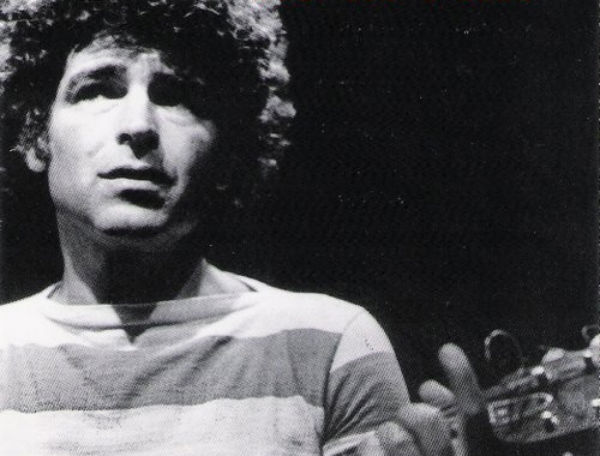
Join me as I try to explore what is going on here, with the help of the iconic Israeli musician Meir Ariel. On Arutz Sheva/Israel National News.

My Body in the East, My Heart in the West

Earlier this year, our family left a suburban Jewish community in New Jersey that we loved in order to fulfill a dream of making aliyah to Israel. In the years leading up to our move, we frequently discussed the merits and drawbacks of life in Israel versus the US. We discussed matters like the dangers of living in an isolated enclave surrounded by enemy states versus our seemingly comfortable and secure  American lives. My husband often pointed out the spiritual dangers of life in the diaspora as well as the potential for established ways of life to degenerate rapidly, even in advanced Western societies. We boarded our aliyah flight against the backdrop of a common web of excitement, anticipation, and doubt.

friedman1

Once in Israel, however, our commonplace constellation of concerns was complicated, perhaps overshadowed, by a new set of events. A wave of antisemitic incidents in the New York City area in late 2019 left us to glued to American news sources for updates. I grew up in the idyllic religious community of Monsey; in my mind it was the peaceful foil to whatever uncertainty we encountered in Israel. Yet the  attack on a local Hanukkah party  by a machete-wielding lunatic revealed that this place was hardly immune from hatred and violence.  Sitting in Israel with rockets from Gaza falling in the distance, my heart was nevertheless in New York and New Jersey, concerned about family members and friends.  I had the  stomach-churning sense that the problem was unlikely to dissipate anytime soon….

For the full essay (which includes a discussion of Yehuda Halevi and Yehuda Amichai) see The Lehrhaus.

A Family Treasure: The Siddur That Survived Auschwitz

lasting-impressions-rindner-siddur-holocaust-auschwitz

My young daughter was playing in my mother’s living room and approached me holding a battered prayer book she found on the shelf. When I realized what it was, I gasped. I hadn’t thought of it in years, but the siddur is a family treasure. My grandmother, Raizel Berger, a native of the Maramures region of Romania, was sent to Auschwitz along with her family in 1944. She managed to smuggle a small siddur into the camp by hiding it in her stocking garter. The young women in her bunker, mostly Chasidic Jews from Romania and Hungary, took turns praying from it each night. One of the girls worked in the kitchen and snuck out a potato sack to use as a cover for the siddur, onto which she used a rough yarn to beautifully embroider a Star of David in the center. The pages of the siddur are delicate with age, but the section of Tehillim (Psalms) is particularly worn from repeated use.

After the war, my grandmother married my grandfather, a Holocaust survivor from Poland. They moved to the United States and had four daughters in quick succession. The siddur continued to be used on a daily basis in their brownstone home in Brooklyn. Each holiday, my grandparents lit dozens of Yizkor candles for their many murdered family members. But their resilience to transition into loving parents and industrious new immigrants almost immediately after surviving such horrors still baffles the mind. So too the siddur, once hidden in the bowels of a dark dungeon and used by inmates of the most horrific and debased place on earth, transitioned to use for mundane, though still holy, daily prayers. In unsentimental fashion typical of Jews of my grandparents’ type, the siddur was not treated as a talisman. At some point, someone even scrawled a phone number on the inside cover…

For the full essay please see the Winter 2019/2020 edition of Jewish Action Magazine.

Why Rachel’s Tomb Occupies So Remarkable a Place in the Physical and Spiritual Geography of Judaism

The Tomb has become a shrine for thousands of pilgrims, just as Rachel herself has become the religion’s ultimate matriarch. Why?

In 1995, when the Oslo process was in full swing, then-Prime Minister Yitzḥak Rabin was planning to hand over several West Bank cities to the Palestinian Authority. Among them was Bethlehem, where the site venerated by Jews as the tomb of the biblical matriarch Rachel is located.

Disturbed at the thought that Israel would relinquish the tomb, Rabbi Ḥanan ben Porat, an influential settlement activist, met with Rabin to convince him to leave it under Israeli control. On the way to this meeting, Porat was unexpectedly joined by Rabbi Menachem Porush, a Knesset member for the ultra-Orthodox, and formally non-Zionist, United Torah Judaism party.

At the meeting itself, Porat put forth a series of arguments, most of them security-related, to persuade Rabin that handing over Rachel’s Tomb would be a mistake. But Porush, to Rabin’s surprise, began to weep and grabbed the prime minister’s hands: “Yitzḥak, it’s Mama Rachel, Mama Rachel!” In Porat’s telling, Rabin was so moved that he changed the agreement so that the site would remain under full Israeli control—a decision in which the Palestinians concurred.

The biblical accountof Rachel’s death can be found in this week’s Torah reading of Vayishla(Genesis 32:4–36:43), which begins with Jacob’s tense reunion with his brother Esau. After years of enmity, the two embrace and weep and then go their separate ways. Shortly afterward, Jacob’s beloved wife Rachel dies while giving birth to her second son, Benjamin. She is not buried in the family tomb in the Makhpelah Cave, where Jacob will be buried alongside his other wife—Rachel’s sister Leah—and where Abraham, Isaac, Sarah, and Rebecca were already interred. Instead, Jacob buried her “on the road to Ephrath, now Bethlehem. Over her grave Jacob set up a pillar; it is the pillar at Rachel’s grave to this day.”

Read the full essay at Mosaic Magazine.

Mikva the Musical

On a June evening in the suburban Orthodox mecca of Teaneck, NJ, a long line of women snaked outside a small independent theater that rarely sees much of a crowd. They were waiting to see Mikva the Musical, which came to the U.S. for a weeklong, women-only run following a successful stint in Israel.

Of course, the terms “mikveh” and “musical” don’t normally go together. A mikveh is a ritual bath, in which, among its other functions, married observant Jewish women immerse themselves each month after completing their menstrual cycles. It’s not something one associates with showtunes and zippy dance numbers: precisely the surprising juxtaposition that gives the play much of its humor and charm.

Read the full article in Mosaic Magazine.