The Riddler

“My teacher used to say that we must learn to stay with a difficult question for forty years. Not to let up, and not to despair. Then there is a chance that we will reach the truth.”
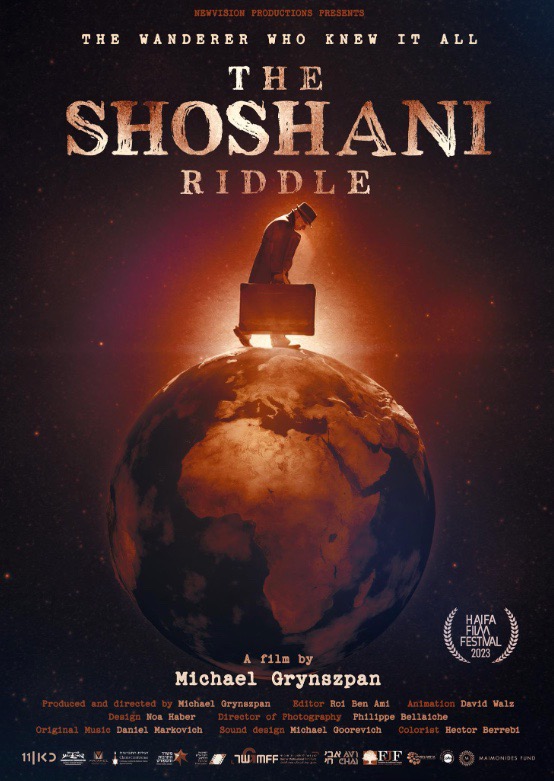
Amid the chaos and trauma of October 7, 2023, one of the innumerable cultural events deferred was the release of a unique documentary about the elusive Monsieur Shoshani. Shoshani’s mysterious persona, brilliance, and iconoclastic disposition have been the stuff of legend since he emerged from Europe after the Holocaust (he is depicted on the movie poster as a hunched-over figure carrying a suitcase). Shoshani was purportedly a master of Jewish tradition, Western philosophy, mathematics, science, and as many as thirty languages. He taught Torah everywhere he went—France, Morocco, Israel, and Uruguay—though what, exactly, he taught and where he came from remain a mystery. His students ranged from scholars and physicists to farmers and Holocaust orphans.

After he met Shoshani, the great French Jewish philosopher Emmanuel Levinas famously said, “I cannot tell what he knows; all I can say is that all that I know, he knows.” His gravestone in Montevideo, Uruguay, reportedly paid for by Elie Wiesel, reads, “His birth and life were sealed in a riddle.”

Although Shoshani’s life remains shrouded in mystery, the curtain seems to be drawing back, at least a bit.In 2021, the National Library of Israel announced Shoshani, whom Levinas once called “the Oral Torah in his entirety,” had left dozens of notebooks behind. Some of these cryptic notes…had been preserved in a secretive trust by four of his students since 1969. Another trove was donated to the National Library by Professor Shalom Rosenberg, an Argentinian-born scholar of Jewish thought at Hebrew University who became close with Shoshani toward the end of his life. For the last fifteen years, French Israeli director Michael Grynszpan has toiled and puzzled over the notebooks and the life of their author. His result is The Shoshani Riddle, which chronicles Grynszpan’s hunt for Shoshani and his attempts to piece together the master’s life story.

For the full review of this wonderful film, please the new Winter issue of Jewish Review of Books.

Kuma: The Story of the Jewish People

The Bible Lands Museum in Jerusalem is known for its collection of Near Eastern antiquities from the Biblical period. Yet amidst its galleries stands a startling cultural artifact of far more recent origin.

Kuma—meaning “Rise”—is a nearly ten-foot-long scroll depicting a dense, vivid, intellectually rich, and aesthetically stunning account of Jewish history. Its full title, Kuma, Mei Afatzim ve-Kankantum,” refers to the materials used to prepare ink for Torah scrolls and other sacred texts. Evoking an unfurled Torah scroll, Kuma is the high-school senior project of a brilliant young yeshiva student, artist and poet named Eitan Rosenzweig הי”ד. Staff Sgt. Rosenzweig, an Alon Shvut native and student in the Yerucham Yeshivat Hesder, served in the Givati brigade and was killed in Gaza in November 2023, at the age of 21.

Kuma weaves together Jungian theories of the unconscious, the mythologist Joseph Campbell’s concept of the heroic journey, and imagery drawn from Western art and Jewish history—some of which appear elsewhere in the Bible Lands Museum. Kuma also incorporates literary allusions to the Bible, Talmud, modern Hebrew literature, Eastern and Western general philosophy, and more. It is a work of art that one must study rather than merely observe.

The full essay can be read at Tradition Online.

Faith and Art in Communist Russia

Anatoly Kaplan was the rare Jewish artist who managed to explore Jewish themes under the eyes of Soviet censors

My review of a wonderful art exhibit at Beit Avi Chai which appeared in the Fall 2023 Issue of Lubavitch International Magazine was recently posted to the web. The exhibit is called “The Enchanted Artist” and it was a the first major exhibit in Israel devoted to the artwork of Anatoly Kaplan, who according to the curators was “the only artist in the Soviet Union to put Jewish culture at the forefront of his work and to be recognized by the Soviet regime despite that.” Kaplan’s paintings are remarkable for how nimbly they incorporate Jewish themes while evading the Soviet censors, and they are also simply remarkable in their own right. It was a pleasure to learn more about Kaplan and also think about how the pressures that weighed upon Kaplan also drove the evolution of Chabad Lubavitch itself: “In a sense, Chabad’s collective memory and ethos were forged in the crucible of communism, in the midst of immense hardship that led to heroism—the sheer difficulty of Jewish observance driving home its precious necessity.”

“In a gray, dimly lit room, a mother ties a red kerchief atop her daughter’s school dress. Behind them, even more deeply in shadow, sits a bearded man wrapped in a traditional black and white tallit, bent over a prayerbook. 

The scene seems innocent enough, and yet, small details hint to the influence of powerful forces beyond the domestic sphere: The red kerchief was an obligatory symbol of membership in the Communist youth movement. The religious man is surrounded by two red curtains, which both serve to frame his figure and also suggest that he may need to hide at a moment’s notice. Even in 1976, when this painting was created by Russian-Jewish artist Anatoly Kaplan, it was nearly impossible to be an observant Jew in the Soviet Union. Like much of Kaplan’s work, Interior draws us into a world of tensions, memories, and contradictions inherent in the experience of Jews in Communist Russia.”

Read the full article at Lubavitch.com.

A Religious Musical in Secular Tel Aviv

Traditional lines between the secular and religious populations are fading, particularly in the realms of music and art.

I’d like to belatedly share excerpts from an article that appeared a few months back in Mosaic Magazine. The growing popularity of religious singers among secular audiences here in Israel has been noted elsewhere. One hopes that this rising trend can serve to combat some of the tragic division we see in Israeli society right now.

“This past Sukkot, a crowd of about 500 children, parents, and grandparents gathered in the Recanati Theater in the Tel Aviv Museum of Art. The audience was made up of affluent and mostly secular residents of north Tel Aviv and its suburbs—stylishly dressed, sipping lattes and organic juice sold at the trendy coffee shop nearby. To an outside observer, the scene would be almost indistinguishable from a family-oriented play or concert in Park Slope, Brooklyn. The content, however, was distinctly Israeli: a jukebox musical called Aluf ha-Olam (literally, “Champion of the World”), based on the songs of the religious Zionist singer Hanan Ben-Ari, written and performed by Israel’s most prestigious children’s dramatic company, the Orna Porat Theater. Tickets for Aluf ha-Olam are in high demand and sell out quickly, so I booked seats for me and my children several months in advance. One could sense from the anticipation in the theater that many others had done the same.

Hanan Ben-Ari is one of Israel’s best-known musical performers, albeit without the international break-through appeal of peers like the religious music sensation Ishai Ribo. His strength is in his songwriting; catchy tunes, drawn from eclectic influences, and coherent, powerful lyrics that comment on personal, often spiritual, struggles…

…Ben-Ari’s penchant for infusing lyrics about universal topics with the language of the synagogue and yeshiva tends to obscure the boundaries between sacred and secular idioms. His 1980s-inspired feel-good ballad “Dream like Joseph,” for instance, argues that every story in the Bible reflects some basic human experience: “everyone leaves his father’s home/ everyone nearly sacrifices his child/ deep within is a little Sodom/ that he wishes to erase already/ and angels will rescue him…”

…Thus the prospect of translating Hanan Ben-Ari’s music into an Israeli secular vernacular, as Aluf ha-Olam seeks to do, is daunting, and perplexing. It raises the question of whether Ben-Ari’s biblicism and Jewish allusions are charming embellishments or so central to his work that they cannot be disentangled from it. But merely to ask this question is to acknowledge that Israeli society’s shared cultural touchstones appear to be growing more and more Jewish, and traditional lines between the secular and religious populations are fading, particularly in the realms of music and art…”

For the full article see here.

One Life to Live: Torah U-Madda Today

In a new symposium at The Lehrhaus entitled “Reclaiming Torah u-Madda,” I was given the chance to reflect on the state of “Torah U-Madda” (the relationship between Torah and Western culture) in the Modern Orthodox community today. I sought to address this topic on a philosophical level, through an analysis of a wonderful story by Isaac Bashevis Singer, as well as through some “real-world” examples of how these ideas might play out in practice. My latter comments generated more controversy than I would have liked. I would like to emphasize that my account of what has challenged me personally about my native community is not meant to constitute a comprehensive indictment of all that is wrong with Modern Orthodoxy. My goal in the essay is to introduce a philosophical framework and then briefly suggest how this framework might cohere in real-life scenarios. I don’t mind disagreement about the relevance of these scenarios but I am even more interested in discussing the worldview that underlies them.

Please see here for the full article. And I recommend perusing all of the terrific contributions to this forum.

Living Antiquities: Ozick, Great Books & Judaism

A recent conversation over at Tradition Magazine discusses the potential relationship (or lack thereof) between “Great Books” and Judaism. I weighed in with the help of one particularly great book, Antiquities by Cynthia Ozick. Please read the full essay here.

An excerpt: “There are many wonderful cases to be made for the contributions of great books to our culture, our civilization, and to ourselves. But on a common-sense level, Menand is right. While people who love literature (myself included) can make a compelling case for why these texts enrich our lives, we cannot generalize that those who read great literature are on the whole better people than those who are interested in other matters. Countless well-known authors and literature scholars have been involved in every kind of sordid affair imaginable. Indeed, whenever a new anti-Semitic tinged crusade against the Jewish State pops up, literature departments are inevitably leading the charge. Menand writes that “knowledge is a tool, not a state of being.” To me there is no doubt that the experience of reading Cervantes or Jane Austen can generate profound insights into the complexity of human experience, and morally sensitive writers like George Eliot or Leo Tolstoy create a powerful case for virtue. Yet clearly something else is necessary in order to lay the foundations of a moral life in practice.”

For more on that “something else,” see my latest in Tradition.

Tom Stoppard and Theodor Herzl in Jerusalem

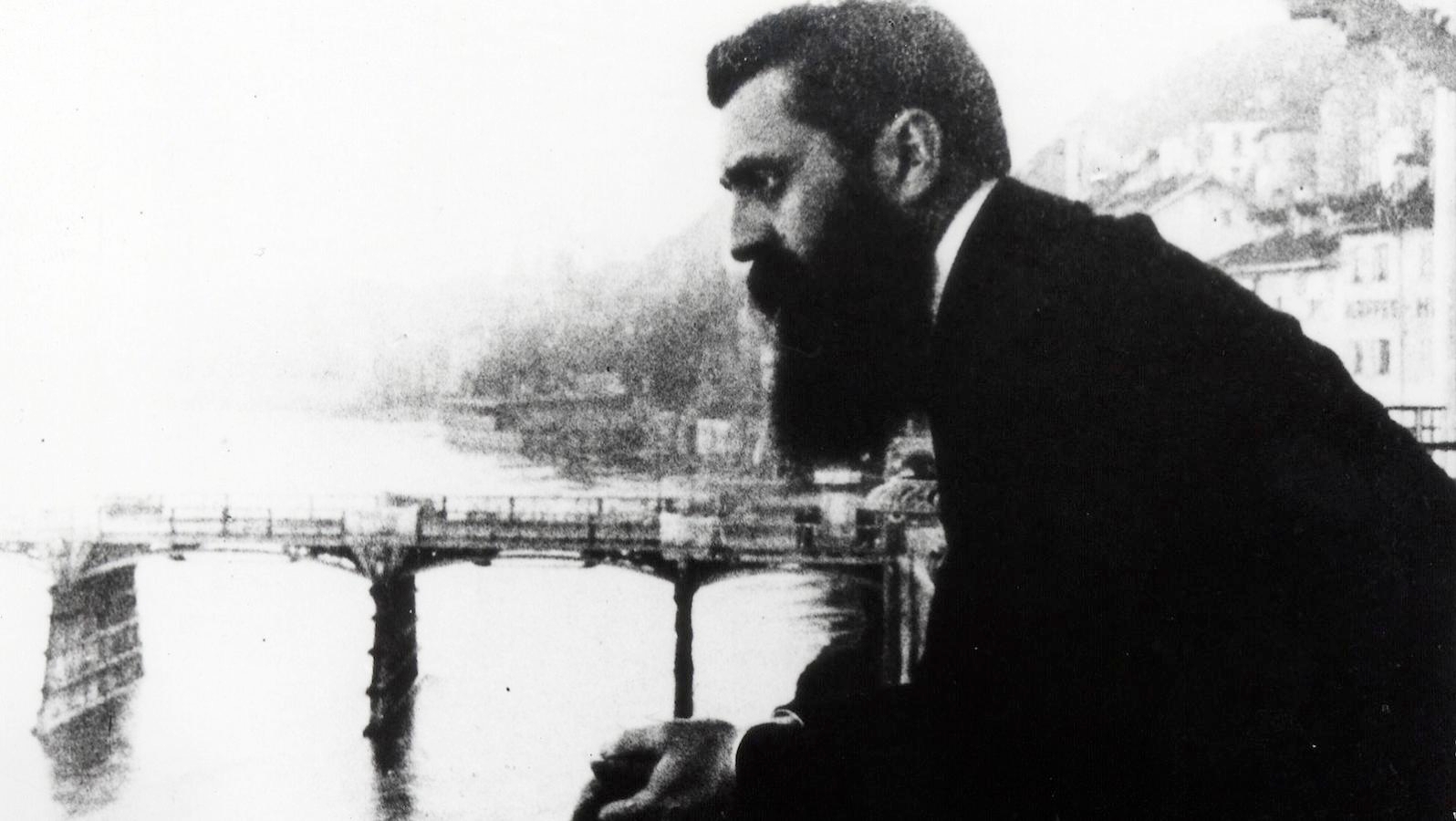
This past February 14th marked the 116th anniversary of the publication of Theodor Herzl’s manifesto The Jewish State, which lay the groundwork for the modern Zionist movement and the state of Israel. That same evening a special event took place in the Jerusalem Theater: a performance of Herzl’s play The New Ghetto, written in 1894, just a few short weeks before he began composing The Jewish State. It is commonly understood that the turning point for Herzl—the moment he realized there was no escaping from anti-Semitism even in enlightened Western Europe—was the Dreyfus Affair that began in the fall of 1894. Yet The New Ghetto, written shortly beforehand, is proof that, as some scholars have argued, a proto-Zionist sensibility had already been roiling in Herzl’s mind.

Last month’s production was a historic privilege for those who attended it: it was the first time the play has ever been performed in Israel. 

For more about this wonderful performance, as well as an intriguing parallel with Tom Stoppard’s newest play Leopoldstadt, please see my new essay in Mosaic Magazine.

Of Synagogues and Seinfeld: “ANU,” The New Museum of the Jewish People

In March, the Tel Aviv Jewish museum formerly known as the Nahum Goldmann Museum of the Jewish Diaspora(or Beit Hatfutsot) reopened after a ten-year, $100 million renovation. Now called ANU—Museum of the Jewish People, it offers a cheery, inclusive vision of Jewish peoplehood.

For the full review see here, in the wonderful new Summer issue of the Jewish Review of Books.