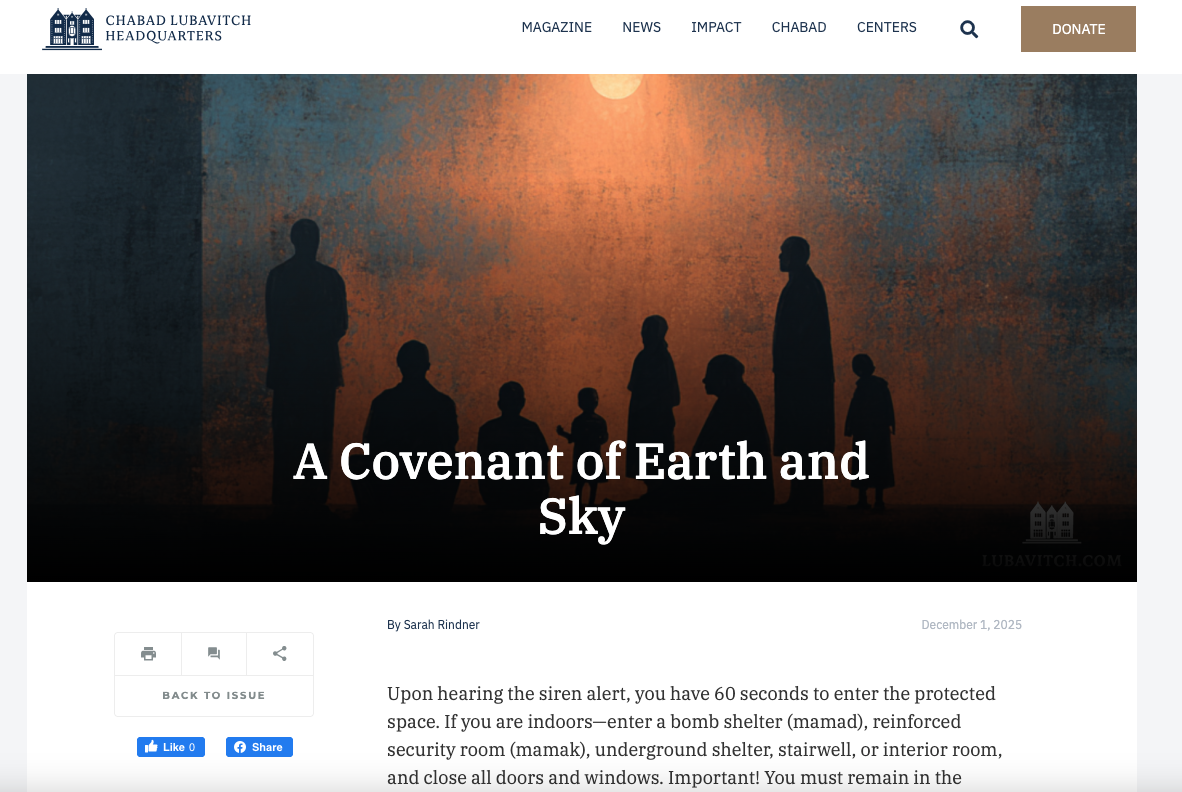
A Covenant of Earth and Sky

In the early hours of June 13 my family and I, like all Israelis, were awakened by the shrill sound of a phone alert. Israel had preemptively attacked Iran’s nuclear facilities. Momentous news, but I promptly put my pillow over my head and went back to sleep. Only when we woke up again later that morning did we realize that something historic had occurred. We also understood that a challenging period lay ahead.

We had only recently moved into a new home and, despite Houthis sporadically firing missiles in our direction, we had grown lax about running to our safe room, what Israelis call a mamad. Ours was filled with dust and leftover construction material. But on the day of the phone alerts—once we’d grasped the gravity of what was happening—we got to work. We spread a plastic mat over the floor, brought in a spare mattress, and set up a pack-and-play crib. The missile fire from Iran began in earnest that evening.

As the days wore on, we adjusted to the confines of this small space where emotions vacillated between fear, comfort from the presence of those we loved, and occasional irritation by those very same people. One mattress turned into four—each of our seven children laid claim to their own little spot. The more time we spent in our safe room, sometimes joined by friends or near strangers who needed a place to shelter, the more we acclimated ourselves to its deprivations and, occasionally, to its surreal benefits. Sociologists talk about the “third place,” which is an additional living space beyond home or work, like a synagogue, for example. These places expose us to people, ideas, and experiences beyond our immediate family and daily routines. During Israel’s twelve-day war with Iran our safe rooms also became a third place, introducing a new mentality and way of being that removed us from our day-to-day lives.

Read the full article, just recently posted online, from the Fall issue of Lubavitch International Magazine.

Faith and Art in Communist Russia

Anatoly Kaplan was the rare Jewish artist who managed to explore Jewish themes under the eyes of Soviet censors

My review of a wonderful art exhibit at Beit Avi Chai which appeared in the Fall 2023 Issue of Lubavitch International Magazine was recently posted to the web. The exhibit is called “The Enchanted Artist” and it was a the first major exhibit in Israel devoted to the artwork of Anatoly Kaplan, who according to the curators was “the only artist in the Soviet Union to put Jewish culture at the forefront of his work and to be recognized by the Soviet regime despite that.” Kaplan’s paintings are remarkable for how nimbly they incorporate Jewish themes while evading the Soviet censors, and they are also simply remarkable in their own right. It was a pleasure to learn more about Kaplan and also think about how the pressures that weighed upon Kaplan also drove the evolution of Chabad Lubavitch itself: “In a sense, Chabad’s collective memory and ethos were forged in the crucible of communism, in the midst of immense hardship that led to heroism—the sheer difficulty of Jewish observance driving home its precious necessity.”

“In a gray, dimly lit room, a mother ties a red kerchief atop her daughter’s school dress. Behind them, even more deeply in shadow, sits a bearded man wrapped in a traditional black and white tallit, bent over a prayerbook. 

The scene seems innocent enough, and yet, small details hint to the influence of powerful forces beyond the domestic sphere: The red kerchief was an obligatory symbol of membership in the Communist youth movement. The religious man is surrounded by two red curtains, which both serve to frame his figure and also suggest that he may need to hide at a moment’s notice. Even in 1976, when this painting was created by Russian-Jewish artist Anatoly Kaplan, it was nearly impossible to be an observant Jew in the Soviet Union. Like much of Kaplan’s work, Interior draws us into a world of tensions, memories, and contradictions inherent in the experience of Jews in Communist Russia.”

Read the full article at Lubavitch.com.

The Rabbi Who Chose Trans Orthodoxy

“Shortly before the 1991 Gulf War, Rabbi Yaakov Smith, a father of six and an emissary of the Chabad Hasidic movement in the Old City of Jerusalem, hosted a Shabbat dinner. As the guests were leaving, one took Smith aside and said something that would reverberate with his host: “That was an amazing act you performed. Whatever is wrong, take care of yourself.” Fast forward thirty years and Yaakov has become Yiscah Smith, a transgender person who still lives and teaches in Jerusalem. Smith’s transformation is the subject of the documentary I Was Not Born a Mistake, created by the Israeli filmmakers Rachel Rusinek and Eyal Ben-Moshe. The film premiered at the Jerusalem Film Festival this past Hanukkah and made its U.S. debut in January.:

Read the full review at First Things.

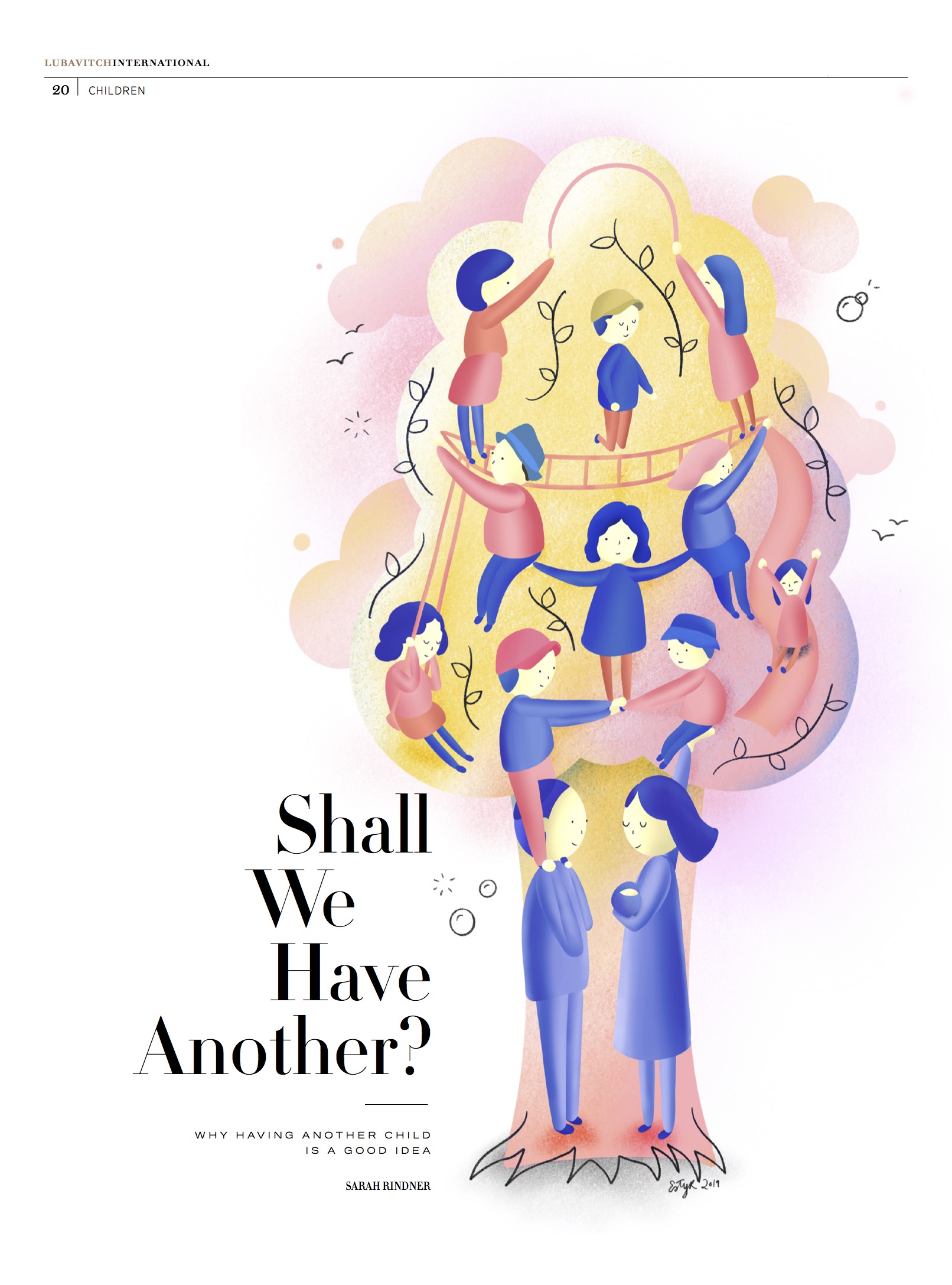
Shall We Have Another? A Case for Children in a Post-Parenting Era

“Ours is physically the healthiest and most affluent society that has ever existed, and, in some ways, raising children is also more convenient than it has ever been. Yet, children are increasingly perceived as a burden.”

Children Article LI Summer 5779(1)

Please see the full article in the Summer edition of Lubavitch International Magazine.