Kuma: The Story of the Jewish People

The Bible Lands Museum in Jerusalem is known for its collection of Near Eastern antiquities from the Biblical period. Yet amidst its galleries stands a startling cultural artifact of far more recent origin.

Kuma—meaning “Rise”—is a nearly ten-foot-long scroll depicting a dense, vivid, intellectually rich, and aesthetically stunning account of Jewish history. Its full title, Kuma, Mei Afatzim ve-Kankantum,” refers to the materials used to prepare ink for Torah scrolls and other sacred texts. Evoking an unfurled Torah scroll, Kuma is the high-school senior project of a brilliant young yeshiva student, artist and poet named Eitan Rosenzweig הי”ד. Staff Sgt. Rosenzweig, an Alon Shvut native and student in the Yerucham Yeshivat Hesder, served in the Givati brigade and was killed in Gaza in November 2023, at the age of 21.

Kuma weaves together Jungian theories of the unconscious, the mythologist Joseph Campbell’s concept of the heroic journey, and imagery drawn from Western art and Jewish history—some of which appear elsewhere in the Bible Lands Museum. Kuma also incorporates literary allusions to the Bible, Talmud, modern Hebrew literature, Eastern and Western general philosophy, and more. It is a work of art that one must study rather than merely observe.

The full essay can be read at Tradition Online.
The Heirs of Asher Lev: Exploring the Art of Menachem Halberstadt and Hendel Futerfas

In Chaim Potok’s classic novel My Name Is Asher Lev, a young Chasidic boy tries to integrate his religious faith with his prodigious artistic talent. In school he scribbles on the margins of his sacred books. On weekends he takes clandestine trips to view Renaissance art at the Brooklyn Museum. Throughout the novel he grapples with the question: Is art something that brings us closer to G-d and to the Jewish people, or does it operate on another plane entirely? 

Asher Lev is a member of the Ladover sect, a thinly disguised stand-in for Chabad-Lubavitch, and the beloved Ladover Rebbe gently explains that it makes no difference whether a man is a shoemaker or a lawyer or a painter; rather, “a life is measured by how it is lived for the sake of Heaven.” Yet, despite the Rebbe’s encouragement, ultimately Potok’s book insists that the chasm between the life of a Chasid and that of an artist is impossible to fully bridge.

The role of visual art in the religious Jewish worldview has always been somewhat tenuous. This may be rooted in the Torah itself: the second of the Ten Commandments prohibits the creation of graven images and the “likeness of any thing that is in the heavens above, that is in the earth beneath, or that is in the water under the earth.” But it may also be an accidental byproduct of history: the destruction of the Holy Temple in Jerusalem in all its aesthetic glory, the exclusion of Jews from artistic guilds, and the overwhelming dominance of Christian iconography in the history of Western art. While Jewish decorative arts abound—micrography, illuminated manuscripts, silver Judaica items—Jewish representation in the fine arts, at least prior to the modern era, is decidedly less pronounced. And while Jewish individuals have achieved prominence as modern artists, they tend toward secularism and individualism in both worldview and artistic language. We have yet to see a uniquely Jewish artistic idiom arise—that is, a path forward for an artist who wishes to tie him- or herself to a Jewish tradition in visual art. 

To read the full article please see the gorgeous art-themed Fall/Winter Issue of Lubavitch International Magazine.

The Muses of October 7

“Some may find art galleries irrelevant amidst the geopolitical challenges Israel now faces, the profound physical and emotional injuries faced by its citizens, our ongoing fear for the hostages and for the soldiers fighting in Gaza and the north. But the art of October 7, like the phenomenal music that has emerged in its wake, is urgent and searing. It provides a visual prism through which we can try to understand our times, to memorialize those who were murdered and to scream over its injustice. ״

Walk the streets of Israel post-October 7 and one experiences a country transformed. This transformation manifests in many aspects of our lives: our political allegiances, our sense of certainty and security, and our attitudes toward one another. But our streets have also literally, physically, been transformed. Cars are bedecked in Israeli flags and bumper stickers that commemorate fallen loved ones and friends. The now iconic red-and-black hostage posters line storefronts and traffic poles (in Israel they don’t get ripped down). Army green is everywhere—at times every fifth person walking down the street seems to be in uniform and carrying a large weapon. And street art and graffiti that focuses on the hostages or the ongoing military campaign is ubiquitous. Grassroots memorials take various forms—from yizkor candles to red poppies (the classic symbol of military loss is also a common wildflower in the south of Israel) to countless other manifestations. This spontaneous public art is intense and concentrated in certain places, such as Hostage Square in Tel Aviv and the Nova massacre memorial in Re’im. But it also can be found on random street corners and benches, in malls or in doctor’s offices. Art is everywhere, a direct outcome of a nation that is actively grieving horrific events and continuing crises. 

Ziva Jelin, Panorama: Pavement and Mud, 2018, acrylic and tar on canvas. Photo credit: Ron Plitnitzki.

A new exhibit, recently opened at the ANU Museum of the Jewish People in Tel Aviv, seeks to explore this creative phenomenon in real time. The exhibit is simply titled “October 7.” It begins by considering the notion that art is irrelevant at the height of wartime, as expressed by the proverb “When the cannons are heard, the muses are silent.” Orit Shaham Gover, the chief curator of ANU, proposes this alternative: “As the cannons are heard, the voices of the muses are emerging all the more clearly from deep down in the throat.”

A full review of this moving exhibit can be read in Moment Magazine.

Faith and Art in Communist Russia

Anatoly Kaplan was the rare Jewish artist who managed to explore Jewish themes under the eyes of Soviet censors

My review of a wonderful art exhibit at Beit Avi Chai which appeared in the Fall 2023 Issue of Lubavitch International Magazine was recently posted to the web. The exhibit is called “The Enchanted Artist” and it was a the first major exhibit in Israel devoted to the artwork of Anatoly Kaplan, who according to the curators was “the only artist in the Soviet Union to put Jewish culture at the forefront of his work and to be recognized by the Soviet regime despite that.” Kaplan’s paintings are remarkable for how nimbly they incorporate Jewish themes while evading the Soviet censors, and they are also simply remarkable in their own right. It was a pleasure to learn more about Kaplan and also think about how the pressures that weighed upon Kaplan also drove the evolution of Chabad Lubavitch itself: “In a sense, Chabad’s collective memory and ethos were forged in the crucible of communism, in the midst of immense hardship that led to heroism—the sheer difficulty of Jewish observance driving home its precious necessity.”

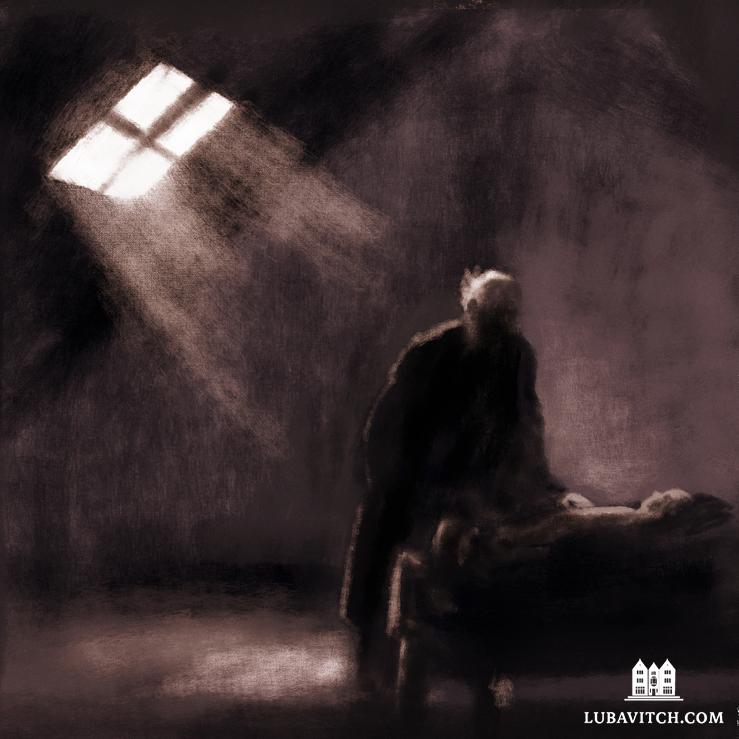
“In a gray, dimly lit room, a mother ties a red kerchief atop her daughter’s school dress. Behind them, even more deeply in shadow, sits a bearded man wrapped in a traditional black and white tallit, bent over a prayerbook. 

The scene seems innocent enough, and yet, small details hint to the influence of powerful forces beyond the domestic sphere: The red kerchief was an obligatory symbol of membership in the Communist youth movement. The religious man is surrounded by two red curtains, which both serve to frame his figure and also suggest that he may need to hide at a moment’s notice. Even in 1976, when this painting was created by Russian-Jewish artist Anatoly Kaplan, it was nearly impossible to be an observant Jew in the Soviet Union. Like much of Kaplan’s work, Interior draws us into a world of tensions, memories, and contradictions inherent in the experience of Jews in Communist Russia.”

Read the full article at Lubavitch.com.

Of Synagogues and Seinfeld: “ANU,” The New Museum of the Jewish People

In March, the Tel Aviv Jewish museum formerly known as the Nahum Goldmann Museum of the Jewish Diaspora(or Beit Hatfutsot) reopened after a ten-year, $100 million renovation. Now called ANU—Museum of the Jewish People, it offers a cheery, inclusive vision of Jewish peoplehood.

For the full review see here, in the wonderful new Summer issue of the Jewish Review of Books.

Whose Museum of the Bible Is It?

In November 2017, the newly constructed Museum of the Bible opened in Washington, DC. It is reportedly the most technologically advanced museum ever built in the United States, and it is the largest privately funded museum in the country. The majority of the financial backing for the museum, which is free to the public, comes from the Oklahoma-based Green family, founder of the Hobby Lobby chain of craft stores and champion of Christian causes. Despite its backers’ beliefs, the Museum of the Bible goes out of its way to make religious Jews comfortable. To take one of many examples, a visitor must strain his or her eyes in order to see the term “Old Testament” used anywhere in the museum. Instead, it is almost always the “Hebrew Bible” or even the “Jewish Bible”—a signal to Jews that their Torah has not been superseded by Christianity. All of that said, the Museum of the Bible is not a Jewish museum, nor should it be mistaken for one. Nevertheless, Jewish visitors who remain aware of the limitations inherent in such an enterprise have much to gain from the Museum of the Bible. Indeed, somewhat paradoxically, a visit to the museum provides an opportunity even for literate Jews to learn something about the impact of our central sacred texts on the wider world and can have a profound impact on our sense of Jewish pride and religious mission.

Please see the Summer 2018 Issue of Jewish Action Magazine for my review of the new Museum of the Bible and its relevance for the Jewish visitor.

Why the Menorah Is the Most Enduring of All Jewish Symbols

At the beginning of this week’s Torah reading of B’ha’alotkha (Numbers 8-12), the Bible gives instructions for the daily kindling of the menorah.

The menorah has long occupied a prominent place in the Jewish imagination. From the time of its placement in the inner courtyard of the Tabernacle in the desert and later of the Temple in Jerusalem, to its rekindling after the Maccabees’ defeat of the Seleucids, to its central position on the Arch of Titus in Rome, to its modern repurposing as the emblem of Jewish revival by the state of Israel, few Jewish symbols have been as familiar or as evocative.

Fray_Juan_Ricci,_Menorah.jpg
Fray Juan Ricci (17th Cent.) Sketch of the Menorah as Described in Exodus

And yet the Bible leaves unstated the significance of the menorah and its seven branches, its importance to the Temple, or its meaning and purpose with respect to the relationship between God and His chosen nation and perhaps beyond. On these matters, an examination of five key scriptural passages can shed light.

The full article may be read in Mosaic Magazine.

The Problem with the Tablets

tencommandmentscover-0

“For Cecil B. DeMille,the revelation at Sinai was a purely solitary affair. Charlton Heston’s Moses ascends the mountain on an individual spiritual quest; he hears the Ten Commandments as the Israelites are preparing to worship the golden calf. The scene certainly captures part of the biblical narrative, but it ignores entirely the collective and communal aspect of the moment, as well as the tension between the people’s desire for direct knowledge of God and their quite correct fear of what such knowledge entails. It also ignores the all-important prelude to the revelation: the covenant between God and Israel, for which Moses is nothing more than a go-between.”

For the full article, see this week’s Mosaic Magazine.


“Unfinished-ness” in Art, Judaism and the Poetry of Eve Grubin

Since March of this year, the Met Breuer, a new annex of the Metropolitan Museum, has hosted a remarkable exhibit called “Unfinished.” The works of art exhibited consist primarily of unfinished work from the Met’s permanent collection, including paintings by Rembrandt, Titian, Van Gogh, Klimt and many other noteworthy artists. Some of the works included were abruptly abandoned by their creators for various external reasons such as death, illness, or a more lucrative commission elsewhere. They feature unpainted spots of canvas, rough blurry lines or pencil sketches that are still visible. These pieces are striking in how they display the creative process of the artist at work –  many display a startling unintended beauty in their incomplete form. Other paintings displayed, particularly the more modern works, were intentionally created with an unfinished or provisional quality, similar to a piece of jazz music.

Many of the pieces in the exhibit don’t fit neatly in either category however – they were neither accidentally abandoned nor purposefully designed to feel incomplete. These are works that an artist stops painting because he or she decides that it captures something essential in an unfinished state that would be lost once completed. Often these paintings were not made at the behest of wealthy patrons, or for the purpose of commercial gain, but rather remained in the artist’s personal collection. See John Singer Sargent’s outdoor scene of his sister and her friend for example, or Rembrandt’s intimate portrait of his housekeeper turned life partner Hendrickje Stoffels.

At their best, all three types of paintings challenge the notion that a “perfect” piece of art is always the most effective one. The unpainted spaces and rough backgrounds of these pieces give them a raw or urgent quality. There is a dynamism to them that would be lost in a more refined, yet calcified, final product. Continue reading ““Unfinished-ness” in Art, Judaism and the Poetry of Eve Grubin”

Judaism as a Visual Religion: Reflections on the Tabernacle and “The Temple”

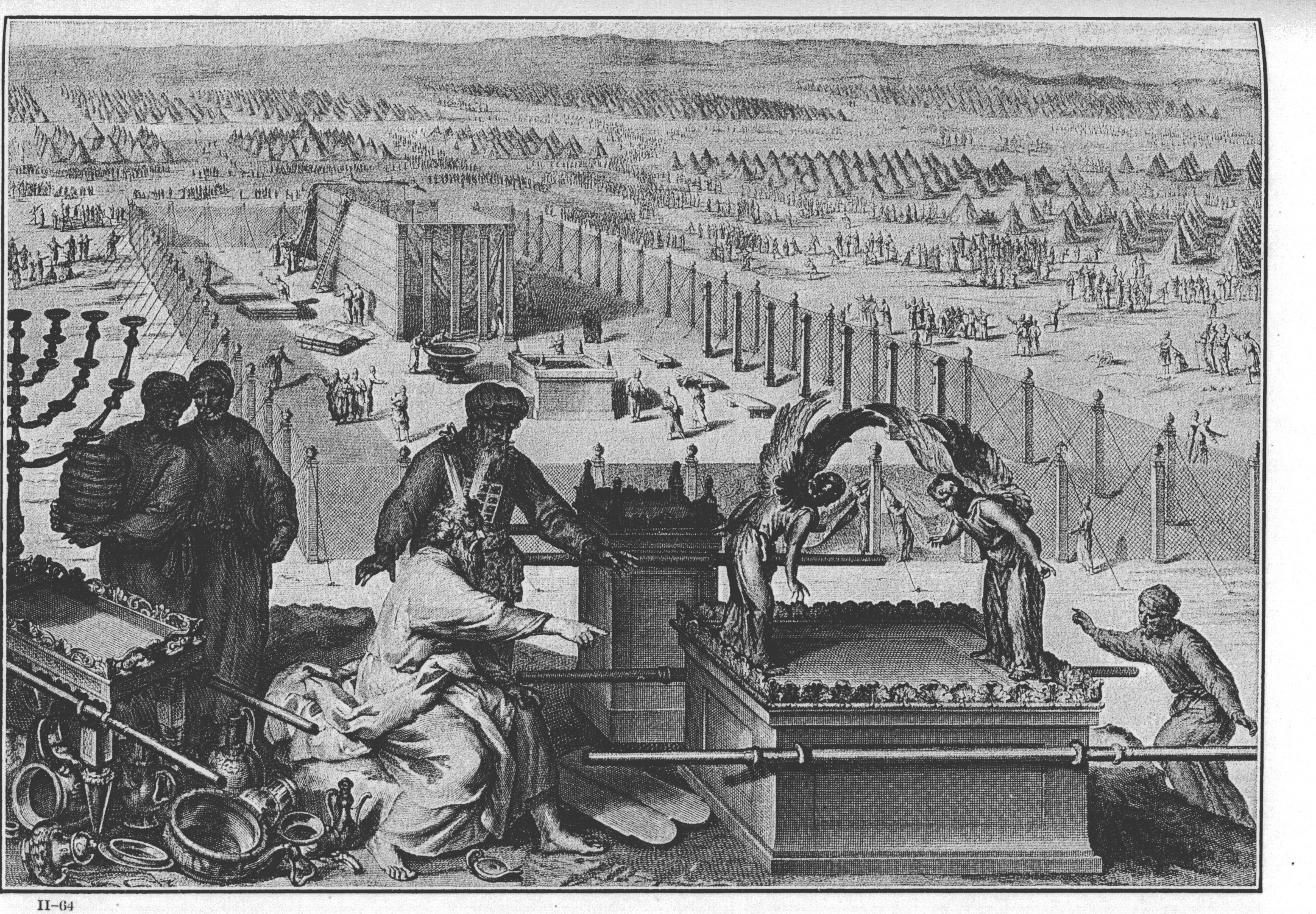
The Book of Exodus contains some of the most fundamental religious-historical narratives of the Jewish people. However, as significant as these narratives clearly are, the book’s largest component verse-wise describes a detailed set of instructions for how to build, and then the actual construction of, the Tabernacle, or Mishkan.  The looming presence of the Mishkan in such a central text, with its gold, precious gems and other valuable materials, challenges certain medieval and/or modern assumptions about Judaism. Judaism has come to be conceived of as a religion of ideas, a textual rather than a visual tradition that is more concerned with matters of the spirit than physical decoration and embellishment.

Figures_The_erection_of_the_Tabernacle_and_the_Sacred_vessels
The erection of the Tabernacle and the Sacred vessels, as in Exodus 40:17-19; from the 1728 Figures de la Bible

Continue reading “Judaism as a Visual Religion: Reflections on the Tabernacle and “The Temple””