Gender and Judaism: A Sophisticated View from the Haredi Camp

Circle Arrow Spiral: Exploring Gender in Judaism by Miriam Kosman Targum Press (2014)

Review by Sarah Rindner

Recent debates about women and the Orthodox rabbinate yielded a range of interesting, impassioned and also banal observations by various Jewish professionals and laypeople. Although sociological and legal arguments abound, a broader philosophical discussion of the nature of gender roles within Judaism is lacking. The assumption in these debates seems to be that the challenge before us is how this issue in Judaism will play out alongside a movement from inequality to equality, from backwardness to progress, in American or Western society. Those who resist this movement and believe that a straightforward march toward gender egalitarianism is neither desirable nor in the spirit of traditional Judaism have yet to articulate what, precisely, a theory of Jewish gender difference could, and should, look like. That is, with the exception of a small coterie of mystically inclined haredi, or ultra-Orthodox, women based in Israel who have been exploring precisely this question for years

Continue reading “Gender and Judaism: A Sophisticated View from the Haredi Camp”
Dancing in Chains: Deception and Destiny in Parshat Toldot

At the heart of this week’s Torah portion lies a kind of riddle “wrapped in a mystery, inside an enigma,” the significance of which echoes throughout the remainder of the book of Genesis, and perhaps even further than that. The riddle in question relates to Jacob’s deception of his father Isaac in order to take his older brother Esau’s blessing. Isaac at this moment is aged and blind, and he plans to give his favored son Esau an important blessing after Esau brings him a meal he has hunted for him. Yet, as we learned earlier in the parashah, destiny is on the side of Jacob rather than Esau. When Rebecca is pregnant, God tells her in a poetic refrain: 

Two nations are in your womb.
Two separate peoples shall issue from your body;
One people shall be mightier than the other,
And the older shall serve the younger.

Despite Isaac’s preference for his oldest son, Rebecca knows very well that Jacob rather than Esau must be groomed for greatness, and she thus encourages Jacob to pretend to be his brother and take the blessing for himself.  When Isaac learns that Jacob deceived him, he is described as being “seized with a violent trembling” and when Esau discovers his brother’s dissimulation he weeps and responds to his father with the agonizing   “Have you but one blessing, Father? Bless me too, Father!” We know from various events throughout the parashah about Esau’s unsuitability for continuing the legacy of Abraham and Isaac. Before this episode, he sells his birthright to his brother Jacob in exchange for a bowl of lentil soup, later on he displeases his parents by taking two Canaanite wives rather than marrying women from his own tribe. Yet it is difficult not to empathize with Esau’s cries here, and we naturally wonder, why couldn’t Isaac have blessed both Esau and Jacob in equal measure? Was Jacob’s guile the only way to address this imperfect scenario, or could an alternative solution have been found?

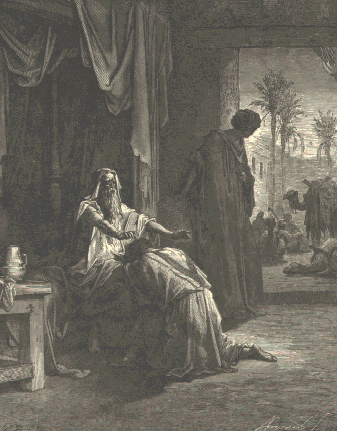
Isaac Blessing Jacob (Gustave Dore, from the 1865 La Sainte Bible)
Isaac Blessing Jacob  (Gustave Dore, from the 1865 La Sainte Bible)

Continue reading “Dancing in Chains: Deception and Destiny in Parshat Toldot”

To Dwell in Possibility: Avraham, the Soil and the Clan in Parshat Chayei Sarah

Guest Post by Robert M. Blum

Last week, Sarah compared Walt Whitman to Avraham, whose “expansiveness” as a figure and founder of various peoples, including the Israelites, is exemplified by his hospitality in Parshat Vayeira. The conceptual key to this reading and comparison is Lewis Hyde’s notion of “gift exchange,” particularly with respect to art, which differs from market exchange in its spiritual underpinnings as well as the bonds formed through gifts. This notion of a gift economy was actually first developed by Marcel Mauss in his anthropological study of pre-modern societies also titled The Gift. A review of the Avraham narratives in light of Mauss’ broad conception of gift exchange reveals aspects of Avraham and his legacy that seem to be in tension with the expansive Whitmanian figure we encounter in Parshat Vayeira.

Continue reading “To Dwell in Possibility: Avraham, the Soil and the Clan in Parshat Chayei Sarah”

Avraham, Lot, Walt Whitman and Dionysus:  Models of Hospitality in Parshat Vayeira

I celebrate myself, and sing myself,
And what I assume you shall assume,
For every atom belonging to me as good belongs to you.
I loafe and invite my soul,
I lean and loafe at my ease observing a spear of summer grass.

(Walt Whitman, Leaves of Grass)

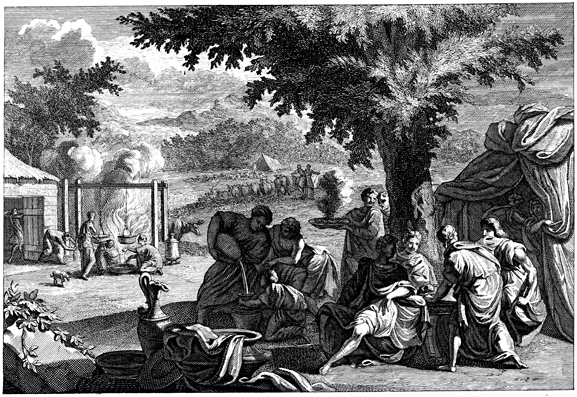
Abraham’s Three Visitors (Jan Goeree, circa 1700)

Avraham’s defining trait in the midrash, and to a certain extent in the text of the Torah itself, is the trait of hospitality. When the three emissaries of God appear to him by the terebinths of Mamre, we hear in detail how he and Sarah rush to make them feel at home. Avraham invites his guests to “lean and loafe” beneath a tree. The midrash is reported to say that the tent of Avraham was open on all four sides so that he and Sarah could welcome guests approaching from any direction. It is striking that Avraham of all people is defined by this trait of openness given that a crucial element of his legacy was shutting the doors on pagan worship and establishing an exclusive covenant with God. Later on in Parshat Vayeira, his nephew Lot echoes Avraham’s spirit of openness when he welcomes two of the emissaries and also treats them with generosity. However, Lot’s openness soon turns into an ugly distortion as we see that in Sodom “hospitality” necessarily involves exploitation and taking advantage of others.

Hospitality rituals were an important feature of the ancient Near Eastern world – and a sense of the importance of these formal and informal customs lingers throughout the Middle East until today. Continue reading “Avraham, Lot, Walt Whitman and Dionysus:  Models of Hospitality in Parshat Vayeira”

Parshat Noach: Abundance, Restraint and the Porridge Pot Myth

The following interpretation of Parshat Noach comes by way of the book of Vayikra, and specifically Mary Douglas’s great work of biblical analysis, Leviticus as Literature.  Douglas’s book emerged from her work as an anthropologist studying various cultures and their sacred taboos. This in turn piqued her interest in the food restrictions listed in Leviticus 11, and she began to explore the question of what makes certain animals prohibited for consumption. One of her many insights is that cultures don’t only prohibit things that are bad, unclean or disgusting – sometimes taboos exist for the purpose of preserving or protecting a revered entity. Douglas cites the example of “winged swarming things” (שֶׁרֶץ הָעוֹף), which are forbidden by the Torah for human consumption, yet their description suggests a kind of overflowing or “teeming” quality that is associated with fertility and expansiveness. In Parshat Noach, the Torah echoes this language in God’s command regarding reproduction shortly after the flood recedes: “Be fertile, then, and increase; abound on the earth and increase on it” וְאַתֶּם, פְּרוּ וּרְבוּ; שִׁרְצוּ בָאָרֶץ, וּרְבוּ-בָהּ. (Gen. 9:7)

According to Douglas, the challenge of what to do with this fertile abundance – how to nourish it, protect it, but also contain it and keep it from “taking over” – is part of what it means to establish a covenant with God. Fertility is something that is addressed by the covenant but is also separate from it. The boundless and expansive spirit of procreation that is represented by the swarming creatures is precious to God and to humanity/the Jewish people, but the covenant is necessary to order and restrict this overflow.

Great_Wave_off_Kanagawa2

There is an obvious connection between this tension and the story of the deluge in Parshat Noach. In this story, water – typically associated with blessing – takes over the world. When God eventually restricts these waters humanity is presented with a covenant, a concrete sign that God has contained this overflow in order to leave room for humans and animals to live.

Continue reading “Parshat Noach: Abundance, Restraint and the Porridge Pot Myth”

“In my end is my beginning”: T.S. Eliot, Kate Atkinson, and the Yearly Torah Cycle

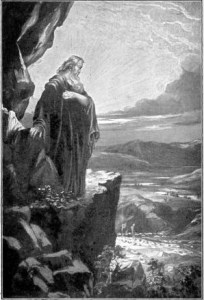
This year on Simchat Torah we experienced that wonderful transition, repeated every year, when we conclude the Torah and then start over again with the creation of the world out of chaos and void. While the book of Deuteronomy, set as the Jews prepare to enter the land of Israel, may itself be read as a kind of beginning rather than an ending, it also functions as a tragic denouement for Moses. Moses is, of course, prevented from entering the Promised Land he spent his whole life moving toward, as God tells him, “I have let you see it with your eyes, but you shall not cross there.” This line, as well as the moment we learn that Moses will buried in an anonymous burial place somewhere in the land of Moab, never fails to move me. Deuteronomy may partly be intended to capture the rousing national entry to the land of Israel, but the very end of it is pure tragedy. It is the human story of Moses, the greatest prophet to ever arise in Israel, who nevertheless succumbed to human frailty and human limitations.

MosesonMountPisgah

Continue reading ““In my end is my beginning”: T.S. Eliot, Kate Atkinson, and the Yearly Torah Cycle”

Harnessing the Spiritual Power of Irony: Rav Shagar, S.Y. Agnon and Yom Kippur

In the discussion of Yom Kippur that appears in The Human and the Infinite, a compendium of translated essays by the late Rav Shagar (Rabbi Shimon Gershon Rosenberg z”l), Rav Shagar describes the difficulty of truly feeling awe during the Days of Awe. A serious attempt to grasp the Absolute during this time-period will, according to Rav Shagar, invariably lead to a kind of anxiety. This anxiety, which may at times be confused with piety, is not actually religiously productive. It can even cause deep despair: “there is an essential paradox in the attempt to understand the Holy with the limited faculties at our command – words, deeds, etc… This paradox, then, fuels despair in the believer.”

The solution to this despair, for Rav Shagar, is a healthy dose of irony. Irony, he reminds us, should not be confused with cynicism: “Cynicism ridicules its subject, presenting it as pathetic. Irony, on the other hand, is a delicate instrument able to grasp two different sides of an issue at once. It can understand the true gravity of a subject, while at the same time showing up its limitations.” Rav Shagar explains that “[i]rony emphasizes new and different possibilities – even for those subjects that are seemingly absolute. The reflectivity of irony can breathe a new spiritual life into the stolid…. The ironic stance adds a lighter side to the religious act and so enlivens it. The religious can no longer stay fixed and see itself, as it were, as its own absolute. The ironic allows the religious to become what it should be.”

Continue reading “Harnessing the Spiritual Power of Irony: Rav Shagar, S.Y. Agnon and Yom Kippur”

The Birthday of the World

An American Jew’s experience of the Jewish holidays is inextricably linked to the American calendar, to regional weather patterns and to the distinct geographies of his or her surroundings. It’s hard for me to imagine the period of Rosh Hashanah through Sukkot without thinking of the onset of autumn, of leaves that are beginning to change colors, cool evenings and fall harvest vegetables. The fall carries with it its own rich poetic symbolism – a yellow leaf can signify the fall from Eden, decisions that can’t be undone, or the flourishing of love in face of the inevitability of death. So what does this all have to do with the Jewish New Year? Not much if you live in a climate where autumn is not as pronounced. Yet for an American Jewish writer like Emma Lazarus, the grandeur of the the Jewish New Year is inextricably linked to its seasonal setting:

Continue reading “The Birthday of the World”

Emily Dickinson and the Wordless Cry of the Shofar

The Bible does not contain very much information about Rosh Hashanah. Nowhere in the Torah is it described as a day of kingship, a day of judgment, or even a new year. The only information we have about the day is that it is a “yom teruah,” or perhaps, “zikhron teruah,” a day of, or remembrance of, teruah. In the Talmud, teruah is defined as yevavah, as a kind of crying (Rosh Hashanah 33b), but the plain meaning of the Chumash seems to be closer to a day of “sounding.” This sounding does not necessarily imply praise, celebration, or even prayer. Yom Teruah is, most literally, a day of sound.  And from the perspective of the Bible, this sound does not have a specific valence, it does not tell us what to think or what to feel.

Continue reading “Emily Dickinson and the Wordless Cry of the Shofar”

Sabbath Rest

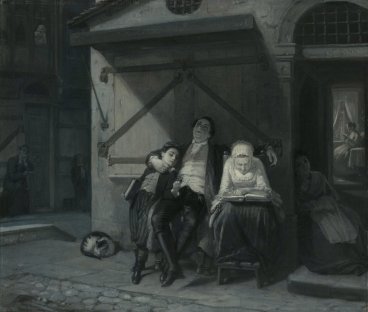
Sabbath-Ruhe auf der Gasse,  1866, Moritz Daniel Oppenheim
Sabbath-Ruhe auf der Gasse (Daniel Moritz Oppenheim, 1866)

This painting, by 19th century German Jewish painter Daniel Moritz Oppenheim, depicts a Jewish family relaxing on a Shabbat afternoon. While the patriarch of the family sits at the center of the tableau, the light in the painting shines on the two women who are reading. There is no way to tell what the women are reading, but art historians assume that the older woman in the foreground is reading a traditional Jewish tome, perhaps a siddur, or the Tzena u’Rena, while the younger woman in the rear is immersed in a contemporary German novel. It’s this assumption, as well as the inscription “1789” above the door mantel, that leads the Jewish Museum catalogue to say the following about the painting :

“Grandmother, hair covered, reads a traditional prayer book for women.  Through the doorway symbolically leading to the future, her modern, bareheaded granddaughter enjoys the latest novel…”

“Seemingly peaceful, this scene harbors dynamic undercurrents.  It honors a political revolution and contains seeds of feminist action.”

While the museum chooses to focus on the discord present in the painting, I am struck by the continuity between the young woman reading a novel, and her perhaps more religious counterpart. Their bodies are hunched in similar positions, and they also share a look of intense absorption that distinguishes them from the rest of their family. Together they present a vision of the Jewish Sabbath that is both vibrant and serene, their absorption in texts is a dynamic alternative to both political action and actual slumber. I suspect that Oppenheim leaves the question of whether they are reading sacred or secular texts intentionally open, it is the act of reading itself that seems to define their experience of the Sabbath. Despite the winds of change that are alluded to in the painting, there is the possibility that this is one tradition that will endure.